


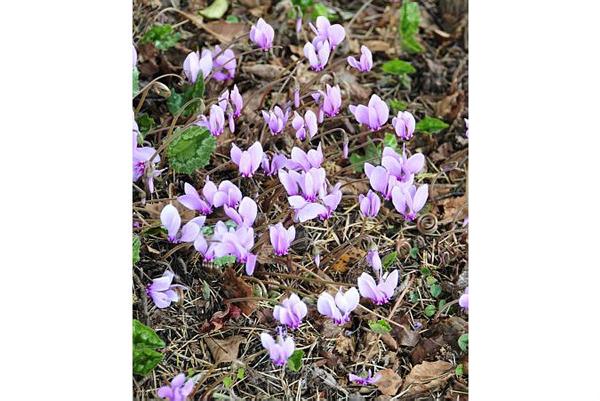
The outdoor hardy sorts of cyclamen are much smaller than the house plant in all of their parts — leaves, stems and flowers, except the tuber which can be as big as those of the larger kind. There are several kinds, some quite well-known, others more for enthusiasts. Easily the best-known of the hardy kinds is the autumn cyclamen, Cyclamen hederifolium, that used to be called Cyclamen neapolitanum. The old name was good because it indicated this species was from the Naples area, which it is, along with many other parts of the Mediterranean region. The newer name refers to the similarity of the foliage to that of ivy, and it could be considered more varied and more beautiful than the foliage of ivy as it is much marbled with silver and dark-green.
The foliage only appears when the flowers have been out and open for a few weeks. The flowers appear very quickly, in a matter of a couple of days, pushing up on elongated stems from buds on the tuber at soil level. The pretty flowers often appear over bare ground for almost a month before leaves push out. In that time, the flowers are pollinated by visiting insects, as soon as they are, the petals are jettisoned, their job is now over. The seed pod containing the developing seeds is wound back down to earth by a coiling of the flower stem, the seed-pods are safer at ground level. In early summer, the pods open and the seeds are shed, often germinating close by the parent plant and developing their own tuber quite quickly.
A colony of hardy cyclamen will build up after a few years and white flowers might appear where there were only pale purple ones, or vice versa, owing to the vagaries of genetics. Autumn cyclamen can flower from the middle of August to the end of September, often starting early in a cool summer and later in a warm one, the trigger for flowering and new growth being plenty of rain and cool nights. The hardy cyclamen likes quite dry soil, well-drained, and for that reason is often planted under big conifers, such as pine or cedar. This is very commonly seen in big old gardens open to the public. Cyclamen does not need to be in such positions and thrives in any open spot in dry soil, ideally a place that is dry enough to impede the growth of potential competitor plants, as this cyclamen is a small plant, really a rock garden plant, and it thrives in a rock garden, or gravelled area too.
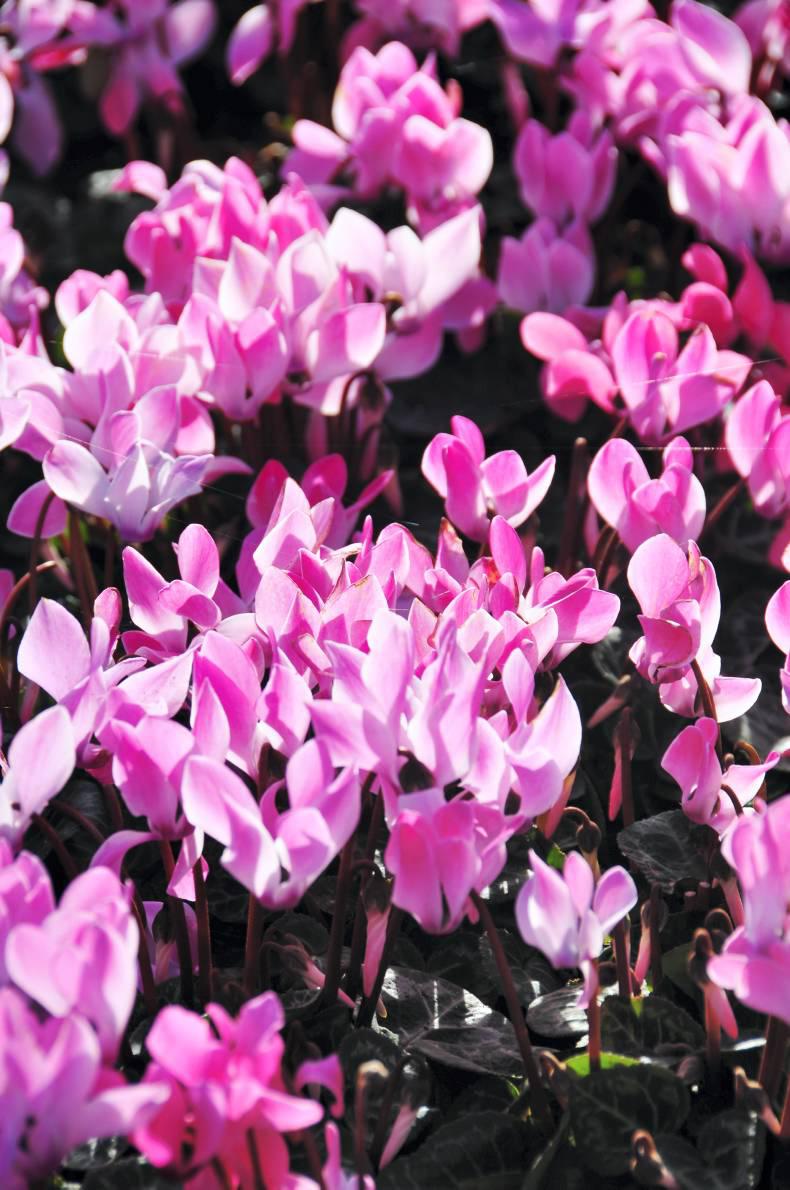
The next best known is the spring flowering Cyclamen coum, as early as February, its petals of distinctive rounded shape. The same conditions of soil and site apply and it can manage to survive in weak grass on dry soil. Also spring flowering, Cyclamen repandum is more like the autumn kind but with more elongated flower petals often with a twist. Some other hardy species appear too, such as Cyclamen purpurascens, with purple flowers and Cyclamen cilicium, with pink, twisted petals, both autumn-flowering. It is worth noting that the hybrid mini-cyclamen crosses between the soft houseplant cyclamen and the hardy species. They are in all the garden centres in recent years and have gained a lot of popularity. They are excellent for winter containers and can be grown in the open ground too. If the ground suits and there is no severe competition, they will re-appear the following autumn and look very well right into late winter.
Weedy plants
Some garden plants can turn into troublesome weeds if they are allowed. These include: lady’s mantle, many hardy geraniums, libertia, dierama, some forms of stipa, some sorts of carex, tellima, verbascum, limnanthes, forget-me-nots, bluebells and teasel.
Other plants self-sow freely, such as calendula, California poppy, candytuft, nigella, cornflower and nasturtium, but never seem to reach truly weedy status.
The solution, which can be applied to some of the above, such as libertia and dierama, is simply to take off the seed pods before the seeds are shed.
Some plants that were once grown in gardens, such as Himalayan balsam and the infamous giant hogweed, eventually became ‘garden escapes’ and now appear semi-wild in many places.
If any flower becomes, or threatens to become, a nuisance, stop it by controlling seed-shedding by hoeing out unwanted seedlings as soon as they appear, or even by hoeing out all plants to get rid of the problem altogether.
THIS WEEK
Trees, shrubs & roses
Some young trees, shrubs and even mature trees, especially birch and beech, have died or are struggling due to the hot weather of July, but others have recovered well. Any scorched or damaged plants should be watered if the soil seems dry. Roses that have stopped flowering can be pruned, removing the flowered shoots.
Flowers
Prevent weeds going to seed in flower beds and borders. Plant spring bulbs as soon as possible — the fresher they are going into the ground, the better they will flower. Take cuttings of tender plants such as geraniums, marguerites, fuchsias and argyranthemums to carry over winter. Continue feeding and watering baskets.
Fruit, veg & herbs
Do not let weeds go to seed now to avoid building up trouble for years to come. Raspberry and tayberry canes that have finished fruiting can be pruned. Finish off any remaining summer pruning of over-vigorous apples and pears, shortening the long whippy shoots to about finger length.
Lawn
Grass growth recovered reasonably well during August and early September with more regular rain but still struggle a bit on faster-draining soils. Continue mowing regularly and apply an autumn lawn feed, if necessary. Patchy areas that did not recover well can be ruffled up and over-sown with lawn seed.
Greenhouse & House plants
Tidy up the greenhouse now and do not overwater. As the nights grow cooler, grey mould disease becomes a problem for many greenhouse plants and good hygiene is the best way to avoid it. Continue to train and side-shoot tomatoes and cucumbers. Allow only existing fruit to develop.




SHARING OPTIONS