


A small group of foresters, woodland owners and forestry enthusiasts got together in June 2000 to form ProSilva Ireland. The main objective was to promote continuous cover forestry (CCF), an alternative forest management system to clearfelling.
CCF was virtually unknown in Ireland when Pro-Silva was formed, although it was the silvicultural system – or variations of it – in a number of European countries for centuries.
As the name implies, CCF maintains continuous woodland conditions as opposed to the practice of clear-cutting at maturity followed by reforestation. There are a number of variations of continuous cover, including shelterwood systems, low-impact silvicultural systems, and dauerwald, the German term for continuous forestry.
Ireland practises a silvicultural or forest management system which is based on a cycle of planting, thinning and clearfelling the crop when it reaches maturity. Depending on species, the clearfell system provides no income for the first 15 years for fast-growing conifers and longer for slow-growing conifers and broadleaves.
This becomes an issue in reforestation sites when State supports are no longer available by way of grants for replanting and premium payments for the first non-productive 15 years.
To practise CCF, you first of all must have an existing forest and be prepared to convert it over time to a permanent crop, comprising mixed species and mixed age classes.
During the early years after it was formed, ProSilva depended on overseas field days and foresters to demonstrate the benefits of CCF as there were few examples in Ireland.
This is changing as a small number of Irish forest owners are converting – or transforming – their forests to CCF. This can be carried out in mature and semi-mature stands, regardless of species.
Slowly, forest owners are exploring the option of CCF and ProSilva is now in a position to organise field days in Ireland demonstrating this silvicultural system.
Coillte has designated 11,759ha of its forests as CCF, while a number of forest owners are making the transition. However, the percentage of forest managed according to the principles of CCF in Ireland is small, less than 2% of the total forest estate.
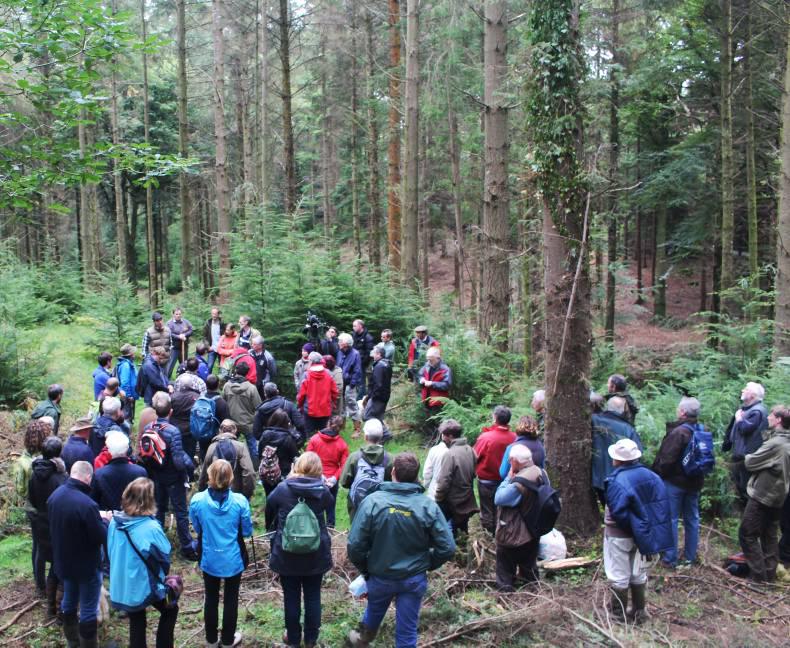
ProSilva recently organised a field day to Knockrath Forest, Co Wicklow, where the Brabazon family decided to convert their forest to CCF in 2005. The field day was led by David Brabazon, Hinrich Joost Bärwald, who manages a 6,000ha CCF privately owned forest in Germany, Paddy Purser, newly elected chair of ProSilva, Padraig O’Tuama, outgoing chair, and Liam Byrne, vice-chair.
Located close to the Vale of Clara nature reserve, and the Avonmore River – a recovering salmonid habitat – the area is a major tourist region, so the Brabazon family is conscious of the multipurpose function of their forest.
Paddy Purser, who is the forestry consultant at Knockrath, outlined the benefits of CCF, including tourism, carbon sequestration and biodiversity.
“We don’t get paid for these and other benefits, including landscape enhancement,” he told the large gathering at the field day.
“We get paid for the timber,” he reminded the group, as it is sometimes forgotten that converting to CCF is as much a commercial as an ecological decision.
CCF requires a more intensive management approach than current practices. The Brabazons work closely with Paddy Purser and the forest contracting company, Larry Byrne and Sons, which carries out the harvesting in the forest. The system demands an innovative approach and careful detail to harvesting and thinning.
The first stop was at a Sitka spruce stand planted in 1986, which received a first thinning in 2010 and a second thinning this year. In a clearcut stand, a large number of small, poorly formed trees are removed but in CCF, the emphasis is on single tree selection of large-volume trees, with straight, well-formed trees retained, regardless of size. As the stand is opened up, these increase in volume, so the forester will eventually select the biggest and best. In making this selection, the emphasis is on quality rather than spacing and keeping an eye not just on the trees around you, but looking up to ensure good crown development.
The eventual transformation to CCF can take between 30 and 50 years depending on species but the Brabazons are well under way in their Sitka stand. Once the transformation is complete, they may end up selecting 30 or 40 trees per hectare with an average volume of 1.5m3 to 2.5m3 compared with conventional thinning which requires the removal of hundreds of trees per hectare but with a much lower average volume per tree.
The key to transformation is the timing of natural regeneration as the success of CCF is based on its ability to naturally regenerate, removing the cost of planting and costly chemical treatment against pine weevil damage.
Species differ widely in their ability to provide seed for natural regeneration (Table 1). For example, Scots pine may provide seed as early as year 10, while beech may be close to the half-century by the time it reproduces. Many of the commercial conifers – Douglas fir, Norway and Sitka spruce – will produce viable seed from 30 years onward with peak seed bearing after 50 years.
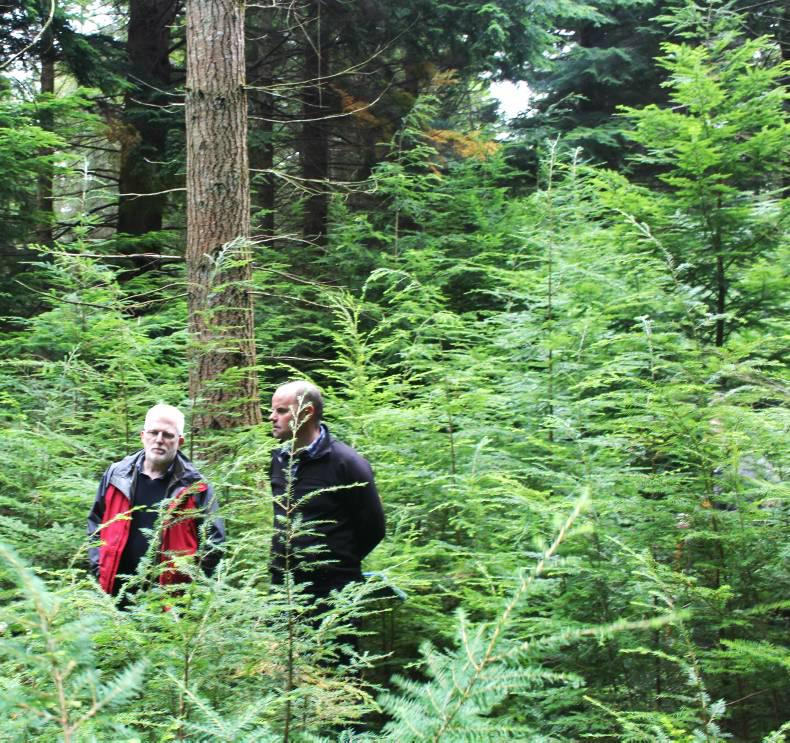
Natural regeneration requires careful management. You can have too much, as the Brabazons discovered. For example, western hemlock is regenerating too prolifically on some sites and will require intervention or a monoculture will be created which is the antithesis of CCF.
CCF has been unfairly consigned by some as only relevant to broadleaf forestry. For example, the current Forestry Programme places it in the Native Woodland Establishment Scheme, where “wood production remains an option and is encouraged, once ecologically compatible, and undertaken through continuous cover forestry”.
However, the programme identifies CCF “as an area requiring targeted training schemes”.
The Brabazons demonstrate that it is a system that is compatible with a wide range of species including conifers Sitka and Norway spruce, Douglas fir, Scots pine, western hemlock and western red cedar as well as broadleaves such as oak and beech.




SHARING OPTIONS