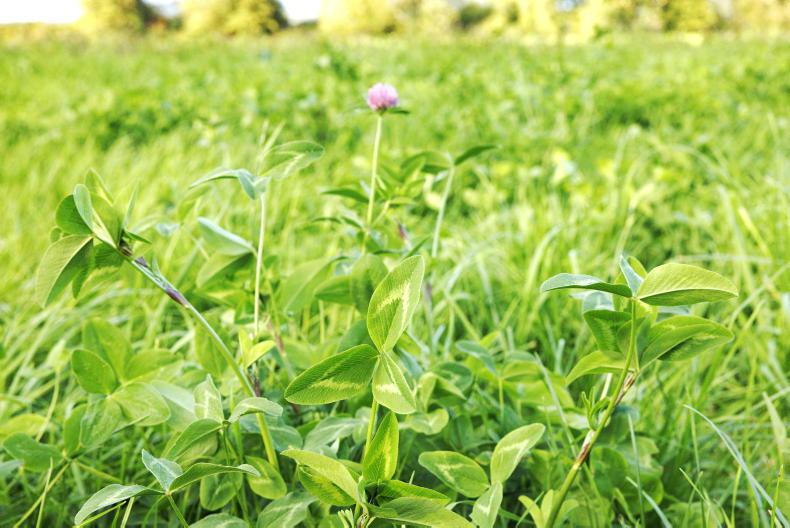
Organic farmers around the country praised the persistence of clover and multispecies swards during the drought.
"During the height of the drought, the only thing that was growing on this farm was clover and red clover in particular," Gavin Lynch, an organic dairy farmer in west Wicklow, told the Irish Farmers Journal.
He believes the high inclusion of clover in his swards slowed the farm from burning up.
“It is that bit quicker to recover and puts out a bigger leaf area, so ground wasn't as inclined to dry as quick.
“When we cut or grazed, the clover came back with a broad leaf quickly and that shielded the soil from the worst of the sun and I think there was probably better moisture attention there because of it.
“In saying that, when you get two months of no rain, it is going to affect you."
Gavin said he is considering including red clover in grazing swards, in addition to his silage fields, to help future-proof his farm from drought.
No space for passengers
The dought also brought attention to stocking rate, Gavin added.
“We're probably all guilty of overstocking slightly and with weather being more variable and difficult to deal with, we have to look at that too.
“We're looking at stock numbers – it's going to be a winter where there's no space for passengers.
“You have to look at everything you're carrying and see are they paying their way or are they going to cost you money."
In terms of the impact of the drought on his farm, Gavin noted that two cuts of red clover silage have been taken so far, which he said were both affected by dry periods, but the third cut has been really badly affected.
“We took our second cut in the first week in July – normally you to cut it every six weeks.
“All we can do is leave it and wait for it to bulk up and we are probably looking at the end of this month to take our third cut.
Winter feed
“It will leave us slightly short on fodder – I won’t have the buffer I’d like to have. I will probably be okay for five months of a winter, but really, you need to be prepared for six months and a little bit along with it.
“We’ve sourced a bit of additional feed; I hope that will be okay. We hope for a good back-end of the year and a good spring next year. It's not a great strategy, but that's what we have."
Thomas Kavanagh, an organic beef and suckler farmer in Dingle, Co Kerry, agreed and said his multispecies swards and clover performed well in the drought.
“There was a week where things were on the tight side at the end of July, but we weren’t feeding cattle or supplementing. Cattle were only lasting three or four days in a paddock, instead of five or six days.
“When the rain came in early August, it was welcome and now I’m flushed with grass and looking at taking another cut of silage in September."
Echoing Gavin’s point on stocking rate, Thomas said he believes the drought was a warning shot for animal numbers.
“I managed fine, I hadn’t any issues, but I wouldn’t be increasing my numbers, looking at what the drought has brought upon others."
Chair of the organic project team with the Irish Farmers' Association (IFA) John Fitzpatrick said that the drought highlighted the importance of the red clover and multispecies swards schemes and called for their reintroduction.
Red clover scheme
"I think it’s important to highlight the need for the red clover scheme, the multispecies sward incentive and liming programme be reintroduced, because they do work and the drought has shown that."
He said that due to no chemical fertiliser being spread on organic farms, the clover roots are inclined to go deeper into the ground, especially in established crops.
But he added that while organics mightn’t have been as affected by the drought as quickly as conventional, everyone was affected in the end.
"The thing about the organics is that the regrowth probably won't be as quick because when the rain does come, conventional farmers have fertiliser to boost on the growth. In organics, we rely on mother nature and the fertility of the ground. Conventional farmers would probably get back growing a bit quicker; the bounce back is slower for organics."
He said, overall, there is a reduction in the silage yield.
"People are going to be in trouble with regards to feeding, but it all depends on what part of the country you are in.
"The big thing being organic is that unlike the conventional, you can't get silage from your conventional neighbour, so you have to travel - transport costs would be a big thing.
"If you think you will be short silage, I suggest try and sort it as soon as possible, in case it gets scarce," the IFA organic project team chair advised.