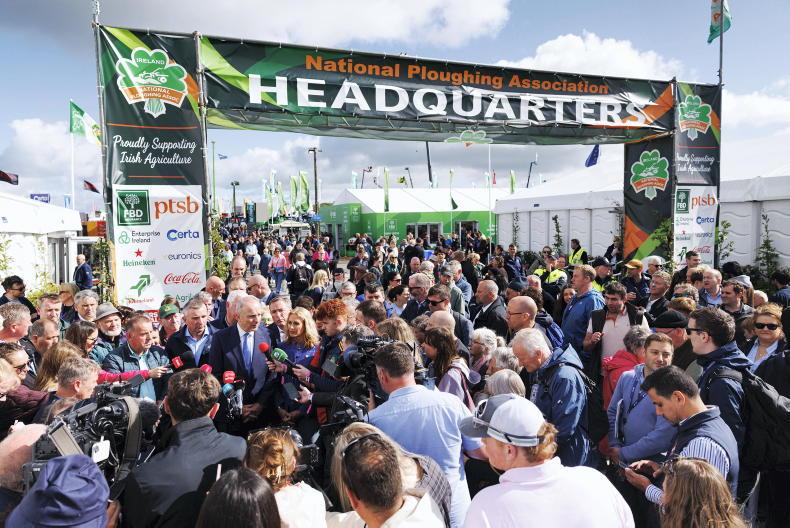
A “small farmer” from Roscommon was convicted of a public order offence and given a suspended sentence of six weeks' imprisonment arising from what he claims was an attempt to enquire whether an Taoiseach Micheál Martin would ask Larry Murrin to resign from his position as chair of Bord Bia.
Mr Vincent Harrington (60) of Cloonmacmullan, Kingsland, Boyle, Co Roscommon was convicted of engaging in threatening, abusive and insulting behaviour on day one of the 2026 National Ploughing Championships in Screggan, Co Offaly, at Tullamore District Court on Tuesday.
The State claimed that a “red mist descended” on the farmer and he “just lost the head” when attempting to confront the Taoiseach at the Ploughing site on 15 September 2026.
Mr Harrington had pleaded not guilty to the charge and maintained that while he may have spoken loudly when asking his question, his voice is generally loud due to him being used to talking around tractors and commanding working dogs.
Garda evidence
Detective Garda Pádraig Ryan’s evidence described his attendance at the 15 September incident which occurred “right in the centre” of the Ploughing site.
Garda Ryan claimed an Taoiseach’s visit to the Ploughing was a “meet and greet” with the public during which politicians are used to responding to “negative interactions”, but he claimed that Mr Harrington had taken his interaction “too far”.
The court heard from the guard that Mr Harrington breached the peace by becoming enraged and that he subsequently tried to resist arrest by tensing his arms, requiring around four gardaí to handcuff him.
There was then some discussion between the prosecution, defence and judge as to whether a video clip that emerged of the arrest should be shown, but it was heard that the source of the video was not known nor whether its original audio had been altered.
The guard said that after being handcuffed, Mr Harrington aired grievances on his “failing beef business” and discontent with the state of the economy with arresting gardaí, calling them “traitors” before making multiple attempts at escaping.
The guard said that the accused calmed down after he was put in a garda van and taken to the station.
Taoiseach’s protection
Detective Garda Peter MacGuire, who was at the Ploughing on plain-clothes protection duties with the Taoiseach - also gave evidence of the incident to which his attention was initially drawn to by Mr Harrington’s gait and body language.
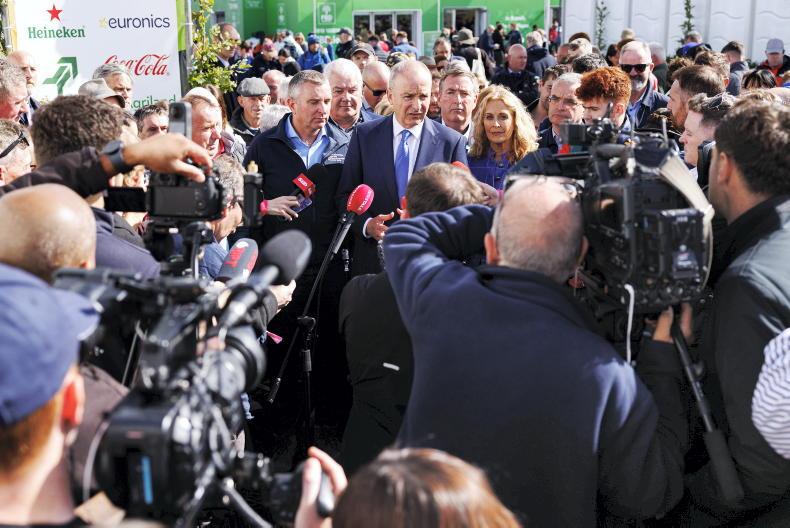
Detective MacGuire said that he heard the farmer shouting expletives at an Taoiseach - including “gobsh*te” and “traitor” – and that he placed his right arm out as a “soft barrier” between him and the Taoiseach when he saw the former approaching.
The detective said he tried to de-escalate the situation before Mr Harrington tried to push closer to the Taoiseach, which he said required that the arrest take place.
He claimed that 1,500 to 2,000 interactions took place between an Taoiseach and members of the public but that there was only this single need to intervene, despite some “curt” exchanges with farmers raising issues, as he denied “heavy-handedness”.
Mr Harrington’s evidence
The farmer said he attended Ploughing 2026 as he had wanted to enquire about purchasing a new cattle crush.
Mr Harrington told the court that he spotted an Taoiseach after he said his 12 o’clock prayers as he was on the way to see some crushes and that he decided to speed up his walk to catch up with him.
Mr Harrington said that his intention was to put a question to an Taoiseach as to whether he would seek Larry Murrin’s resignation in light of an EU ban on Brazilian beef imports.
The accused recounted his statement to the Taoiseach as being "seeing as Brazilian beef has been banned out of Europe now, does that mean you are asking Larry Murrin to step down from his position on Bord Bia’s board."
He said that an Taoiseach then “stood back” and “there was a heap of men around me” who he did not understand initially were gardaí.
He acknowledged that at this point, he may have raised his hand in a bid to regain balance “like a footballer in a tackle”.
Mr Harrington then recalled asking “do you want to poison the Irish children when they are going back to school” in a raised voice.
The accused said that he was then informed that the others involved in the incident were gardaí to which he responded that “it would be more in line if ye were above on the motorways stopping people coming down the wrong way”.
Expletives denied
Mr Harrington denied uttering expletives or calling an Taoiseach a “traitor” during the incident, claiming that if he had, there would have been politicians present who would have videoed and posted it online.
When asked by the State if he saw his actions as having frightened the 50-60 members of the public in the vicinity, Mr Harrington responded “no” and added “a farmer with a bad hand asking a question. How would that be frightening.”
He denied getting frustrated at an Taoiseach’s lack of a response to his question, to attempting to push by the garda protection or to getting “irate” during the incident.
Mr Harrington denied uttering expletives or calling an Taoiseach a “traitor” during the incident
During State questioning in court, Mr Harrington agreed that he had replied “sorry” when the charge sheet was read out to him in Tullamore Garda Station.
He clarified that his apology was directed towards gardaí for the shame they had brought upon themselves and not the Taoiseach, before adding “we are not under English rule yet. Thanks be to God.”
The farmer accused the State of treating his case “like the Kerry babies tribunal” as he suggested that the members of An Garda Síochána who gave evidence against him had been told to lie on the stand “to blacken” his name for the sake of their wages.
The judge intervened shortly after to ask Mr Harrington to stick to answering the State’s questions to him after he asked whether those present could swear on the crucifix as to whether they had “told the truth today”.
He also said that the Gardaí who dealt with him in September had been courteous, even lighting a cigarette for him while he was handcuffed, adding that he had offered to buy one of them lottery tickets as a gesture of his appreciation for their treatment of him.
Sentencing
Judge Andrew Gubbins found Mr Harrington guilty of the public order offence, stating that while he was not punishing the accused for the fact he contested the charge, he would not receive the benefit of a guilty plea.
The judge remarked that the State was not required to produce witnesses from the public who had seen the incident unfold to account for whether they had experienced fear during it, nor was the State required to produce an Taoiseach as a witness.
He said that Mr Harrington’s demeanour during the hearing suggests that he is an “emotional man” with “quite a loud voice” and “who is very passionate about his views”.
The judge found that Mr Harrington’s claim that he did not raise his voice when asking his question of the Taoiseach didn’t stand to reason as he had raised his voice when recounting the incident in his own evidence.
Two historic and unrelated convictions were not factored into the sentencing decision, but evidence that women and children were shocked over the incident factored into the judge’s decision that the charges were that of a severity at “highest end of it”.
Mr Harrington was sentenced to six weeks’ imprisonment suspended on a €100 bond for a period of two years dependent on him keeping the peace and remaining on good behaviour.
After the sentence was handed down, Mr Harrington asked the judge if he could make a remark to the court, which judge Gubbins declined as court matters were still in progress.
Mr Harrington then said he intended on praying for the gardaí and began to recite an Our Father, before judge Gubbins interrupted the farmer to say that if he wanted to say prayers, he could do so in a church.