



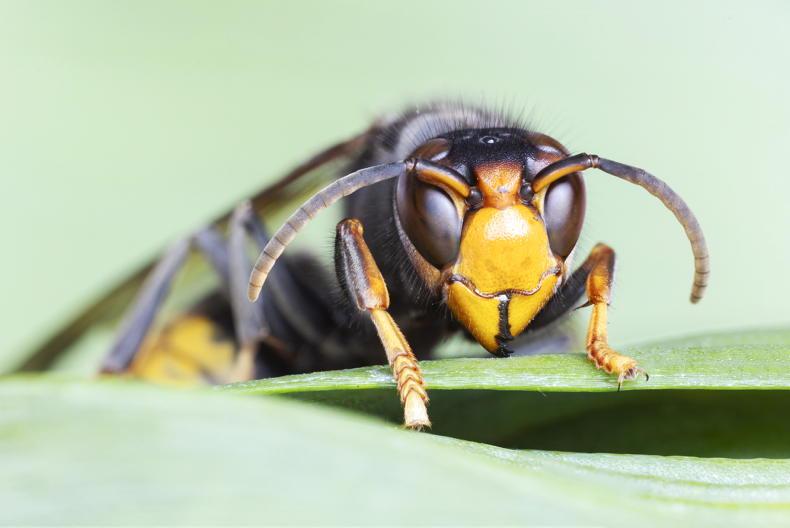
An intensive National Parks and Wildlife Service (NPWS) operation is underway to locate and remove an Asian hornet nest in the Ringaskiddy area of Co Cork, Minister for Nature, Heritage and Biodiversity, Christopher O’Sullivan has confirmed.
The operation escalated following the successful capture of a second Asian hornet close to the location where an initial specimen was photographed by a member of the public late last week.
Minister O’Sullivan said that since the confirmation by the National Biodiversity Data Centre of the initial sighting of an Asian hornet in Ringaskiddy, the NPWS had mounted an intensive surveillance and monitoring operation in the area.
Minister O'Sullivan noted that the discovery of a second hornet on Wednesday was a significant development, as it suggested that a nest may be present nearby.
Critical new phase
He added that the response had now moved into a critical new phase, with specialist bait stations being deployed to track and trace any further hornet activity and pinpoint the nest location as quickly as possible.
“Conservation rangers will use the latest transmitter technology to follow the movements of individual hornets back to their nest,” he said.
“This approach has proven highly successful in other countries, including the UK, and gives us the best possible chance of locating the nest before the species can establish itself.”
Early detection and rapid intervention
“We know from our successful response to last year's incursion that early detection and rapid intervention are absolutely critical. Using the latest science, technology and expertise, we are moving swiftly and decisively to protect Ireland's biodiversity and our native pollinators from this invasive species."
Minister O’Sullivan thanked the public, whose vigilance helped alert the authorities.
He encouraged anyone who believed they may have seen an Asian hornet to report it immediately through the website www.invasives.ie.
Invasive species
Native to southeast Asia, the Asian hornet is considered to be an invasive species, posing a significant threat to Ireland's biodiversity.




SHARING OPTIONS