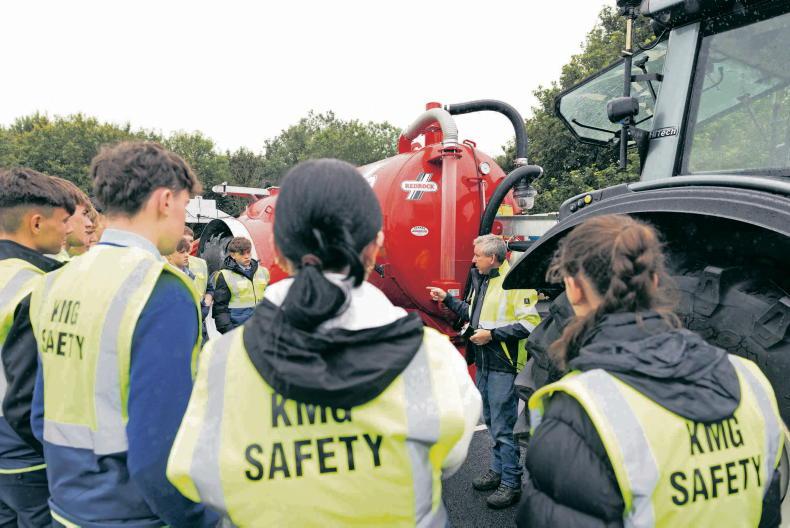
Young people aged 14 and over are getting behind the wheel as part of a series of tractor driving and safety courses being delivered across Cavan, Leitrim and the surrounding areas.
Kieran McGovern of KMG Safety Training secured funding under the Department of Agriculture’s proposals for Farm Safety, Health and Wellbeing Projects 2026 to provide safer tractor driving and safety awareness training.
The Department is covering 100% of the cost of the programme, with McGovern funded to deliver 25 six-hour courses to groups of 12 participants, providing places for up to 300 young people.
McGovern, who has been delivering tractor training for 13 years and is a suckler farmer himself, is running the courses through secondary schools, combining classroom-based theory with practical training.
The programme covers tractor and machinery safety, including PTOs, tyre pressures, tractor stability, front loaders and counterbalance weights, as well as working on hills, road safety and the use of machinery including trailers and slurry tankers.
McGovern said knowing how to physically drive a tractor is only one part of operating machinery safely.
“It’s sometimes not that hard to drive a tractor, but it’s a lot more difficult when you get into bother to know what to do,” he said.
“That’s the key one. Driving along is great, but if you know what to do when there’s a problem, or what not to do, that’s important.”
Rural connection
Principal Anne Conaghan and vice-principal Martha Brady said the course was particularly relevant to their school given the number of students with links to agriculture.
“We are in a rural demographic area, so quite a big population of our students will either be attached to a farm, their parents might be part-time farmers or have a connection to the land,” said Anne.
A number of students also take up summer employment with local agricultural contractors, meaning some can find themselves operating machinery on different farms and unfamiliar terrain.
Conaghan and Brady said this was among the reasons the school wanted to give students formal safety education alongside the practical experience many already have.
“We looked at it from a health and safety and an educational perspective, could we tap into something that would be really beneficial to the students and also helping local farmers and employers in the area?”
The course includes an hour of classroom-based theory before students move outside for the practical session. The school said students had responded particularly well to getting behind the wheel, with strong participation from both male and female students.
“They love it. There’s a great uptake and they really enjoy it,” Martha said.
Safety into practice
For the principal and vice-principal, the practical element complements the agricultural education already available at the school, which included agricultural science and agricultural and horticultural modules through the Leaving Certificate Applied programme.
“It makes the subjects really come alive,” they said.
The school would now like to see funding for the initiative continue so future groups of students can receive the same training.
“You’d love if there was funding provided for it to be rolled out and for this to be an ongoing thing.”