



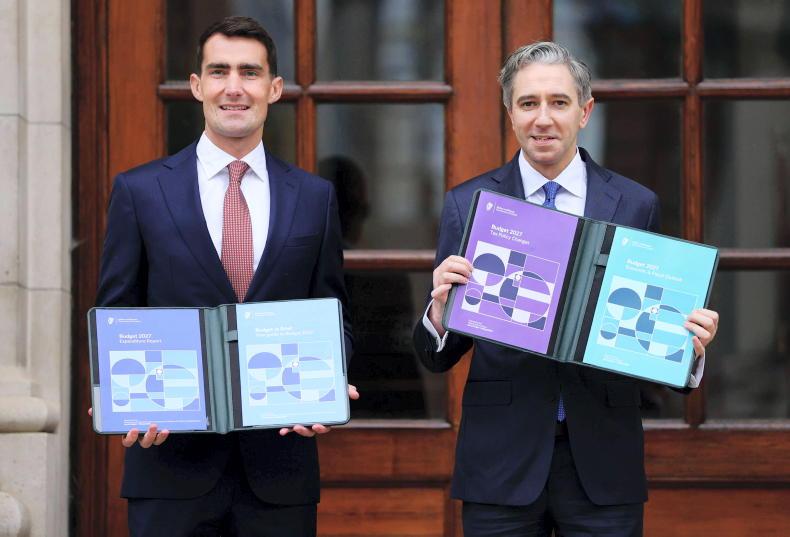
Minister for Finance Simon Harris repeated at the weekend in Mullingar his commitment to "people who get up early every morning and go to work", a category which covers a high and rising portion of the entire electorate. Employment continues to set new records and the labour force continues to expand. Meanwhile, Government revenue exceeds Government spending, and the minister’s declared intention is to undertake further spending measures in the upcoming budget. The budget surplus is already falling and it is stated policy to ensure that the surplus turns to deficit over the next few years. What happens when the figures catch up with the rhetoric? Readers will recall, without nostalgia, the last period of false optimism and the under-estimation of risk to the public finances in the period leading up to the financial crash. The mantra was ‘soft landing’ through the years of Bertie Ahern’s leadership and we know what happened next, an extended period from 2008 to about 2013, when the Government could no longer borrow and had to cut back, relying on conditional funding from the IMF and EU institutions. The assurances about a soft landing were not entirely unreasonable either – the future path of a small economy highly exposed to trading conditions with its neighbours is uncertain, although there were Cassandras in Ireland during the early 2000s warning of a property bubble. The Cassandras were right unfortunately.
Accelerating instability around the world has followed the optimism of the 1990s, when the fall of communism and the apparent triumph of the west promised a broadening of international co-operation and free trade. The Princeton anthropologist Clifford Geertz in 1995 warned that, far from ushering in a new golden age, the end of the cold war could work out differently and the multiple armed conflicts and trade wars in recent decades have proved him right. He wrote ‘a stream of obscure divisions and strange instabilities’ would emerge, and asked ‘...what is a country if it is not a nation?’ For small countries like Ireland, fully exposed to high volatility through trade and finance, the environment has become more stressful and purely national policy more limited in its impact whatever the minister for Finance may prefer.
Geertz knew that countries are states rather than nations and states can dissolve into fractious internal culture wars, indeed shooting wars, with neighbours including territorial claims, even settler colonialism in the 21st century. Geertz died in 2000 and one can only guess what he would have made of Trump’s tariff wars, the conflict in the Middle East, the effective dissolution of the western alliance over Putin’s invasion of Ukraine and the re-emergence of Hindu nationalism as state policy in India where the Muslim minority numbers 200 million. Fears of nuclear proliferation are rising. The creeping occupation of the West Bank by Israel, US threats to Canada and Greenland, the re-naming of the Gulf of Mexico to the Gulf of America, all justify his foreboding and have turned any kind of long-range planning of economic policy into a branch of astrology. Economists can only recommend caution and governments, including our own, eschew caution in response to any manifestation of voter discontent. Short-term populism rules and most governments around Europe have been running up bigger budget deficits.
Populists of left and right agree on one constant response, more spending, in the battle to see off insurgent political parties and the pattern has reached Germany where a right-populist party has just had a breakthrough election result, celebrated with flag-waving and German nationalist sloganising. A recent example is the proliferation of Irish tricolours on lampposts in districts of Dublin promoted by right-wing political groups, mirroring the popularity of the (English rather than British) flag of St George at demonstrations across the water. The underlying sentiment is Germany First or Britain First and Ireland is not immune.
The budget deterioration is accelerating despite the continuing inrush of corporation tax revenue – the only cautious official voices are the independent Fiscal Council and think-tanks like the ESRI, and their influence is offset with every monthly announcement of Exchequer figures. The bonanza is continuing, at least for now, and nobody is predicting an early end to the monthly injections of what looks like free money.
If it proves transient and there is an international downturn, Ireland will not be immune. The rates governments pay for fresh borrowing have been rising, even in Germany, and both the UK and the USA, key destinations for Irish exports, already face rising debt service burdens. In Ireland, the State has been paying extra on fresh borrowing, needed to replace maturing debt, and the ingredients are coming together for a re-run of the last period of tight budgetary policy. The budgets before 2008 threw away the capacity to spend in the subsequent downturn.



SHARING OPTIONS