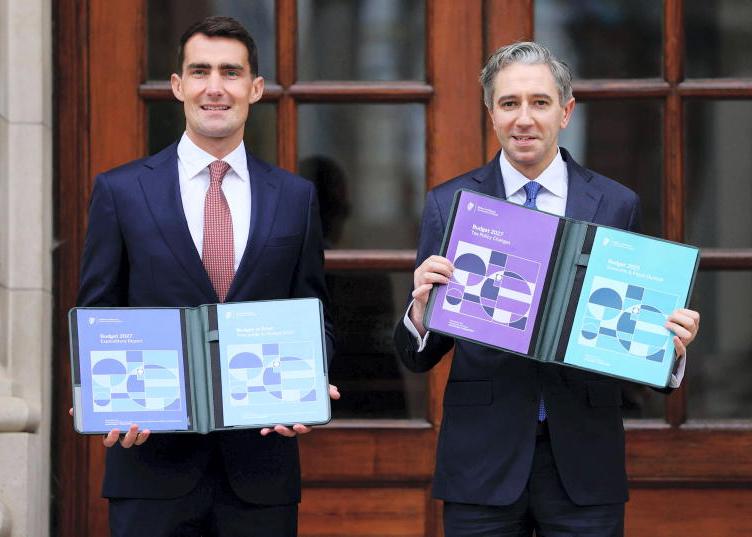
Big tax concessions and expenditure increases in Tuesday’s budget will not be enough to derail another sizeable fiscal surplus next year, according to the Department of Finance projections.
But it will be a lower surplus than it could have been and is forecast to stay on a downward path in later years.
The 2027 surplus would have been even lower had the demands of Sinn Féin and the other opposition parties been met.
Since expenditure ceilings have been ignored for several years past, the out-turn in 2027 will in any event see a weaker figure than Simon Harris has promised.
All of this matters unless you believe that the comfortable fiscal position will last indefinitely, a view implicitly shared by all political parties represented in Dáil Éireann, all of whom have supported tax give-aways and spending increases.
But a lower surplus and the risk of slipping sooner into deficit is not popular with independent economic commentators.
The Fiscal Council and the ESRI have warned that the corporation tax bonanza will not last and that the opportunity should instead be taken to build a permanently stronger State balance sheet.
The Minister for Finance has moreover chosen to ignore the recent upward drift in the cost of Exchequer borrowing. There is an outstanding stock that must be re-borrowed every year as it matures, even without fresh borrowing for any new deficits.
The resulting debt service outflow from the Exchequer has been rising.
The Irish Government is currently paying around 3.7% on ten-year bonds versus less than 3 earlier this year and today’s cost is a little ahead of the 3.4% rate for Germany, the AAA-rated borrower in the Eurozone.
Rising
But France, also a single currency member, pays 4.9% and rising, since the French public finances are in crisis and the debt and deficit numbers are worse than Italy or Greece, both of whom pay less than France for 10-year money. The last time Eurozone members saw this kind of attack from the bond market vigilantes, all of whom are volunteers, was in 2008 and 2009.
Bond yields rose sharply for the financially overstretched members, eventually forcing Ireland into emergency borrowing from the Troika and Greece into actual default. The lesson is that only if the budget surplus turns out to be permanent, or at worst a small deficit, will small countries survive give-away budgets and be able to re-finance freely in future years.
Aside from the political enthusiasm for looser budgets, there are other looming threats to Irish fiscal comfort.
Both US and European Union politicians, including Howard Lutnick, president Trump’s commerce secretary and Roland Lescure, the French finance minister, have been casting envious glances at the buoyant revenue in Ireland from the multinational, mainly American, payers of corporation tax and there is every likelihood that they will demand a share.
There is pressure too for increased defence spending in Europe and neutrality could prove a weak excuse - there is a mutual defence obligation in the Lisbon treaty’s article 42.7 which would take a constitutional amendment in Ireland to evade.
EU budget negotiations are not yet resolved on the Multiannual Financial Framework (MFF) for 2028 to 2034 and defence obligations are a major sticking point, with pressure for EU-level financing. Even if neutrality survives, Ireland could end up paying more in EU contributions toward joint defence as part of the budget compromise, even while staying nominally neutral.
There is growing domestic pressure for higher defence spending anyway, some of it fanned by serving and retired military officers as well as politicians with ambitions for new or expanded defence facilities in their constituencies.
Finance minister Simon Harris has endorsed, without any cost estimate, a new naval base for Galway and various TDs and councillors have been seeking naval expansion elsewhere along the west coast.
Both Dun Laoghaire and Drogheda on the Irish Sea have local supporters for new naval bases and there have been lobbyists for a bigger air force, including squadrons of jet fighters, responding to the threat of Russian snooping of the coast and the risk of interruption to undersea communications.
It is possible that Ireland could talk itself into extra defence spending, be pressured into doing so, or actually choose to join NATO. The cost of NATO membership would be enormous, 20 times the prospective military budget next year of about €1.6 billion.
Member countries like Latvia are spending 5% of GDP, the UK and France are headed for 3.5% or 4% while Ireland spends a tiny one-fifth of one per cent.
The political parties are all in favour of preserving Ireland’s neutrality but remarkably shy about drawing attention to the enormous annual financial savings Ireland enjoys. The eventual bill for NATO membership could be €20 or €25 billion per annum, every year and forever.