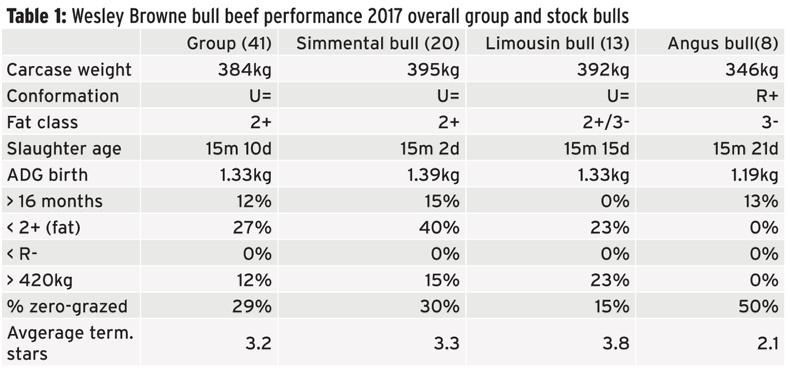
In the paper this week, we broke down Monaghan BETTER farmer Wesley Browne’s under 16-month bulls, by how they performed based on their sire and their diet (concentrate-fed or zero-grazed).
Farm facts – Wesley Browne:
78 suckler cows.
Spring-calving herd.
58 hectares.
Four blocks.
Under 16-month bull beef.
Simmental-based herd.
Second highest average cow maternal index in BETTER farm at €105.
Liveweight produced per hectare in 2016: 800kg (national avg. 477kg).
ADVERTISEMENT
As we saw, his Simmental bull was doing best, ahead of his Limousin and Angus bulls, although his Angus was used largely on heifers.
It is vitally important to look into the data that we generate and use it to make decisions. Ninety percent of the data generated on farms today serves no further purpose. This data costs money to collect and the idea of collecting it is that it will enable us to make our management decisions in a way that will lead to a more efficient use of resources.
For example, if we find that a certain sire is hard calving on our farm, we change to an easier one and save time and money via reduced potential mortality. If we find that cattle aren’t performing as well as we had targeted, we look at why that is: diet? Parasites? Environment? Genetics? The less we measure in a scenario like the above, the more we are clutching at straws when diagnosing a potential cause.
Here we look at another comparison within Wesley’s bulls – individual terminal index value, a measurement largely forgotten with the advent of the BDGP.
It is well and truly working on Wesley’s farm. High terminal index cattle are grading better, killing sooner and growing faster. There may be a slight zero-grazer effect at play, with Wesley having finished 12 of his 41 bulls this way in 2016.
Read this week’s main BETTER farm article to see how Wesley’s zero-grazed bulls stacked up against their conventionally-finished comrades.
This content is available to digital subscribers and loyalty code users only. Sign in to your account, use the code or subscribe to get unlimited access.
The reader loyalty code gives you full access to the site from when you enter it until the following Wednesday at 9pm. Find your unique code on the back page of Irish Country Living every week.
CODE ACCEPTED
You have full access to the site until next Wednesday at 9pm.
CODE NOT VALID
Please try again or contact support.
In the paper this week, we broke down Monaghan BETTER farmer Wesley Browne’s under 16-month bulls, by how they performed based on their sire and their diet (concentrate-fed or zero-grazed).
Farm facts – Wesley Browne:
78 suckler cows.
Spring-calving herd.
58 hectares.
Four blocks.
Under 16-month bull beef.
Simmental-based herd.
Second highest average cow maternal index in BETTER farm at €105.
Liveweight produced per hectare in 2016: 800kg (national avg. 477kg).
As we saw, his Simmental bull was doing best, ahead of his Limousin and Angus bulls, although his Angus was used largely on heifers.
It is vitally important to look into the data that we generate and use it to make decisions. Ninety percent of the data generated on farms today serves no further purpose. This data costs money to collect and the idea of collecting it is that it will enable us to make our management decisions in a way that will lead to a more efficient use of resources.
For example, if we find that a certain sire is hard calving on our farm, we change to an easier one and save time and money via reduced potential mortality. If we find that cattle aren’t performing as well as we had targeted, we look at why that is: diet? Parasites? Environment? Genetics? The less we measure in a scenario like the above, the more we are clutching at straws when diagnosing a potential cause.
Here we look at another comparison within Wesley’s bulls – individual terminal index value, a measurement largely forgotten with the advent of the BDGP.
It is well and truly working on Wesley’s farm. High terminal index cattle are grading better, killing sooner and growing faster. There may be a slight zero-grazer effect at play, with Wesley having finished 12 of his 41 bulls this way in 2016.
Read this week’s main BETTER farm article to see how Wesley’s zero-grazed bulls stacked up against their conventionally-finished comrades.
If you would like to speak to a member of our team, please call us on 01-4199525.
Link sent to your email address
We have sent an email to your address. Please click on the link in this email to reset your password. If you can't find it in your inbox, please check your spam folder. If you can't find the email, please call us on 01-4199525.
ENTER YOUR LOYALTY CODE:
The reader loyalty code gives you full access to the site from when you enter it until the following Wednesday at 9pm. Find your unique code on the back page of Irish Country Living every week.
SHARING OPTIONS