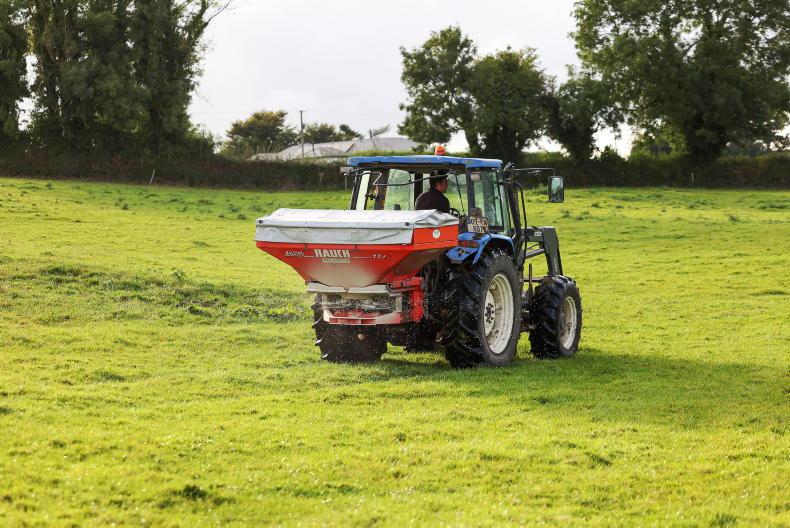
Andrew Blackwell spreading Sulphacan on cow paddocks at Gurteen Agricultural College,Co.Tipperary.
ADVERTISEMENT
The head of Fertilizers Europe, the main body representing European fertiliser producers, told the IFA’s international fertiliser conference on Thursday that he expects nitrogen fertiliser prices to fall later this year.
Jacob Hansen delivered the news as European producers are under pressure to explain why nitrogen fertiliser prices have increased by upwards of 7% over the past year, while gas prices were falling by 30%.
Maixmo Torero from the International Food Policy Research Institute presented figures showing the evolution of fertiliser and oil prices and said “something was going on”: while crude oil and fertiliser usually track eachother, “today there is a huge gap”.
ADVERTISEMENT
Hansen said he expected European producers to reduce prices by mid-to-late summer, but he did not know by how much as this would “depend on what is supplied and demanded”.
Outlining the reasons why fertiliser prices remain high despite the fall in gas prices, Hansen likened the linkage to that of cereals and pigmeat: “When the price of feed comes back to the pig farmer, there is a lag time before the price of pigmeat falls.”
Register for free to read this story and our free stories.
This content is available to digital subscribers and loyalty code users only. Sign in to your account, use the code or subscribe to get unlimited access.
The reader loyalty code gives you full access to the site from when you enter it until the following Wednesday at 9pm. Find your unique code on the back page of Irish Country Living every week.
CODE ACCEPTED
You have full access to the site until next Wednesday at 9pm.
CODE NOT VALID
Please try again or contact support.
The head of Fertilizers Europe, the main body representing European fertiliser producers, told the IFA’s international fertiliser conference on Thursday that he expects nitrogen fertiliser prices to fall later this year.
Jacob Hansen delivered the news as European producers are under pressure to explain why nitrogen fertiliser prices have increased by upwards of 7% over the past year, while gas prices were falling by 30%.
Maixmo Torero from the International Food Policy Research Institute presented figures showing the evolution of fertiliser and oil prices and said “something was going on”: while crude oil and fertiliser usually track eachother, “today there is a huge gap”.
Hansen said he expected European producers to reduce prices by mid-to-late summer, but he did not know by how much as this would “depend on what is supplied and demanded”.
Outlining the reasons why fertiliser prices remain high despite the fall in gas prices, Hansen likened the linkage to that of cereals and pigmeat: “When the price of feed comes back to the pig farmer, there is a lag time before the price of pigmeat falls.”
If you would like to speak to a member of our team, please call us on 01-4199525.
Link sent to your email address
We have sent an email to your address. Please click on the link in this email to reset your password. If you can't find it in your inbox, please check your spam folder. If you can't find the email, please call us on 01-4199525.
ENTER YOUR LOYALTY CODE:
The reader loyalty code gives you full access to the site from when you enter it until the following Wednesday at 9pm. Find your unique code on the back page of Irish Country Living every week.







SHARING OPTIONS