


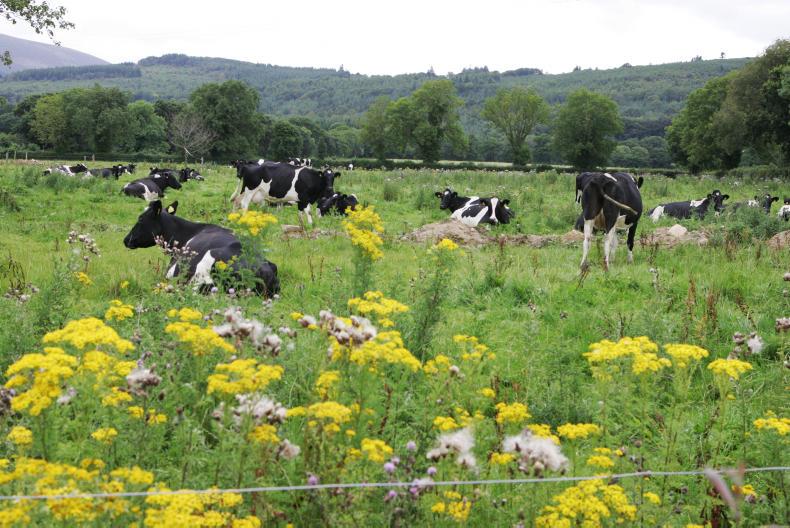

If a farmer does not stop the growth of certain weeds, they can be liable under the Noxious Weeds Act.
For farmers, the growth of noxious weeds can pose a major issue if growing on their lands. But what are the noxious weeds that must be controlled and how can they be treated?
The noxious weeds that must be controlled as set out by the Department include:
Treatment
When control and subsequent grassland management is good, the benefits of this spray programme could be expected to go beyond a total of four years.
Enforcement of Noxious Weeds Act
The Noxious Weeds Act is implemented by the Department of Agriculture, Food and the Marine. If noxious weeds are found on a farmer’s land, the farmer is issued with a “notice to destroy”.
These notices are issued after an inspection by Department field officers or after a complaint has been made by a member of the public.
Follow-up action is then undertaken by the Department to ensure these steps are taken to destroy the noxious weeds present.
However, questions have been raised about the process around enforcement and punishment of the act. Since 1936, no farmer or landowner has actually been punished for offences in breach of the act.
In fact, wording of the act has also come into question. The wording of the act states that when a noxious weed is found growing on a land, they “shall be liable on summary conviction thereof to a fine not exceeding £20.”
The Department also confirmed that there are no plans currently to change the noxious weed legislation.
Difference with knotweed
Japanese knotweed is not a noxious weed. Instead, it is classified as an invasive species under Irish legislation (SI 477 of 2011) as provided for under the Habitats Directive and therefore falls under remit of the Department of Arts Heritage, Regional, Rural and Gaeltacht affairs.
The effect of knotweed on land can be extensive. Not only can it reduce land price, but it can also affect planning permission and mortgages.
With help from the National Biodiversity Data Centre, here are a number of pieces of advice on how to identify and deal with Japanese knotweed on your property.
What does Japanese knotweed look like?
It is a green shrub with bamboo-like hollow stems that grow to 3m in height and it forms dense stands during the summer.
Spring
In spring, small red buds appear that develop into ‘‘asparagus tip’’-shaped stems. As it grows, it has a green stem with red/purple flecks. Leaves are arranged in a zig-zag pattern on the stem (see picture).
Summer
Clusters of small, creamy white flowers emerge in late summer.
Winter
In winter, the plant dies back leaving dead brown cane-like stems still standing or lying on the ground. Often, there is still evidence of browned flowers on stems.
Underground
Underground, it has an extensive rhizome (which is essentially an underground stem) system, commonly with an orange centre that snaps easily like a carrot when bent.
Can Japanese knotweed or the other invasive knotweed species be confused with any other plant in Ireland?
Due to its bamboo-like stems and dense growth, it is sometimes confused with bamboo plants or Red Dog Osier (Cornus sericea).
These other plants are, however, rarely encountered outside of areas where they have been planted and the shape of the leaf and zig-zag leaf arrangement on the stems will distinguish Japanese knotweed from these species.
Japanese knotweed could affect farm payments
Letter: concerns over spread of Japanese Knotweed

