



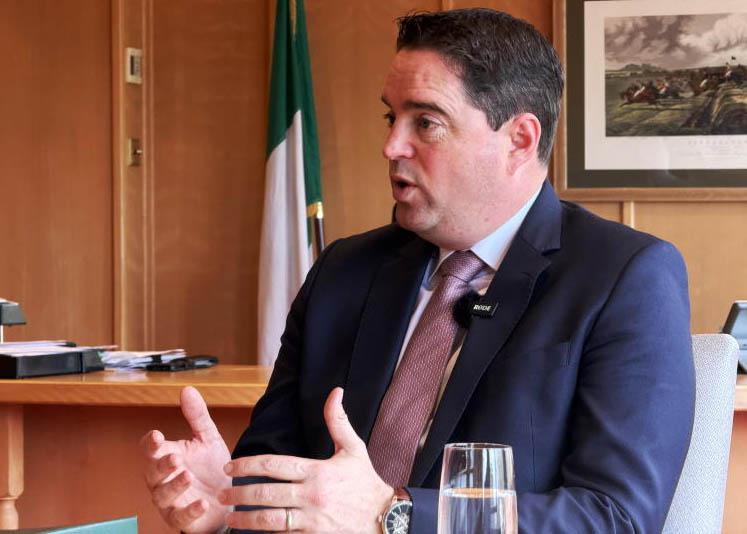
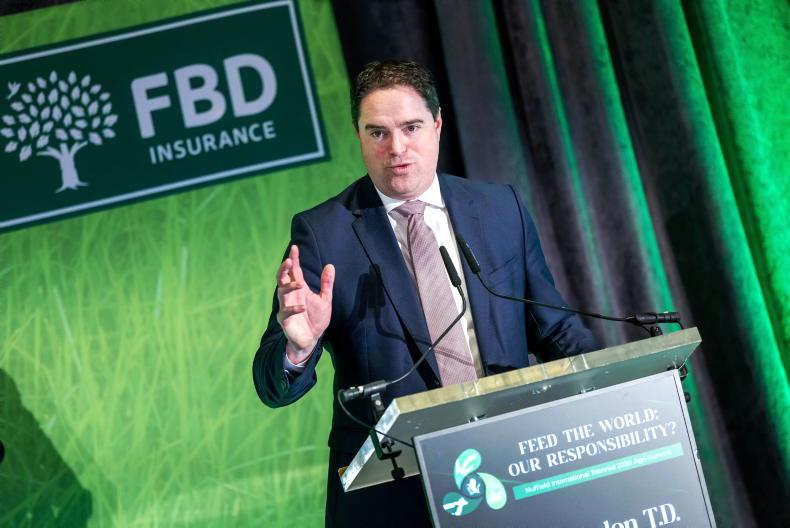
Martin Heydon faces a daunting challenge when he assumes the chair of the EU’s Agriculture and Fisheries Council (AGRIFISH) of the 27 Agriculture Ministers on 1 July.
He must try to broker a deal when the opening hand played by the European Commission is to cut the Common Agricultural Policy (CAP) budget by 22%, while bundling the fund in with other programmes.
It’s a package that farm leaders across the continent have described as the road to ruin. To improve it will require agreement between his ministerial colleagues and the European Parliament with the Commission watching.
Here, the Minister for Agriculture gives his first in-depth interview around his aspirations for a defining six months for the future of farming in Europe.
How developed is the conversation regarding CAP within the ministerial council at this point in time?
“It is developing. I’ve had a lot of bilateral meetings, one-on-one meetings with other ministers. They’re looking to meet me because I’m going to have the presidency in three months’ time and be in the chair, and they want me to understand their priorities.”
“This is a really important period where I get to tell them Ireland’s priorities. Once you go into the chair, like the chair of any club or organisation, you have to be an honest broker, you have to be kind of impartial. Obviously, I will still have Ireland’s priorities, and I’ll be working through them, but these three months are really critical for me to push Ireland’s agenda in a very big way before the constraints of the chair set in.”
“I have a very clear understanding of the differences between countries. Some have very small farmers, and our average size farm of 30ha will be a lot bigger than them. Others have massive farms. For each country, it’s about where they are in terms of pillar one, pillar two, what’s important to them historically, and how that’s going to work out in the new National-Regional Partnership Plan system.”
“We’re discussing all of that, but finance is dominating. This is all about the budget, and, in parallel to everything I do from July to December, the ongoing negotiations that Ireland will be leading in terms of the multi -annual financial framework , the overall budget for the EU, because if we can’t get the 80% of current budget allocation for Ireland up, then we’re really in trouble, that is really going to hurt.”
And that falls to Micheál Martin as Taoiseach, doesn’t it?
“The role of Micheál Martin, the role of Finance Minister Simon Harris, in terms of the Economic and Financial Affairs Council (ECOFIN) as well, will be key.
“If you remember in 2013 when Simon Coveney was chairing the AGRIFISH council, Enda Kenny had the pivotal role of getting the budget over the line. That allowed Simon Coveney to then really push on the reform agenda. I could be in a similar position.”
“Timeline wise, it is getting very tight to have a new CAP ready for 2028. A lot of colleagues are asking if there will be a transition period. If there is going to be a transition period, which looks more likely than not, I’d be keen to get clarity on that sooner rather than later.
“But you can understand why the Commission doesn’t want to concede that, because they’re afraid people will take the foot off the gas.
“But it is a tight, ambitious, deadline to effectively get CAP signed off by the end of this year, to have a year then to build all your systems.
“That is extremely tight when the budget isn’t agreed.
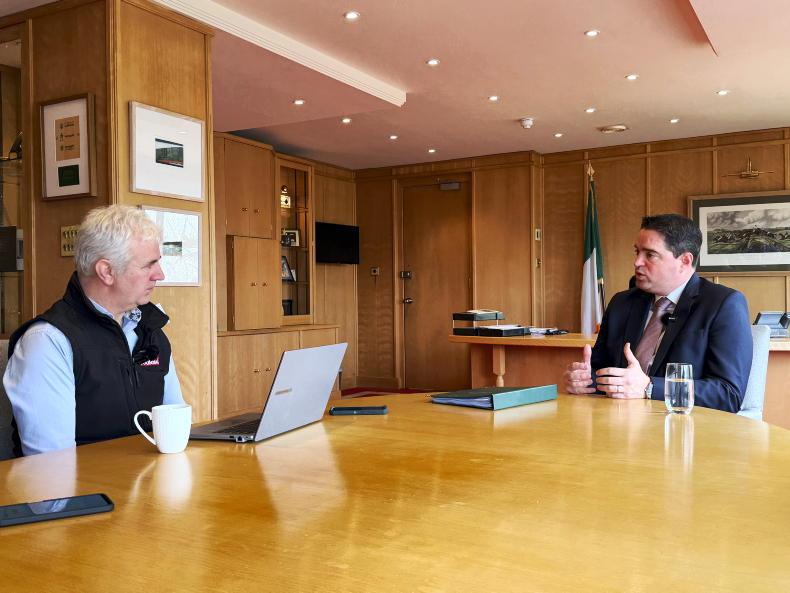
“So in all my dealings with all of the other ministers for agriculture from the other 26 member states, budget is the number one discussion as it should be, and how we how can we work with Commissioner Hansen to try and secure more, but also the access keys for the likes of the €45 billion that Ursula von der Leyen proposed additionally to front load from what was held back for the midterm money.”
The Minister said that, in simple terms, the member states have said their budgets are constrained, they can’t pay more into the overall budget for Europe.
“Yet, those same member states, particularly ones close to Russia, believe they’re in a pre-war phase.
“They’re pretty convinced Putin might invade them, and they’re all saying Europe has to spend more on defence.
“If the cake doesn’t get bigger, then other areas contract. That’s why I frame everything I’m talking about in agriculture in terms of food security.”
“My view, personally, is that Europe has been complacent about food security for some time.
“We’ve seen that in successive CAPs; that’s why we need to put more money into CAP.”
He said Ireland needs to protect the commonality of the CAP, so countries aren’t undermining each other.
“But we also need subsidiarity, which is the ability of member states to have the flexibility to design the schemes that best suits them. It’s not just about the money, it’s about the restrictions that are put on the money we get.”
As Ireland is now a net contributor to the EU budget, doesn’t the simple maths now say that it would cost more to put money into the central EU budget for CAP than to support Irish farming directly through the Irish Exchequer?
“In simple maths, yes. But in overall terms, Ireland won’t make that decision on its own. I do think we need to reflect that we’re managing our economy well here.
“We’re talking about less of a surplus this year due to world events, but we’re still talking about a surplus. Those countries in eastern Europe spending more on defence don’t have a surplus; they’re cutting spending on things like education and health to fund that.
“So the chances of the budget allocation increasing from each member state is quite unlikely. There’s a trap here we have to be careful not to fall into. The opposition are already asking “what’s the government going to do to top up CAP”.
“Yes, a day will come where I will need really sharp elbows, and I’ll be fighting with other Cabinet colleagues for the national pot to top up on the agriculture side. But right now, it’s about getting the most out of Europe and not to get into that space.
“But it is important for everyone to bear in mind, the time will come where there’ll be a national discussion around how this is all divided.
“Agriculture’s standing in the country with the general public will matter. We need to protect that.
“We don’t need people thinking the farming doesn’t need that level of support.
“I’m always acutely aware we all across the sector, have to continue to explain to the general public the work that our farmers do and the importance of agriculture to our economy.
“If any of us ever think what the general public think of us doesn’t matter, it will really matter when I’m having those debates.”
Are you speaking of the social licence farming has, and do you think recent events have affected that?
“I’m not going to say that. It’s been a very tough start to the year, a hard four months, and agriculture has dominated.
“I’d say I’m a more relevant Minister for Agriculture in Government than there has been for a while, because of disputes and conflict.
“I’m not talking about any one issue in particular. I’m just saying in general, we’re insular.
“Every sector tells themselves they’re really important, and we are because people need our food, and we’re a key driver of the rural economy.
“We have a good standing with the general public in the national debate around where our country is at, and where we are going.
“We shouldn’t take that for granted, and we want to be careful we don’t damage that.”



SHARING OPTIONS