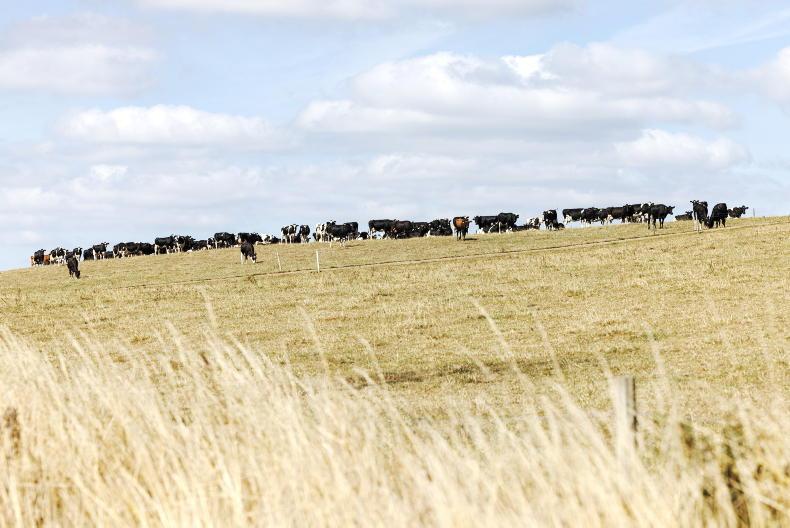
Dairy farmers across the south and southeast are facing mounting feed bills and rapidly diminishing winter fodder reserves as weeks of drought conditions leave grass growth at a standstill.
Farmers speaking to the Irish Farmer’s Journal this week reported daily additional costs running into hundreds of euro, with some herds already on full winter diets and concerns now turning to winter fodder supplies.
Bill O’Keefe, IFA farm business chair and Kilkenny dairy farmer
“Grass growth is non-existent. We got 8mm of rain last weekend, but it has had no effect. We’ve been feeding silage and concentrates, basically a winter diet, since 4 July.
“It’s costing about €1,000 a day to feed the cows, around €800 a day more than we would normally be spending.
“We’ve culled 10% of the herd and we’ll be selling in-calf heifers later this month. We’re working on securing hay and silage for the spring. The best thing farmers can do now is plan their feed requirements right through to March next year.”
Ashleigh Fennell, Carlow dairy farmer
“Grass growth has been non-existent here since the first week of July. We’ve been buffer feeding since 7 July and at the moment it is costing us an extra €500 a day to feed 100 cows.
“Milk is slipping back and we’re eating into our winter reserves. We’re heading towards a 100mm soil moisture deficit in this area and there is simply no green grass to be got.
“We need so much rain now that we’re running out of time to salvage anything. Some of the grass isn’t going to come back.
“It’s a winter workload at this stage. I can’t see cows being back out full time until next spring.”
Thomas Meade, IFA Laois dairy chair
“As of tomorrow, the cows will be on a full winter feed. We’ve had zero grazing going for five weeks and that finishes tomorrow.
“All replacement heifers and dry stock are housed and we’re buffer feeding all the milking cows.
“It’s costing about €1,200 a day to feed 150 cows. We’ve already eaten half of our second cut, so essentially six weeks of winter feeding is gone. Even when the rain comes, we’re talking about 20 to 30 days of growth before there is enough grass to stop feeding. September is the earliest I can see grass being back.”
MJ Scallan, IFA Wexford dairy chair
“We’ve had 13mm of rain in the last 40 days and no substantial rain since 30 June. The drought came in within a matter of days.
“We’ve been buffer feeding for three weeks and on a full winter ration for the last 10 days. The bales are running out now, so we’re moving into pit silage and eating into winter fodder.
“We need the co-ops and farm organisations to get a handle on where the country is with fodder.
“We need an audit of where we are because farmers have also cut back on fertiliser applications due to the cost.”
Robert Tobin, IFA Wicklow dairy chair
“It has been very dry here, with no rain in July and just 6mm so far in August.
“It’s costing us an extra €3,000 to €3,500 per week, while milk price is 10c/l lower and milk yield is nearly 10% behind last year.
“We’ll scan in the next week or so and the dry cows will be sold in the following weeks. Usually, we would keep them until Christmas. Even beef farmers are starting to feed silage now.
“Farmers from the south and southeast into the midlands are under serious pressure.”