




Emotions ran high at the meeting of around 200 dairy farmers on Wednesday night, where questions from the floor criticised Glanbia’s milk price. One farmer asked: “Why should we borrow money for the pleasure of milking cows? We would be better off putting trees on our farm at the moment.”
President of the @IFAmedia, @joehealyfarmer, opens the dairy farm income meeting in Kilkenny pic.twitter.com/9Yz4tgWYB5
— Farmers Journal (@farmersjournal) September 14, 2016
Another farmer criticised Glanbia for justifying that it was placed fifth on the 2015 KPMG milk price review as it “is skewed by the fixed milk price scheme”.
“There has been serious resistance among farmers to enter schemes taking money off the milk price in the summer and flatten the curve. That is understandable as they were offered at a time when the milk price was above the fixed milk price,” Henry Corbally responded. In his presentation to the meeting, he said that between 30% and 40% of Glanbia suppliers have got fixed milk price contracts. “We intend to initiate others at a price as best we can on the day when old contracts slip out.”
In addressing farmers’ fears over value-added product being sold through the plc and not returning as much as possible to farmers, Corbally said: “We don’t sell product through the plc at all. There is no such thing as cross subsidisation between any two parts our organisation. It is a complete fallacy to say that the plc is funded by the milk price.”
Glanbia was also criticised for increasing the August milk price just days before the deadline for farmers to express interest in the EU’s voluntary milk production reduction scheme.
Chairman of @GlanbiaAgri Henry Corbally says their strategy is "to maximise returns for all our stakeholders." pic.twitter.com/BEIeKurUsA
— Odile Evans (@OdileEvans) September 14, 2016
Scope for further price increases
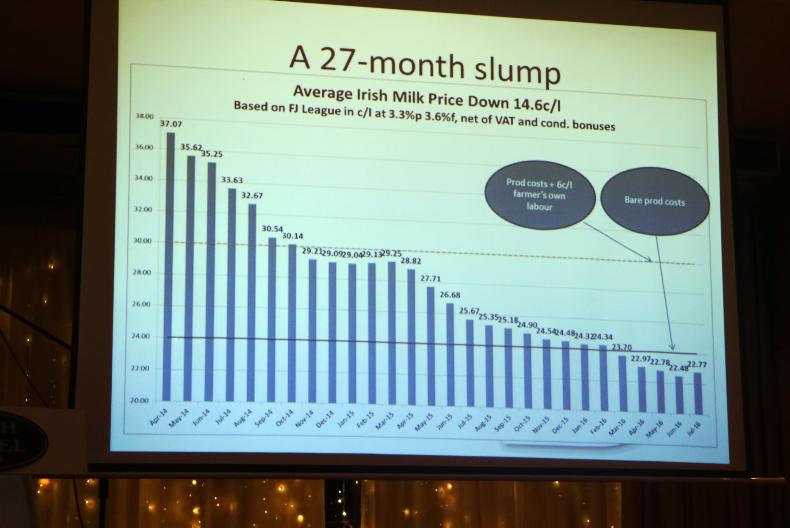
Catherine Lascurettes described the trend over the last few years as a “27-month slump” in price and this has recovered slightly in July and August. But the executive secretary of the IFA national dairy and liquid milk committees said that there is scope for further price increases.
“The reason for the slump was not because demand collapsed because it didn’t; production increased,” Lascurettes said: “Exports out of the EU have increased significantly; granted, those exports may be at a certain price.”
According to Lascurettes, there are a number of positive signals:
“EU and global production is continuing to reduce,” she said. “China is back purchasing, nothing as crazy as 2013 and 2014 but still purchasing. With supply coming back with the kind of demand growth that is there, I see no reason why the recovery is not sustainable. Obviously, the US is an expansionary producer and it will very much feature on the landscape.”
Co-ops all increase for August
EU’s €11m in aid should be used to create a financial tool for farmers – Deering





SHARING OPTIONS