I’ve just returned from a week of camping in the Central African jungle. (There’s a sentence I never thought I’d say!). The experience was both exhausting and exhilarating and I saw an Africa that very few non-natives ever get to see.
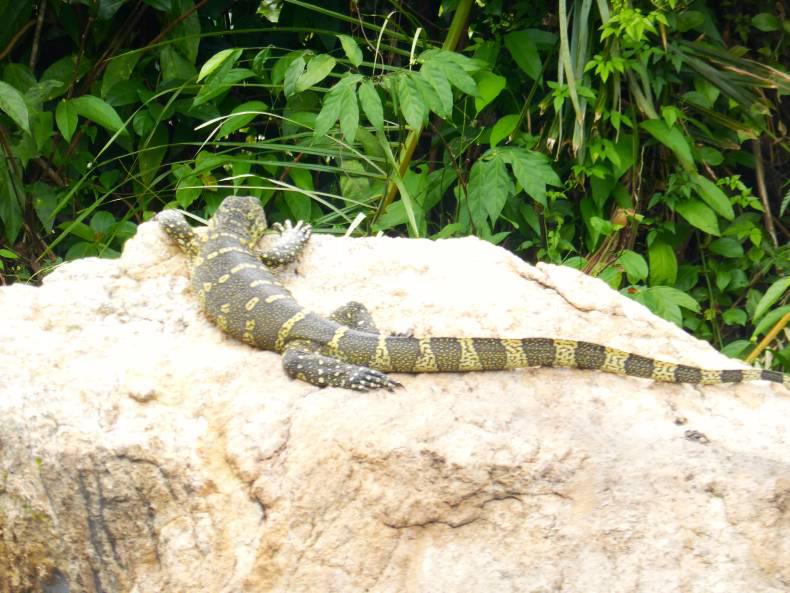
Getting to the camp, which was located deep in the rainforest, was half the battle. We travelled by pirogue - a long, hollowed out tree trunk, down the Ivindo River, through rapids with nothing but a flimsy wooden plank as a seat to hold on to. The scenery was beautiful. At one point I spotted a monitor lizard sunning himself on a rock, his yellow and black scales gleaming.
Later on that day. my ‘guide’ got us completely and utterly lost in the forest as we searched for our camp. Not only this, but he also managed to misplace his rucksack in the process. So we first had to look for his bag and then after eventually finding it, had to begin, once again, searching for the trail. After a good 4 hours of wandering about aimlessly in a sea of trees with, might add, a very heavy rucksack on my back, we eventually stumbled into our camp just before nightfall.
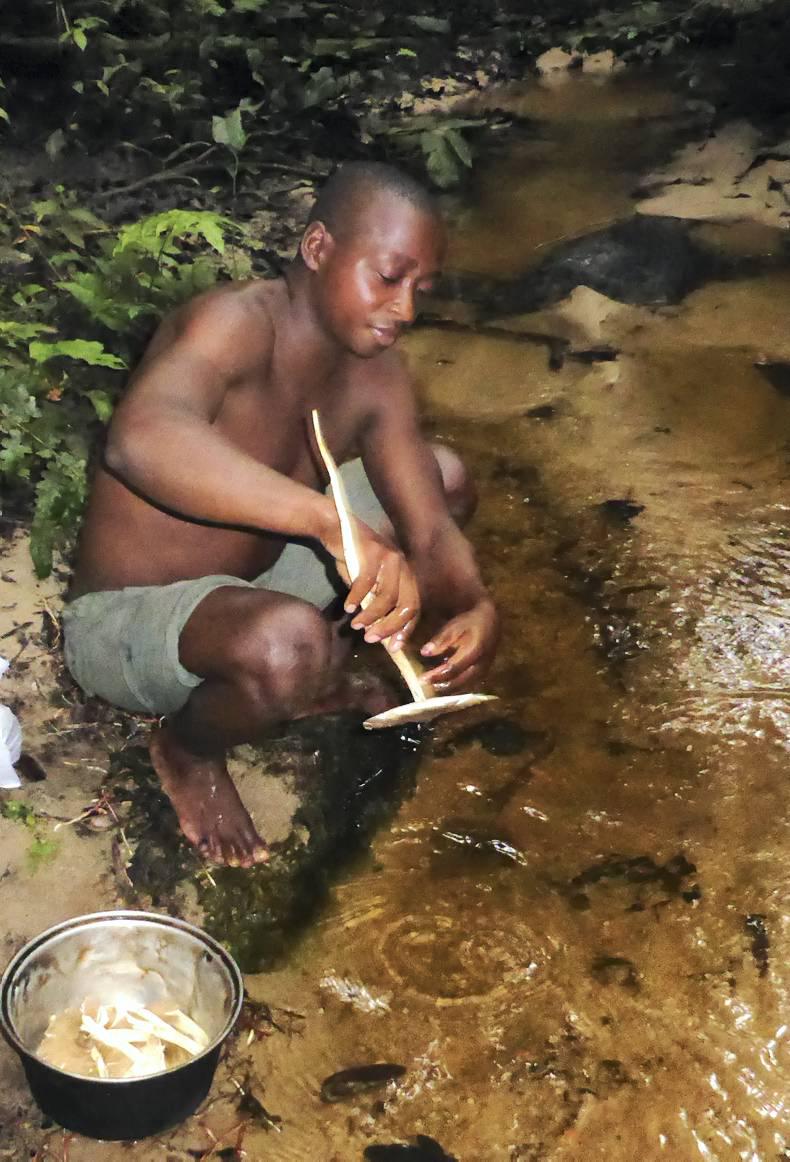
In brief, the research I was conducting involved measuring the diameters of trees to assess the effect of elephant disturbance on the vegetation of the forest. I started work shortly after 8 a.m. every morning and by 5 p.m. I was back at camp ready to relax for the evening. There, I bathed in a small stream near my tent and afterwards boiled some rice, beans and forest mushrooms on the campfire for dinner. Those, along with my daily anti-malarial pill, formed the basis of my diet. It wasn’t gourmet but it wasn’t too bad either.
Mid-week, as I was measuring the diameter of a large tree, I saw something in the jungle which gave me the fright of my life; OTHER HUMAN BEINGS. When you’re a needle in a haystack the very last thing you expect to see is another needle, never mind seven of them. But there they were, seven big, burley men clad in camouflaged uniform, striding towards me. They were Eco-Guards; Gabonese men hired by the Government to survey the National Parks and fend off poachers. I composed myself and we chatted for a while before they once again marched off into the depths of the surrounding abyss.
It was a good week for animal sightings as well. We came across a large group of Red River Hogs, a wild forest boar, as they shuffled through the undergrowth. They are peculiar looking animals with red coats, short, sharp tusks and a long, triangular face only a mother pig could love. A large male noticed us and jerked his body to attention, tensing every single muscle from his snout to his rear in one sharp movement. We stared at each other for a long moment, neither hog nor human daring to break eye contact. Eventually, he snorted at us and shuffled off, swishing his little tail behind him indignantly.
On another day we saw a Duiker - a delicate little creature belonging to the antelope family. It was tiptoeing through the leaves with such lightness of hoof that it barely seemed to touch the ground. Its neat body was covered with dark brown fur and a long brown stripe extended down its back. We watched from afar for a few precious seconds before it pranced off into the forest, silently, without moving a leaf.
Before heading back to the research station at the end of the week we decided to take a hike to Meko Bai, a large, open clearing in the jungle where tall grasses grow in the place of trees. Bais are very strange places indeed, like windows into the dense jungle. Apparently, animals such as elephants and gorillas regularly frequent these marshy anomalies and we hoped to catch a glimpse of them. So there we waited.
And waited. After a couple of hours and with no animals in sight we decided to call it day. That’s Mother Nature for you though: she’s unpredictable and doesn’t make any promises. I guess that’s exactly what makes her so intriguing and keeps people like me coming back for more.
I’ve just returned from a week of camping in the Central African jungle. (There’s a sentence I never thought I’d say!). The experience was both exhausting and exhilarating and I saw an Africa that very few non-natives ever get to see.
Getting to the camp, which was located deep in the rainforest, was half the battle. We travelled by pirogue - a long, hollowed out tree trunk, down the Ivindo River, through rapids with nothing but a flimsy wooden plank as a seat to hold on to. The scenery was beautiful. At one point I spotted a monitor lizard sunning himself on a rock, his yellow and black scales gleaming.
Later on that day. my ‘guide’ got us completely and utterly lost in the forest as we searched for our camp. Not only this, but he also managed to misplace his rucksack in the process. So we first had to look for his bag and then after eventually finding it, had to begin, once again, searching for the trail. After a good 4 hours of wandering about aimlessly in a sea of trees with, might add, a very heavy rucksack on my back, we eventually stumbled into our camp just before nightfall.
In brief, the research I was conducting involved measuring the diameters of trees to assess the effect of elephant disturbance on the vegetation of the forest. I started work shortly after 8 a.m. every morning and by 5 p.m. I was back at camp ready to relax for the evening. There, I bathed in a small stream near my tent and afterwards boiled some rice, beans and forest mushrooms on the campfire for dinner. Those, along with my daily anti-malarial pill, formed the basis of my diet. It wasn’t gourmet but it wasn’t too bad either.
Mid-week, as I was measuring the diameter of a large tree, I saw something in the jungle which gave me the fright of my life; OTHER HUMAN BEINGS. When you’re a needle in a haystack the very last thing you expect to see is another needle, never mind seven of them. But there they were, seven big, burley men clad in camouflaged uniform, striding towards me. They were Eco-Guards; Gabonese men hired by the Government to survey the National Parks and fend off poachers. I composed myself and we chatted for a while before they once again marched off into the depths of the surrounding abyss.
It was a good week for animal sightings as well. We came across a large group of Red River Hogs, a wild forest boar, as they shuffled through the undergrowth. They are peculiar looking animals with red coats, short, sharp tusks and a long, triangular face only a mother pig could love. A large male noticed us and jerked his body to attention, tensing every single muscle from his snout to his rear in one sharp movement. We stared at each other for a long moment, neither hog nor human daring to break eye contact. Eventually, he snorted at us and shuffled off, swishing his little tail behind him indignantly.
On another day we saw a Duiker - a delicate little creature belonging to the antelope family. It was tiptoeing through the leaves with such lightness of hoof that it barely seemed to touch the ground. Its neat body was covered with dark brown fur and a long brown stripe extended down its back. We watched from afar for a few precious seconds before it pranced off into the forest, silently, without moving a leaf.
Before heading back to the research station at the end of the week we decided to take a hike to Meko Bai, a large, open clearing in the jungle where tall grasses grow in the place of trees. Bais are very strange places indeed, like windows into the dense jungle. Apparently, animals such as elephants and gorillas regularly frequent these marshy anomalies and we hoped to catch a glimpse of them. So there we waited.
And waited. After a couple of hours and with no animals in sight we decided to call it day. That’s Mother Nature for you though: she’s unpredictable and doesn’t make any promises. I guess that’s exactly what makes her so intriguing and keeps people like me coming back for more.





SHARING OPTIONS