


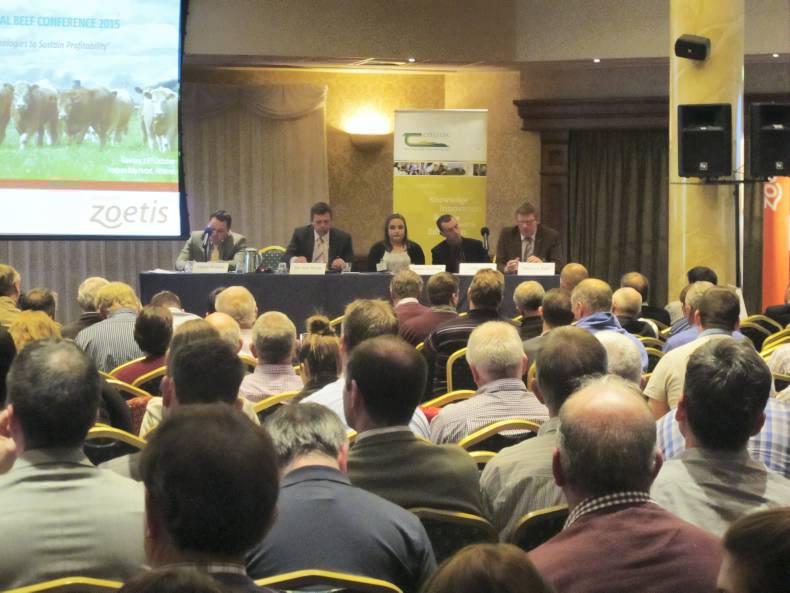
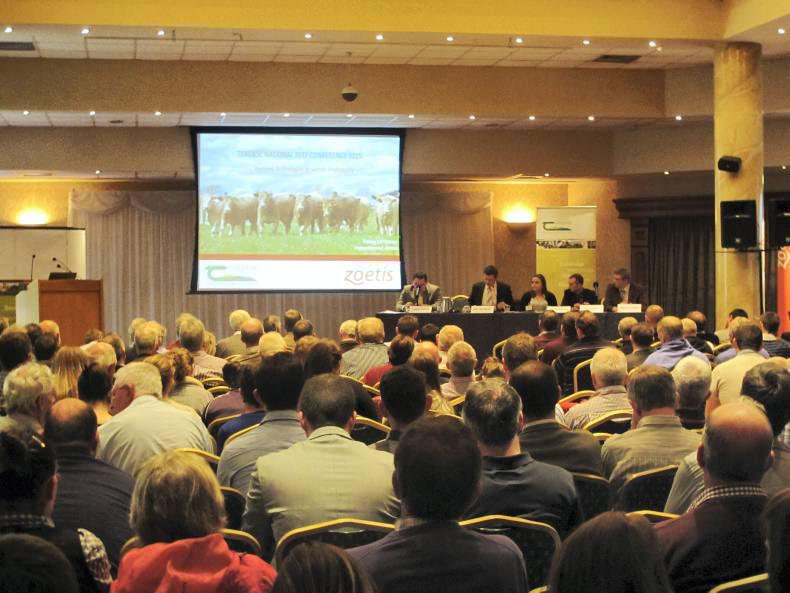
The first half of the day, chaired by Ger Ryan, Dovea Genetics, focused on the use of artificial insemination (AI) in the suckler herd, synchronisation, the replacement index and the demonstration herds in Grange and Athenry.
Delivering more
Noirin McHugh, Teagasc, Grange, presented details of the replacement index, its background and an assessment of its success. She said the ideal suckler cow should be fertile, have a good milk yield, be easy to manage, docile, easy calved, healthy, have a good survivability and be robust.
She said that the current replacement index is broken down 71% on cow traits, with the remaining 29% on calf and progeny traits. She showed data taken from 34 farms where they were comparing the genetic index of the cow with her own performance and the performance of her progeny.
She said that when the 1-star and 5-star cows are compared, the 5-star cows are calving for the first time 66 days earlier than a 1-star cow. In addition, weaning weight of calves is 30kg/head higher for 5-star cows and cow weight is 26kg lower.
In addition, 5-star cows are lasting longer, are easier calved and have lower levels of calf mortality. Noirin said that when all factors are combined, a 5-star cow will deliver €172 per lactation more than a one star cow.
AI in suckler herds
Mervyn Parr introduced the topic of AI, saying that just 23% of beef animals are born to AI each year. He detailed the key points of AI, stressing how to optimise its effectiveness along with how to reduce the labour input.
He said that results from a countrywide trial encompassing 2,200 cows had conception rates from 30% to 75% at herd level, with the average at 50-55% conception rates to first service. He added that where this was the case, re-insemination for the second service resulted in normal conception rates of 65% to 75%.
He advised farmers who are considering synchronisation programmes to have cows in a BCS of 2.5-3 at the time of treatment and that cows are a minimum of 35 days calved at the start of the treatment. He emphasised the need for cows to be on a good plane of nutrition before, during and after synchronisation.
Along with this, good levels of semen fertility and competence by the inseminator are required to optimise performance. Conception rates are 10-15% lower with sexed semen than what can be achieved through the use of conventional semen. As with all sexed semen, it is more suited to heifers.
AI and synchronisation
Artie Birt, a farmer based in Newtownards, Co Down, detailed how a synchronisation programme is working on his farm.
He runs a herd of 180 spring-calving suckler cows with a calving interval of 375 days. Cow type on the farm is a split between Simmental and Limousin crosses. As part of the programme, 81 and 68 cows were subjected to the trial over two years.
Over 2014 and 2015, he said that they had 55 cows and 49 cows pregnant to first service. This equates to conception rates of 68% to 72%. He said that cows are scanned prior to synchronisation and again 35 days after the end of breeding.
At the start, he thought that the pre-breeding scanning was an expensive luxury but now sees the value in it as it picks up cows which need veterinary attention. Normally these may be lost as culls through infertility. This has helped him condense his calving pattern further, while reducing the demand for stock bulls on the farm.
With the higher use of AI and synchronisation, he now runs two stock bulls as opposed to the seven which used to be carried.
He said that one of his main fears at the start was a high level of cows coming due for calving on the same date. In one year, he had 55 due to calve on March 15. Of this group, calving took place over a 24-day period and at peak, seven calved on any one day.
In terms of repeats, he said that the cows were kept in paddocks close to the yard for the first insemination. He found that repeats were coming back again in 17 to 24 days and it somewhat matched the grass rotation.
He emphasised the importance of heat detection in the system, saying that they use chalk on the tails and bring the cows into the yard daily to inseminate those in heat, and re-apply the chalk on the tail heads. He said it is a simple and cost-effective heat detection aid, costing approximately one pound per cow over the season.




SHARING OPTIONS