


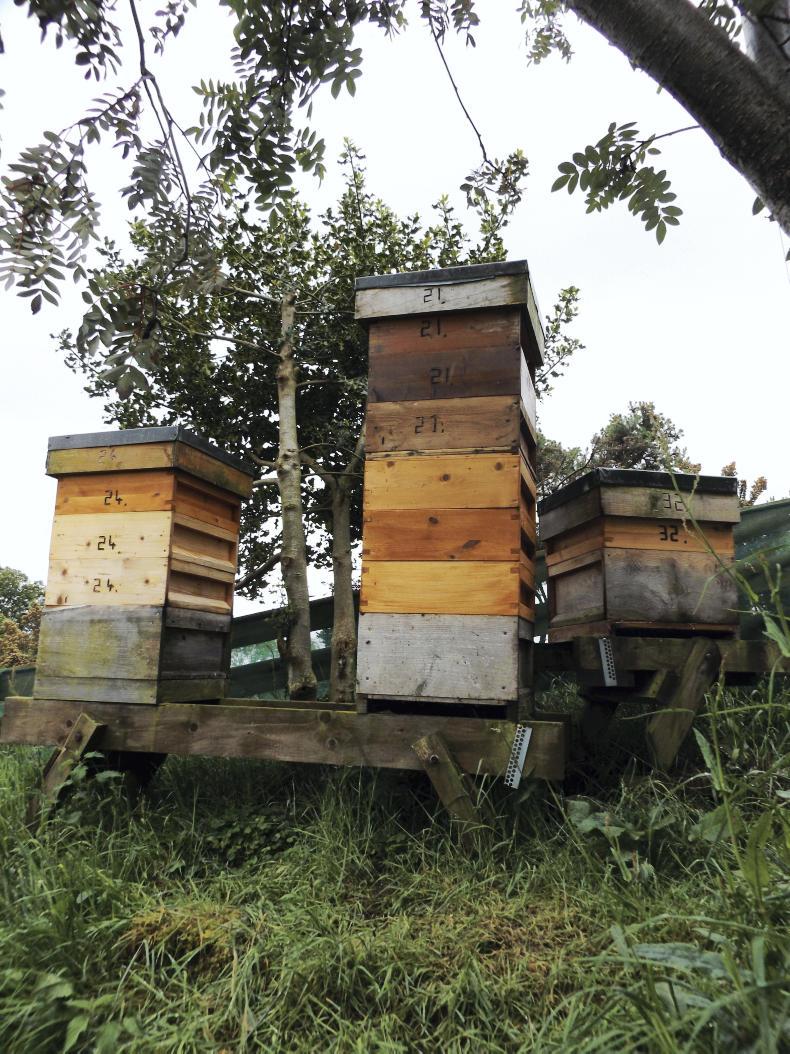
Over a number of years, once the first week of May arrived when the sycamore came into bloom, the weather turned wet and windy, depriving the honeybee of a bountiful nectar supply. This year, beekeepers were happy with the summer weather during the early sycamore nectar flow and the hawthorn flow which followed. While the good spell only gave us two weeks, it nonetheless gave the bees a chance to take in a considerable amount of nectar.
The sycamore is a wonderful supplier of nectar. The sheer volume of flowers in one place makes for real energy saving to the bees. The hawthorn was magnificent in its blooms this year and did yield nectar during those summer days in early May. Despite its beauty during flowering, it does not always yield nectar, as noted by beekeepers. Bees filled two and three supers (honey collection boxes) with honey during the nectar flow.
As with any creature, there is always one which excels and is an exception to the rule. I had a couple of these this year, with one hive in the home apiary producing six supers, and we still have the blackberry and clover to come in.
Since this is the time of the year where we beekeepers are doing swarm controls, such a hive is a headache to handle – are we ever happy?
All supers must come off the hive so that the brood chamber can be accessed. With25 to 30 pounds of honey in each, lifting them off in two lots of three is heavy work. Putting them back on after is worse, as one is lifting above one’s height.
Once the brood chamber is accessed, the job of going through each brood frame for signs of queen cells must be done. As each frame is withdrawn, it is as well to remove the queen as soon as she is seen, so that she may be kept out of harm’s way. A queen catcher clip is ideal for this and once in it, the clip can rest on the top of the brood frames while the inspection proceeds.
It is very often the case that all one will find are “play cups”. These could be the beginning of a queen cell. Experienced beekeepers will watch these and note if the base of the play cell is dull or polished. If they are polished, it means that they are prepared for the queen to lay an egg in them.
Finding an egg in a play cup does not mean it will develop into a queen cell, but beware: it is possible. I tend to tear them down and make a note in the log book so that at the next visit I will be watching for possible queen cells. Queen cells with a larva which has been fed with royal jelly (food) is a guarantee that swarming is now on the cards. The time for action is now, so the beekeeper must create an artificial swarm or remove the queen. Failure to do so will see a swarm leave the hive, and so the bees required to produce honey are gone.
If removing the queen is the chosen option, the subsequent queen cells may be left develop for harvesting, ensuring that the hive has one left for itself. These cells may not all be good quality, so one needs to get to know what should be kept. There is a bit to be known about this, but it is too technical and time-consuming for this article. Queens removed during swarm control may be used to good value. Nuclei may be made with them. Nuclei supply beginners with bees as well as being useful for replacing winter losses. Any nuclei made up will need feeding with syrup for a week or so to give them a start.
Now, I must get out to the apiaries to continue my swarm control. CL


SHARING OPTIONS