


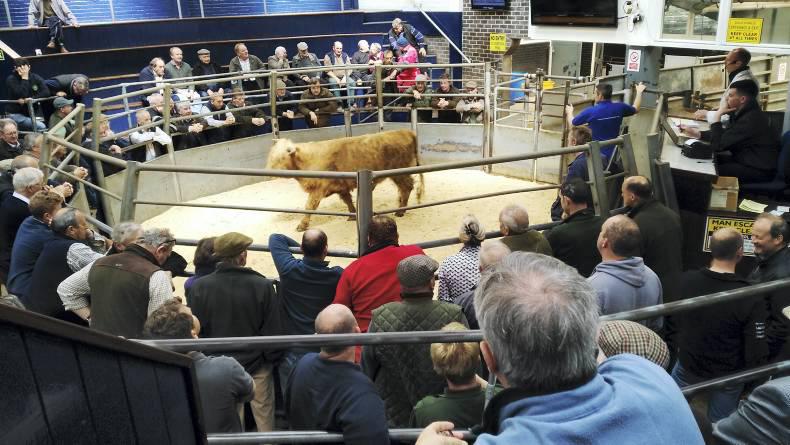
Trade was strong at Borderway mart, Carlisle, Cumbria, at the Wednesday 18 May sale. The calf ring saw black and whites in great demand, with 127 calves averaging £83.46 (€107.78).
Judging of the pedigree dairy cows took place in the morning and, after the sale, the cows were milked before being loaded for transport. Trade topped at 1,700gns (€1,785) to average £1,264 (€1,632) for a 100% clearance of the heifers and cows in milk. While many farmers would chat about the upcoming EU referendum, few would go on the record.
Farmers are a key demographic in the referendum, with about 2% of the national vote. Like Ireland, they directly receive money from Pillar I of the Common Agricultural Policy (CAP) through the Basic Payment Scheme.
Borderway mart is just over 10 miles from the Scottish border which, in the context of the Scottish referendum on membership of the UK, makes it a europhile area (in favour of participation in the EU).
Most farmers at the sale were leaning towards the argument for staying in the EU, which could be perceived as the less popular side, hence the apprehension to talk to the Irish Farmers Journal. One of the mart directors said they wouldn’t publicly say which way they would vote because Borderway mart, like most businesses, is not taking a stance.
A large number of people maintained they were undecided, with one man asking: “Are the British public qualified to vote?” There is definitely a lack of information for voters aside from public political debates. However, farmers say the debates are rarely grounded in facts and the MPs are more worried about their own careers and internal party politics than the situation the UK has found itself in. One cattle dealer said he believed the UK is better to stay within the EU because it returns a good deal to the English agricultural sector. While the UK is one of the largest contributors to the EU in monetary terms, British farmers get paid through the CAP just like everyone else. The dealer said that, outside of Europe, British farmers would not receive half as much in direct payments because such a small percentage of the voting population is employed by agriculture.
He was surprised to hear so many farmers he meets saying they wanted to leave the EU. They have told him there would be less red tape to deal with if the UK didn’t have to answer to Europe. However, he believes that regardless of whether they are in or out, they will still have the same level of paperwork because it maintains civil service jobs.
Perhaps of more immediate concern to the farmers is milk price. The mainly high-input system used in the UK, coupled with prolonged low prices, has meant farmers have switched suppliers, changed contracts and unfortunately dispersal sales are becoming all too common. One farmer at the mart with his daughter, who will take over the farm, said that for her future and the future of dairy the UK should stay in the EU.
Milk prices range from 14p/l (18c/l) to 19p/l (25c/l) and some even higher depending on the contract they are on. This particular farmer wanted to stay within the EU to continue providing markets for their produce.
Survey
The National Farmers Union, which has a membership base of 47,000, conducted a random telephone survey of 658 members in October and November on Brexit. Just over half, 52%, said they would vote to stay in the EU while 22% were undecided. Many who were undecided were waiting for more information before making a decision. With a total export value of €26bn and an import value of €57bn, the UK is a net importer of agricultural products, according to a Wageningen report commissioned by the NFU. The EU27 (EU28-UK) is the UK’s major trading partner: agricultural exports to the rest of the Union amounted to €16bn and imports were at €40bn in 2014. The UK’s exports to other EU member states accounted, in recent years, for 60-65% of total agricultural exports, and around 70% of the UK’s imports originates from other EU countries.
In: Eric Hetherington
Former dairy farmer Eric Hetherington from Cumbria has decided to vote to stay within the EU. Following a farm accident, he went in to beef and now trades store cattle. “We stay where we’re at, there is no future in us leaving,” he said on the referendum.
“Alright, I am of an age where my future doesn’t really matter that much, but it’s the young ones that need to be convinced they’ve got to stay with it.”
He believes the UK and the farming sector gets a good deal out of being involved in the EU. “If we leave we can forget about the Single Farm Payment and a big lot of farms rely on that. There is all kind of things that are connecting with Europe that we get a benefit from.”
There is a perception among some people that the UK does not have a fair say in decision-making in Europe given the amount of money it contributes to the budget.
But Hetherington says: “We can’t have things all our own way – life isn’t that way.”
He agrees to the principle of helping the new countries joining the EU, but suggested there should be a different level for them to join to help decision-making.
“We went in it when we were a small European country. We’ve had help over the years,” said Hetherington.
“I’m a strong believer that it [the EU] is too large; far too large. There was room there, when they started taking in other countries three or four years ago, to have started something new.
“There was the EU and there could have been, for these countries, another group at a different level.”
The lack of importance placed on the farming sector by the British government is a worry for farmers. “The MPs don’t want farmers, people don’t want farming. Every now and then we’ve got to give them [the politicians] a poke to let them know we are important.”
He believes the government would “walk away from British farming” if the UK decides to leave Europe.



SHARING OPTIONS