


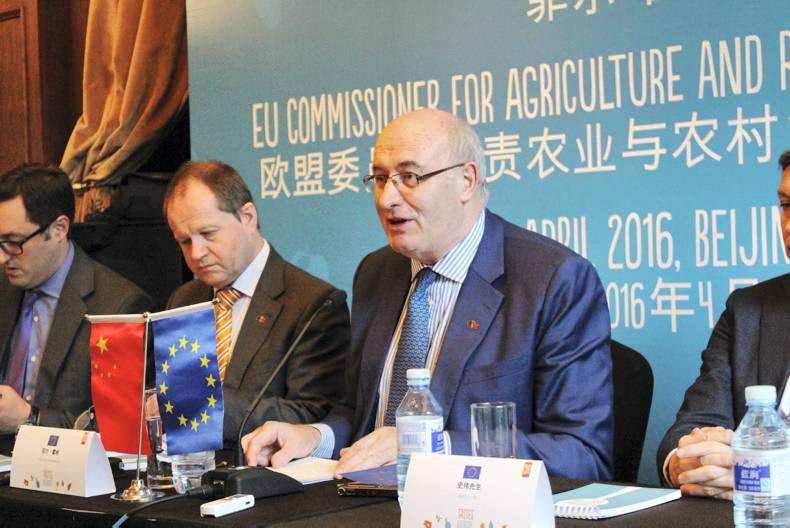
EU agriculture commissioner Phil Hogan has successfully persuaded Hong Kong to drop its single country of origin rule on imports from the EU. Basically this means an animal born in the Republic of Ireland and slaughtered in the north couldn't be sent to Hong Kong because it was no longer one member state origin.
That will now change to an EU designation (for the moment).
This is in itself of minor interest to Ireland because their age requirement of 30 months means that imports to the Republic from Northern Ireland which are predominantly cows, are not eligible anyway.
This business has been killed off by the double whammy of neither the UK market nor factories not wanting mixed origin beef and the collapse in the value of sterling
There could be benefit going the other way for store cattle to northern finishers, but this business has been killed off by the double whammy of neither the UK market nor factories not wanting mixed origin beef and the collapse in the value of sterling.
The minuscule amount of the carcase that would be exported to Hong Kong wouldn’t begin to compensate for the inability to get the prime cuts into UK retail or top end food service markets because of current EU beef labelling regulations.
Template
The success of Hogan in Hong Kong could, however, be used as a template within the EU to address this anti-competitive element of beef labelling.
Currency will change again but labelling rules will keep Northern Ireland and Britain effectively closed to Irish store or finished cattle for direct slaughter because once they leave the Republic of Ireland, they become known as nomads.
Penalties on non-UK origin cattle are a fact of life in Northern Ireland and totally draconian in Britain
In 2010, a year when the exchange rate varied between 82-90p to the euro, 95,331 cattle went north either as stores for finishing or direct slaughter.
In 2015, when the exchange rate was between 70-76p to the euro 56,429 cattle went north and this year so far just 19,800 cattle have gone north - less than half that went in the same period last year.
Penalties on non-UK origin cattle are a fact of life in Northern Ireland and totally draconian in Britain, effectively closing this trade unless Irish stores are at rock bottom prices.
An option for cattle with multi origin identity
Where the Hong Kong agreement could provide a solution lies in the creation of an option for cattle that have multi origin identity within the EU. If ‘born in’, ‘reared in’ and ‘slaughtered’ in was replaced by either the origin of the country where the animal never moved outside, or the option of ‘origin EU’ where one or more than one country was involved, it would remove the nomad element and create just two categories of beef.
If the ‘EU origin’ option was available it would allow a processor to put Irish and Northern Irish beef together under an ‘EU origin’ label
This would remove one of the barriers to trade in the UK supermarkets that are prepared to take Irish beef. They will run two categories no problem, UK origin and Irish origin, but understandably, won’t carry a third “mixed origin.”
If the ‘EU origin’ option was available it would allow a processor to put Irish and Northern Irish beef together under an ‘EU origin’ label.
This doesn’t prevent the UK or Ireland having its “national” range to offer consumers that want to buy local, but having the option to opt for EU would remove a bureaucratic element of labelling that wasn’t intended when the concept was devised at the beginning of this century as a response to BSE – a disease which is now thankfully history. It is time to revisit labelling just as it is time to revisit BSE risk category classification to reflect the fact that it has passed.
Listen: access for sheepmeat to Morocco on agenda as mission moves to Algeria




SHARING OPTIONS