Minister Michael Creed has announced changes to the bovine viral diarrhoea (BVD) eradication programme for 2017, which he believes will help fast-track and achieve higher removal of persistently infected (PI) calves off farms.
Minister Creed paid tribute to the programme: “The progress to date in the eradication effort, which has seen the incidence of PIs fall by 75% since 2013, has resulted in very substantial savings to farmers, currently estimated at €66m per year, and these savings will increase further in the years ahead, as the incidence of the disease continues to decline.”
The current scheme was introduced in 2012 on a voluntary basis, becoming compulsory the following year.
Payments
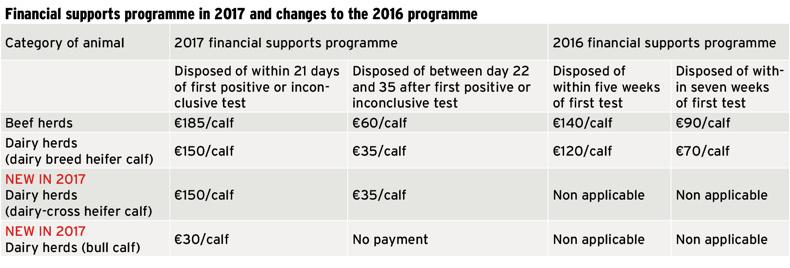
Payments for the early disposal of PI animals are increased for all categories of animals, with dairy-cross heifer calves and dairy bull calves included for the first time. However, the window has been shortened from 35 to 21 days. Payments outside that initial phase have been cut. A five-week cut-off deadline for all payments now applies, with restrictions for herds with PI animals commencing at that stage.
The payment for beef calves has increased from €140 to €185 while the payment for dairy heifer calves has increased from €120/calf to €150/calf. It is also proposed to introduce a €30 payment for Friesian bull calves disposed off from farms within 21 days.
There is a further encouragement for early disposal with the second window to remove calves tightened from seven weeks to between 22 days and 35 days from the first positive or inconclusive test. The payment rate for beef calves in the second window has reduced from €90 to €60 while dairy heifer calves have reduced from €70 to €35 with crosses also added into this category. There is no second payment window for Friesian bull calves.
Retesting
On the recommendation of the BVD implementation group, confirmatory blood testing, where a farmer wishes to avail of it, is also replacing repeat tissue sampling.
Additional funding will allow a private veterinarian to visit the farm and collect a blood sample from the dam and calf, which will eliminate the chance of a PI animal slipping through the net.
Furthermore, a vet will conduct a mandatory farm herd investigation once a PI animal is unveiled.
Minister Creed said: "The progress to-date in the eradication effort, which has seen the incidence of PIs fall by 75% since 2013, has resulted in very substantial savings to farmers, currently estimated at €66m per year, and these savings will increase further in the years ahead as the incidence of the disease continues to decline. Whilst recognising the very significant progress made over the past four years, I believe the increased level of support for the early removal of PI calves will give a further major impetus to reducing incidence of the disease and final eradication in the foreseeable future. The inclusion of dairy crosses and dairy bulls for the first time in the support arrangements will further assist this process.”
Reaction
While welcoming the increase in financial supports now being provided by the Minister for farmers in the BVD eradication programme, IFA Animal Health chairman Bert Stewart said it is disappointing the Minister and his department did not see fit to support farmers from the outset of the programme at these levels.
"Farmers who supported the programme from the start and took the enormous financial hit in disposing of their calves for little or no compensation feel rightly aggrieved at the decision not to retrospectively provide similar levels of support payment to them" he said.
"It will not go unnoticed with farmers that the Minister and his Department have taken the easy and cheaper option of only increasing payments when the numbers of PI’s being identified have reduced to very low levels having left individual farmers carry an enormous cost burden in the earlier stages of the programme. The Minister, his Department and AHI cannot turn their backs on the farmers who have incurred these losses."
In relation to the shorter window provided to claim the higher levels of compensation, Bert Stewart said the retest facility has been a critical component of the programme to reduce the losses for farmers and effectively ruling out this option in order to avail of the higher levels of payment is a fundamental change, with over 10% of retested animals testing negative. "Automatic restriction of herds must be balanced with immediate de-restriction when the PI animals are disposed of and the Ministers decision to pay vets to carry out the retest, which was cost effectively and accurately completed by farmers in the programme up until now, must provide testing in a timely manner to avoid any unnecessary disruption to trade" he said. BVD eradication is costing farmers up to €9m annually and the benefits will only start to accrue when the this enormous cost is removed, he said IFA have sought direct support for all farmers towards this cost and it is very disappointing the Minister did not see fit to recognise this farmer investment in a meaningful way".

Read more
Full coverage: BVD
Minister Michael Creed has announced changes to the bovine viral diarrhoea (BVD) eradication programme for 2017, which he believes will help fast-track and achieve higher removal of persistently infected (PI) calves off farms.
Minister Creed paid tribute to the programme: “The progress to date in the eradication effort, which has seen the incidence of PIs fall by 75% since 2013, has resulted in very substantial savings to farmers, currently estimated at €66m per year, and these savings will increase further in the years ahead, as the incidence of the disease continues to decline.”
The current scheme was introduced in 2012 on a voluntary basis, becoming compulsory the following year.
Payments
Payments for the early disposal of PI animals are increased for all categories of animals, with dairy-cross heifer calves and dairy bull calves included for the first time. However, the window has been shortened from 35 to 21 days. Payments outside that initial phase have been cut. A five-week cut-off deadline for all payments now applies, with restrictions for herds with PI animals commencing at that stage.
The payment for beef calves has increased from €140 to €185 while the payment for dairy heifer calves has increased from €120/calf to €150/calf. It is also proposed to introduce a €30 payment for Friesian bull calves disposed off from farms within 21 days.
There is a further encouragement for early disposal with the second window to remove calves tightened from seven weeks to between 22 days and 35 days from the first positive or inconclusive test. The payment rate for beef calves in the second window has reduced from €90 to €60 while dairy heifer calves have reduced from €70 to €35 with crosses also added into this category. There is no second payment window for Friesian bull calves.
Retesting
On the recommendation of the BVD implementation group, confirmatory blood testing, where a farmer wishes to avail of it, is also replacing repeat tissue sampling.
Additional funding will allow a private veterinarian to visit the farm and collect a blood sample from the dam and calf, which will eliminate the chance of a PI animal slipping through the net.
Furthermore, a vet will conduct a mandatory farm herd investigation once a PI animal is unveiled.
Minister Creed said: "The progress to-date in the eradication effort, which has seen the incidence of PIs fall by 75% since 2013, has resulted in very substantial savings to farmers, currently estimated at €66m per year, and these savings will increase further in the years ahead as the incidence of the disease continues to decline. Whilst recognising the very significant progress made over the past four years, I believe the increased level of support for the early removal of PI calves will give a further major impetus to reducing incidence of the disease and final eradication in the foreseeable future. The inclusion of dairy crosses and dairy bulls for the first time in the support arrangements will further assist this process.”
Reaction
While welcoming the increase in financial supports now being provided by the Minister for farmers in the BVD eradication programme, IFA Animal Health chairman Bert Stewart said it is disappointing the Minister and his department did not see fit to support farmers from the outset of the programme at these levels.
"Farmers who supported the programme from the start and took the enormous financial hit in disposing of their calves for little or no compensation feel rightly aggrieved at the decision not to retrospectively provide similar levels of support payment to them" he said.
"It will not go unnoticed with farmers that the Minister and his Department have taken the easy and cheaper option of only increasing payments when the numbers of PI’s being identified have reduced to very low levels having left individual farmers carry an enormous cost burden in the earlier stages of the programme. The Minister, his Department and AHI cannot turn their backs on the farmers who have incurred these losses."
In relation to the shorter window provided to claim the higher levels of compensation, Bert Stewart said the retest facility has been a critical component of the programme to reduce the losses for farmers and effectively ruling out this option in order to avail of the higher levels of payment is a fundamental change, with over 10% of retested animals testing negative. "Automatic restriction of herds must be balanced with immediate de-restriction when the PI animals are disposed of and the Ministers decision to pay vets to carry out the retest, which was cost effectively and accurately completed by farmers in the programme up until now, must provide testing in a timely manner to avoid any unnecessary disruption to trade" he said. BVD eradication is costing farmers up to €9m annually and the benefits will only start to accrue when the this enormous cost is removed, he said IFA have sought direct support for all farmers towards this cost and it is very disappointing the Minister did not see fit to recognise this farmer investment in a meaningful way".
Read more
Full coverage: BVD





SHARING OPTIONS