


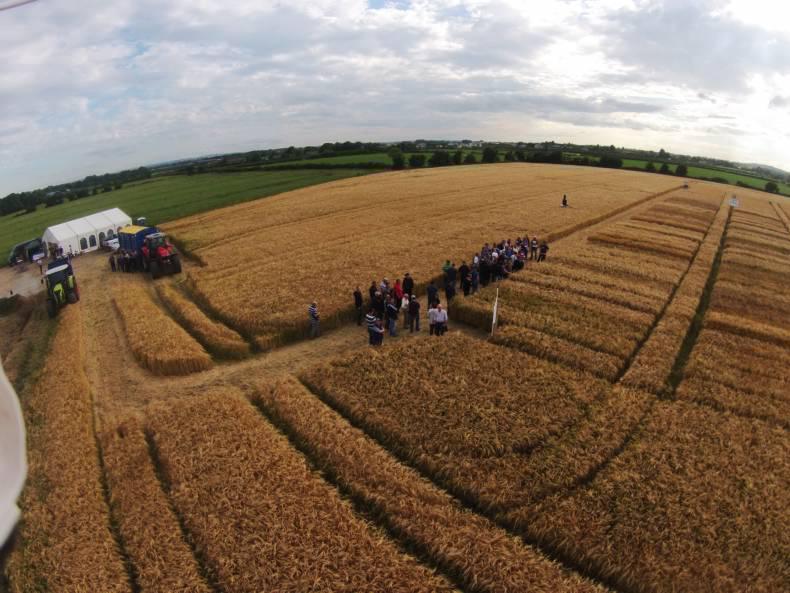
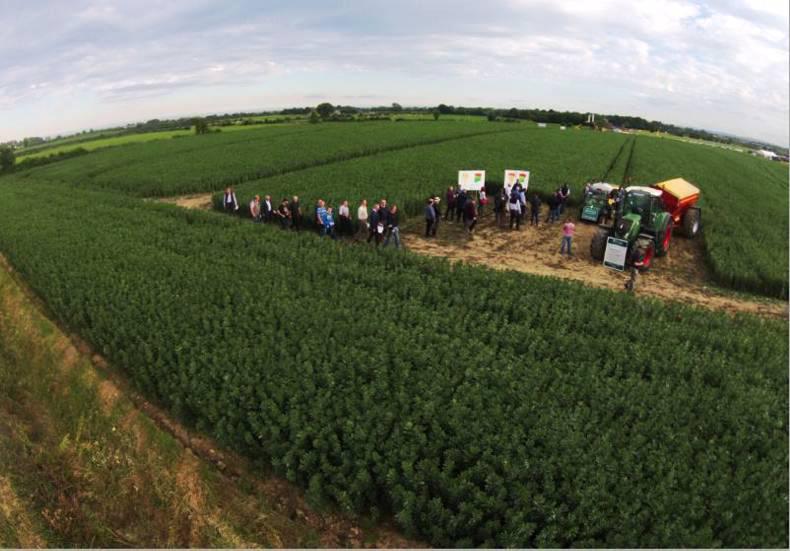
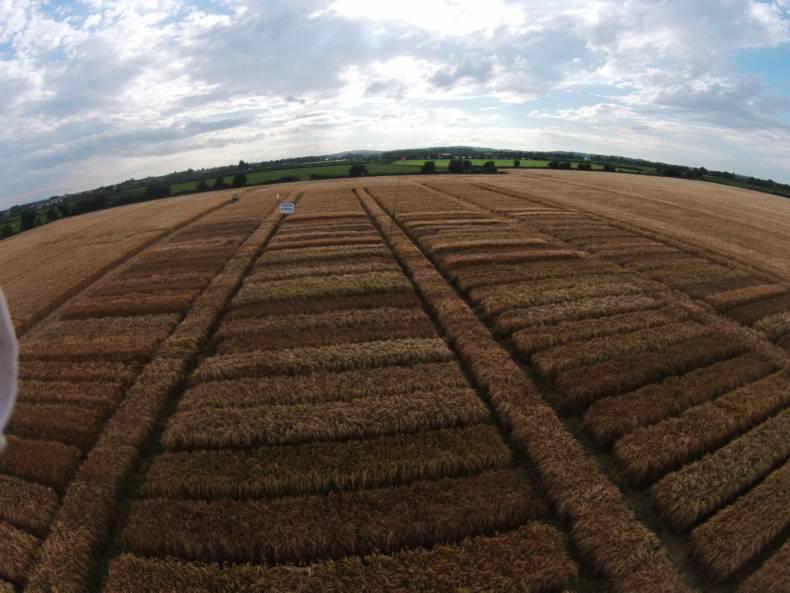
A big crowd attended the open evening at the Drummonds trial site in Termonfeckin, Co Louth, last week. The evening could be described as well-planned, lively and informative. Drummonds employees spoke on different topics that are currently being researched, while machinery and other service providers were also there to add to the diversity of discussion.
BYDV
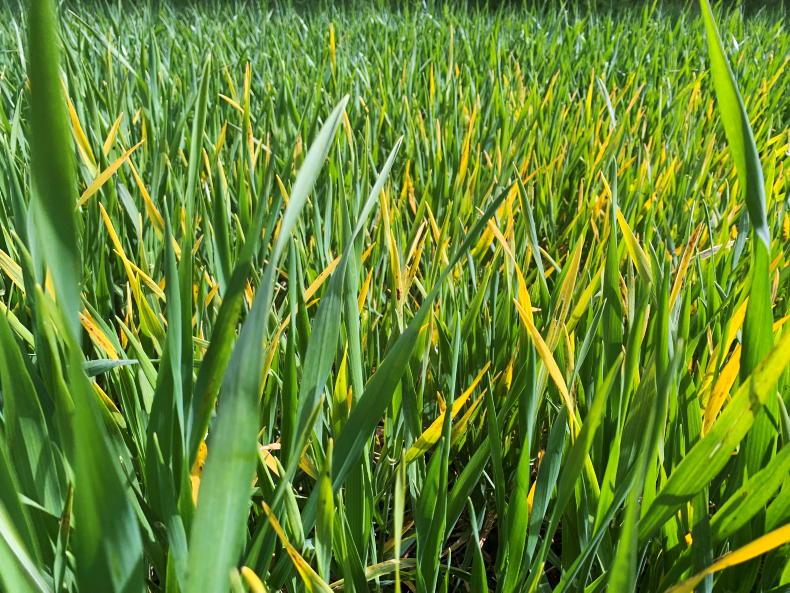
There was little doubt but that BYDV infection was a major issue for farmers in the immediate coastal area. Infection levels were regarded as high and quite uniform across infected fields. From conversation with growers, there did not appear to be any major implication of stubble management or hygiene on infection patterns.
The effect of sowing date wasn’t even clear-cut. One grower told me that his March-sown crops carried little or no infection in comparison with his April-sown crops. However, another grower reported that his March-sown crop was heavily infected.
The question was posed as to whether aphicides were working at all or not, or whether it was essential to treat at the one- to two-leaf stage rather than the well-proven four- to five-leaf stage. These are valid questions.
In previous Teagasc trials on this topic (now historic), when BYDV incidence was also quite high, up to five different timings were tested and some treatments were sprayed up to five times.
But the conclusion then from that work was that a single aphicides at the four- to five-leaf stage was optimum for yield. However, it was also noted then that there was still a level of BYDV symptoms in all treatments, including those that received the five aphicides.
That said, the questions now are ‘does this area possibly have full-blown pyrethroid resistance, making insecticides useless?’ or ‘might we be looking at a different strain of the virus that might be transferred in a somewhat different way?’
Whatever the reason, these questions need answers and very quickly. There are already a number of reports of winter crop replanting as a consequence of serious BYDV infection.
It must also be noted that problems with BYDV are not confined to the northeast. Severe problems were also encountered in other parts of the country.
One must wonder if the growing problem of BYDV infection has moved directly in line with the obligation to maintain green cover over winter, coupled with recent mild winters.
Variety choice
Whatever crops you grow, the time has come to choose varieties carefully and wisely and not just on the basis of proven yield potential.
Varieties need to be chosen wisely for resistance, especially for early planting, for critical diseases and for other major challenges like BYDV. Are there real differences between varieties in this regard?
I would add to these the need to avoid opening up another disease control cost while choosing a variety to combat another specific disease.
The time has come for growers to pay much more attention to the choice of variety with regard to all its characteristics. But the ones that relate to production costs, such as disease susceptibility, standing power, etc, need careful consideration for all crops.
Yellow rust was perhaps the most serious disease on the winter wheat at this Co Louth site and unsprayed plots showed the range of susceptibility levels.
Torp is a variety that was identified and promoted by Drummonds for the region and it continues to perform well there in terms of its very good resistance to septoria and its yield level.
It is now in recommended list trials, but it may be that it could perform less well in other regions or that its more widespread production will weaken its resistance to septoria in time.
Disease resistance must also form part of our resistance management strategy. The more susceptible our varieties are to a disease, the bigger will be the challenge on the chemistry and the greater the risk of resistance development.
So management decisions and variety choice have important roles to play in resistance development, as well as a good mix of chemistry at each application.
Continuous wheat
Having discussed the range of varieties that will be available this autumn, Brian O’Reilly from Drummonds rightly questioned the production of continuous wheat.
“One would need to be getting very big yields to justify continuous wheat production, but the need to comply with the three-crop rule is now also providing more opportunities for growers to target really good first-crop slots where yield should be higher and production cost lower,” he said.
Spring beans
Beans look to be shaping up quite well this year in most fields. While the crop does not like dryness early in the season, most appear to have produced strong vegetation with plenty of pods present.
Seed rate is always a live question with beans, given the high quantity of seed needed as a result of thousand seed weights that are either side of 600g per thousand seeds.
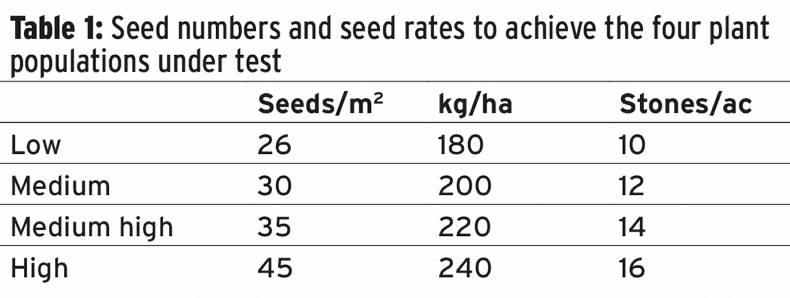
The variety was Fuego and four-seed rates (see Table 1) were being examined to look at the consequence of plant density on the development of chocolate spot.
While yield is the ultimate arbiter of any evaluation, it did appear on the night that the incidence of chocolate spot, at least of disease symptoms, was higher in the denser plant populations. Chocolate spot was evident in all the seed rates, but it looked like the problem could become more serious more quickly in the high populations.
Late season potash
One of the messages that has carried consistently from this event has been the yield benefit associated with the late season use of foliar potash (Foliar K) on winter wheat.
Yield improvements from this treatment have been up around 0.8 t/ha and the suggestion is that this benefit is likely regardless of the soil K index level.
The question was rightly posed as to the reason or justification for this yield benefit. It is roughly 15%K so at an application rate of 3.0 l/ha the total quantity of K is relatively small. Perhaps even this small amount can make a big difference at this critical time or perhaps it is indirectly having other affects or perhaps some other component of the product is having the major impact.
Its successful use on winter wheat for the past number of years has spurred its application on winter barley this year. Whatever the reason for the yield increase in recent years, growers are interested in the product following its consistent yield benefit on wheat.




SHARING OPTIONS