


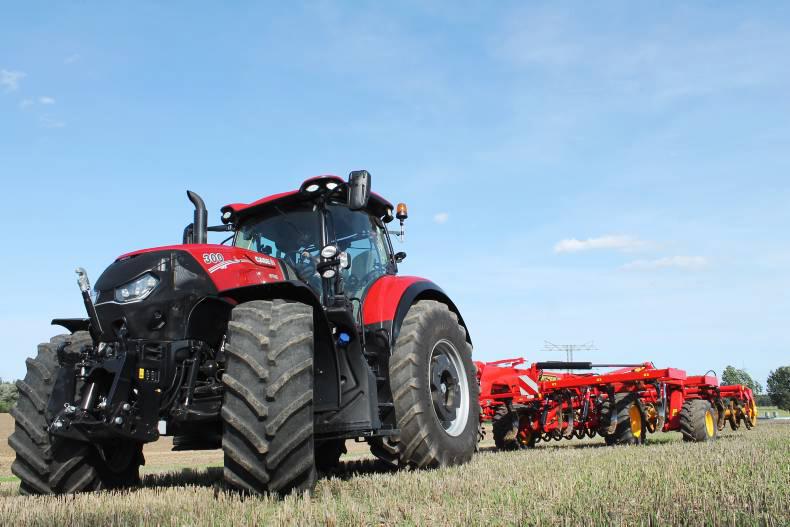
Case IH has launched its new Optum CVX range of high-horsepower tractors, which will get their first public viewing at Agritechnica in Germany this November
The Irish Farmers Journal recently previewed the series at a Case IH launch in Germany.
There are two models in the range, the Optum 270 and Optum 300. Both are available only with continuously variable speed CVX transmissions. There are no powershift options.
Rated horsepowers of both are their respective model numbers and they fill a gap in the selection of high-horsepower tractors at Case IH.
The development of the Optum range sees the company recognise that there is a demand for a higher horsepower tractor in a compact, conventional build. Tractors of this build size and up to 300hp are particularly popular among contractors and large tillage users.
Case IH always had high horsepower on offer with its Magnum range, but these are big tractors designed with heavy draught work in mind. The new Optum’s dimensions are better suited to European and Irish roads, while still packing a mighty punch.
The Case IH Optum 270 and 300 provide more power in a tractor closer in size to Puma. In fact, the Optum range is not unlike the firm’s Puma series in many respects. Its engine, drive train and cab have all evolved from the Puma series. That said, there are a huge number of differences between the Optum and Puma.
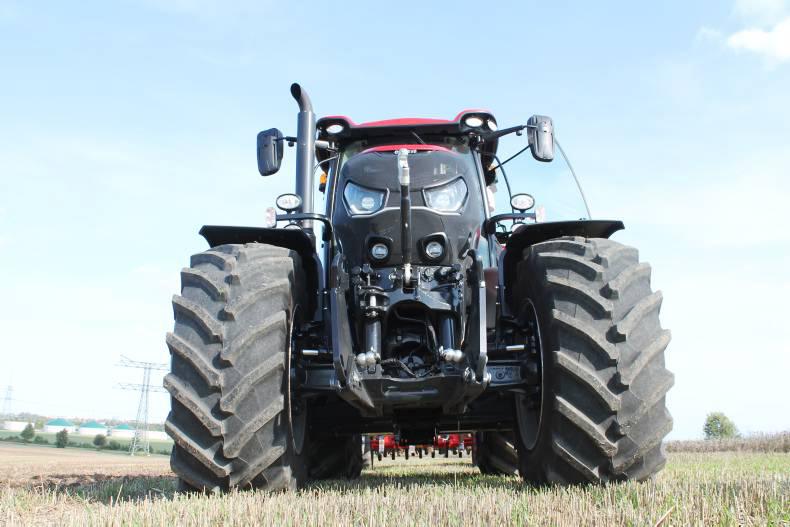
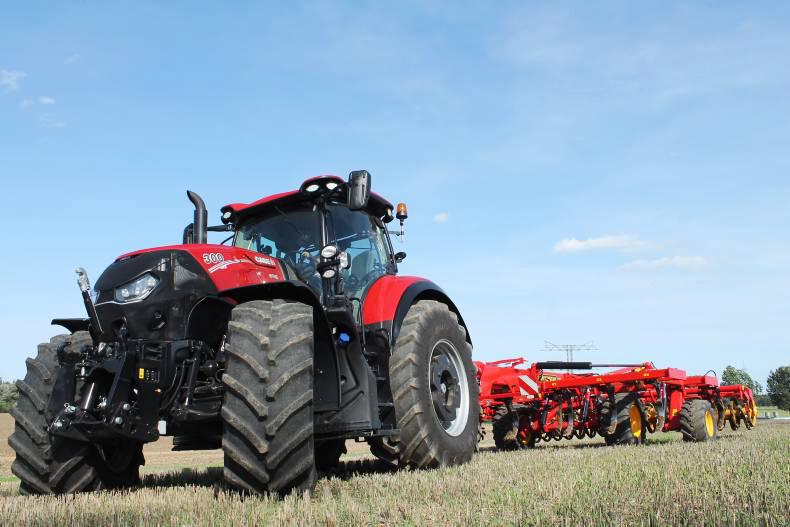
The Optum’s stylish bonnet is like an aggressive version of the Puma’s. The cab’s roof adds to that aggressive look. And under the skin, there are plenty differences.
Engine
Powering both Optum models is a fully re-worked Tier 4-Final, 6.7 litre NEF engine from FPT. There is no boost facility. Rated horsepower of 270hp and 300hp is achieved on both models at a rated speed of 2,100rpm. Maximum power of 313hp is achieved at 1,800rpm on the larger of the two.
Quite a bit of work has been done on the tuning side to meet stringent T4-final emission standards and get the extra power out of the NEF engine. FPT did this without adding EGR-Exhaust Gas Recirculation or a DPF-Diesel Particulate filter.
FPT claims it enhanced the cylinder head design of the NEF engine with new valve material and design for higher combustion pressure. A single electrically controlled eVGT-Variable Geometry Turbo pumps more air into the engine. Lower-powered Pumas uses a standard wastgate turbo.
The turbo incorporates some clever features including an exhaust flap which closes to get the engine up to running temperature quicker. As an option, this can be used as an exhaust brake, operated by a second accelerator pedal on the left hand of the foot pedal assembly.
A Hi-eSCR-only after-treatment solution cleans up the engine’s exhaust gases after combustion. This is a catalyst-only based system using three types in total to scrub the exhaust gases clean. Used are a diesel oxidation catalyst (DOC), selective catalytic reduction (SCR, AdBlue) and clean up catalyst (CUC). The latter cleans up the bad smell of the ammonia used in SCR.
Physically, the engine receives a structural sump and the engine block is no longer stressed. The new structural sump design also eliminates the need for side-rail supports.
Intricately moulded plastic and auxiliary fuel tanks are wrapped around, and extend into every void to create an on-board fuel capacity of 630 litres. AdBlue capacity is 96 litres.
Transmission
Moving rearwards, the Optum’s drivetrain is based on the Puma’s but beefed up to handle the extra power. Internally, gear ratios are also different from the Puma and out at the axles is a double epicyclic final drive in each trumpet housing.
Flange or bar axle design is available. Case IH anticipates that most will be ordered with the bar-type axle. The Optum can accommodate tyres up to 2.15 metres in diameter. Optionally available is a tyre pressure monitoring system, but not inflation/deflation. Up to 16 tyres can be monitored on the tractor’s AFS monitor.
There are four mechanical ranges within the CVX transmission to provide maximum efficiency according to the manufacturer. Range changes are automatically managed by the tractor’s electronic control system, and in conjunction with the firm’s double-clutch system. Top speed of 50kph is achieved at a fuel-sipping 1,600 rpm.
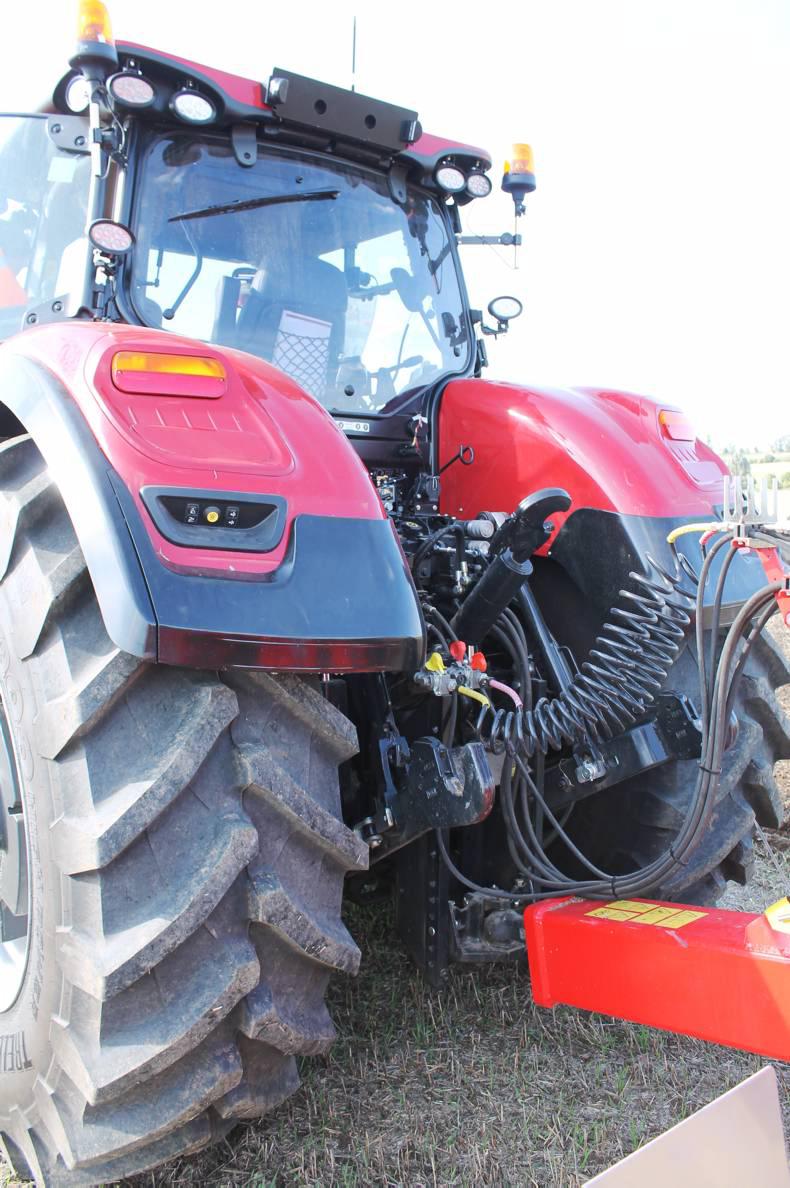
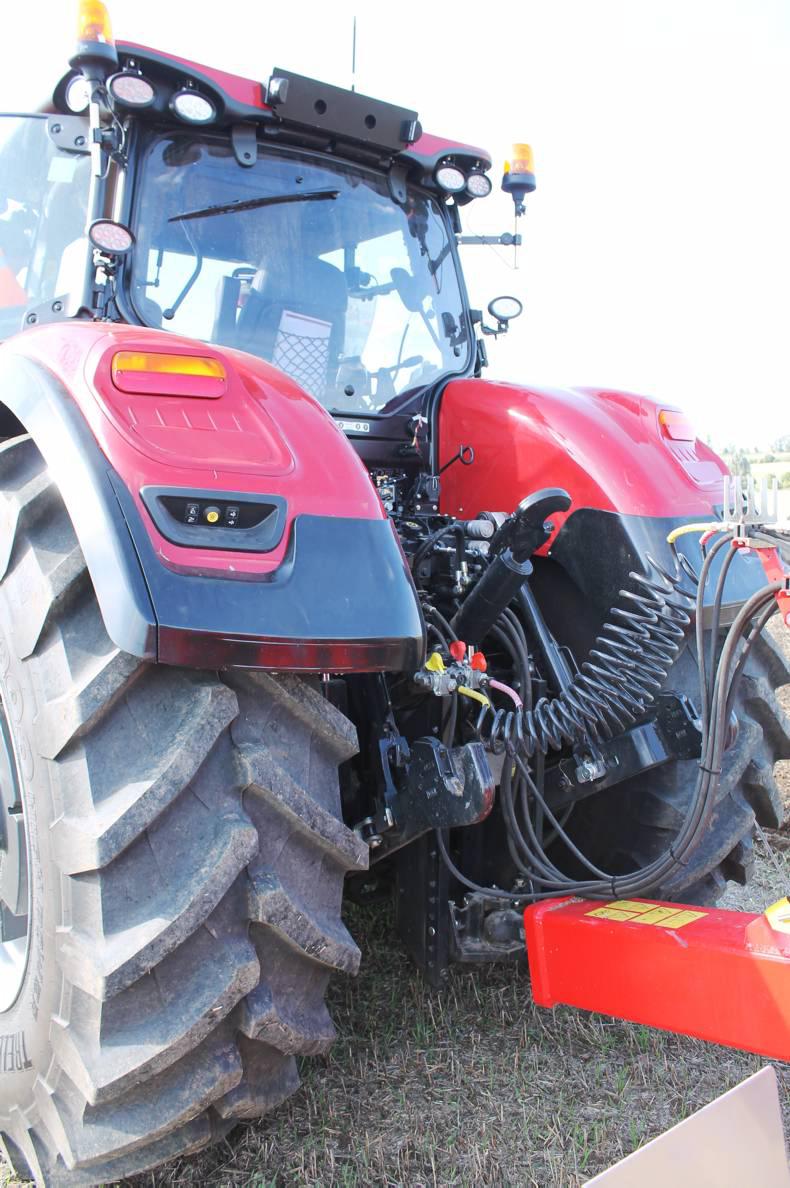
At the very rear, a four-speed PTO is standard, providing ECO 540/1,000rpm speeds in addition to standard 540/1,000rpm speeds. PTO speed selection has been via lever-operated cable controls on Puma tractors.
On the new Optum, PTO gear speed shifting has gone electric, with speeds being shifted directly by electrically operated solenoids. Up front, Case IH offers a two-speed PTO as standard. Case IH claims this is an industry first, with standard 1,000rpm and 1,000rpm eco speed offered.
The standard hydraulic pump offered is a 165 litre/min pressure and flow controlled, variable displacement piston pump. Optionally available is a 223 litre/min pump.
The hydraulic and transmission system share the same oil supply. Featuring an extra back-end oil sump, the Optum has a massive 148 litre capacity. The extra sump helps keep oil drag to a minimum, maintaining transmission efficiency.
Three replaceable filters plus a suction filter and mesh filters in the hydraulic lines ensure the oil is kept as clean as possible. Filter change intervals are 600 hours while back-end oil is double that at 1,200 hours.
Steering the Optum is a front axle used on the smaller Magnum models, which is rated for 7,500kg. This features a saddle-type suspension system, similar to that used on the Magnum. The comfort level of the front suspension can be set from the seat’s armrest controller to hard, medium or soft.
Front axle brakes are available as an option. Reactive steering is a standard feature. This feature returns the wheels to straight ahead like a mechanical or power-assisted steering system. ABS braking is also offered as an option. Cab suspension is a mechanical-only system with five comfort settings.
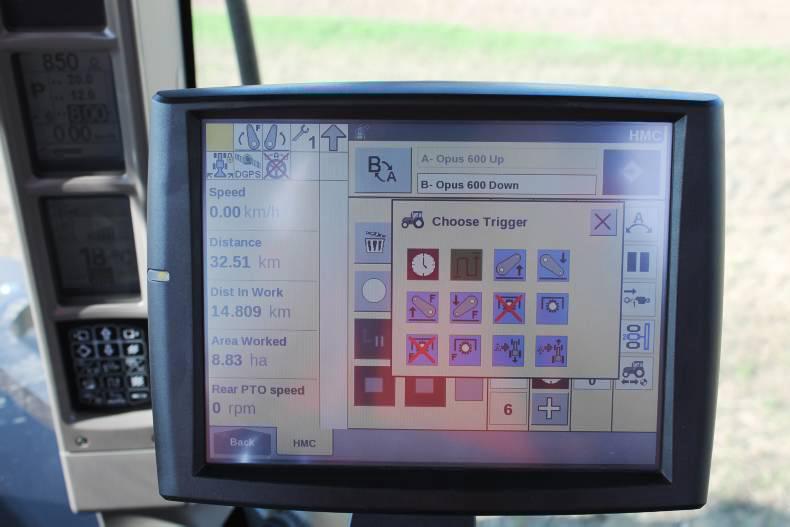
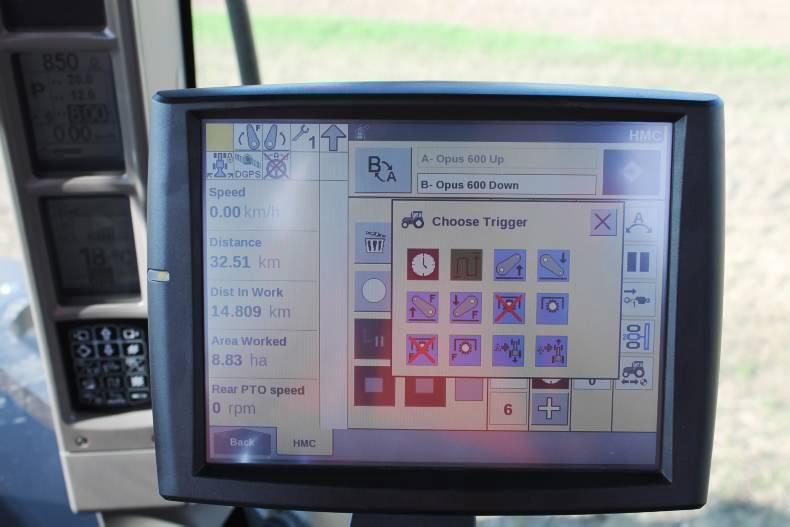
Inside the cab things are much the same as Puma models. The Optum benefits from changes to Case IH’s headland management system introduced earlier. The Optum also features ISOBUS Class 3 with federate control for use with the Case IH large square baler range. This allows the baler to control the tractor’s forward speed to get the most out of both tractor and baler.
Seating options are also similar to those recently introduced on Puma models, including dual-motion, leather and various seat heating options. Again there are lots of lighting options.
Case IH remains tight-lipped on pricing other than to say the new Optum models will be more expensive than the Puma series and a little less than the Magnum series.


SHARING OPTIONS