


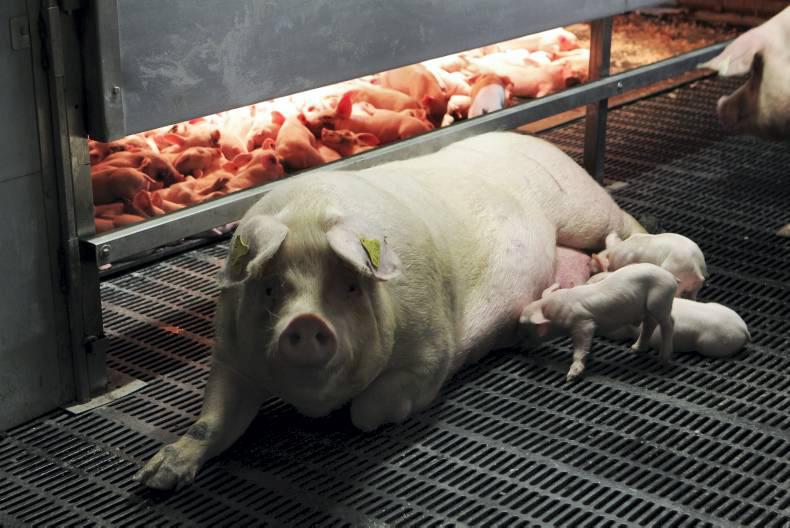
Financial pressure on NI pig producers is continuing as pigmeat prices move downwards without any immediate signs of a significant turnaround.
Prices of around 112p to 113p/kg were reported in the industry at the beginning of this week for finished pigs, but average prices in NI are difficult to calculate due to the variation in the types of contracts that producers have with processors. There are reports of further price reductions for finished pigs of 2p to 3p/kg, possibly by the end of this week.
One pig farmer told the Irish Farmers Journal that pigs were being produced at a loss on his farm and on the majority of farms in NI. “The way things have gone now means that the industry cannot stick it like this for much longer,” he said.
On breeding units, cull sow prices are also adding to the pressure. The farmer said that at current prices for heavy sows of around £42 per head, it was the poorest trade for cull sows that he could remember.
The reduction in feed costs has been welcomed in the industry, but Ulster Farmers’ Union deputy president Ivor Ferguson points out that this has been offset by the continued fall in pig prices.
He said that over the years, reductions in feed costs have not benefitted pig farmers as much as expected as processors and retailers are aware of the reductions in costs and can pull prices back accordingly.
Price differential
Ferguson said that the main issue continues to be the price differential between NI and Britain for pigs that are going into the premium Red Tractor branded market. This difference currently sits at around 10p to 12p/kg.
“Having only two processors here creates very little competition, meaning we are price-takers. NI is being used as a cheap source of pigmeat for the Red Tractor market,” Ferguson said.
Reports suggest that there is a surplus of pigmeat coming from continental Europe, due in particular to the loss of the 800,000t Russian market through the trade embargo, but only quality-assured pigmeat from NI and Britain qualifies for Red Tractor.
Non-Red Tractor pork is substantially cheaper; for example, in the Republic of Ireland, finished pigs are around £1/kg. However, Ferguson said that Red Tractor is still a substantial part of the market in the UK and that if NI producers were getting paid the same as producers in Britain for supplying it, then the pressure on farmers here would be greatly reduced.
Haulage costs from NI to Britain for pigmeat may contribute to the price differential, but in November Ferguson told the Assembly’s agriculture committee that this is estimated at around 1.5p/kg. Some farmers who mix their own feed may be at a slight advantage if they happened to get a good deal when purchasing a large quantity of straights. Also, those without large repayments on loans due to limited spending in recent years are probably under less financial pressure. But Ferguson said that this is not the case for many producers and that all farmers need to keep reinvesting in their businesses. Pig farmers, in particular, need to invest in buildings which have high maintenance costs, he said.
Optimism
Looking ahead, provisional approval in November 2015 for export of pork from NI to China, and the expected approval for products such as offal and trotters is a positive for the sector.
There is also the opening of EU Private Storage Aid (PSA) for pigmeat on Monday (4 January), which should help to put a floor in the market which historically drops in the new year.
Access to the Chinese market has been estimated to be worth an additional 3p to 5p/kg, but further price increases are required for most farmers to regain profitability.



SHARING OPTIONS