


The Christmas and New Year’s celebrations are now in the past and so the countdown to calving begins. There are three weeks remaining before the first heifer is due to calve and I can see them springing already. In one way, I can’t wait until we have calves on the ground. However, in another way, the longer they hold out the better! The reality is we have no control over when they calve. We just need to use the next couple of weeks prudently to focus our minds and prepare the farm for the busy season ahead.
Focus is the key word. I find that it is a two-step process, involving two important stages: identification and prioritisation.
You have to identify the important things and prioritise these above all else. Easier said than done. I find it difficult to follow through on this concept if I fail to plan ahead - it leads to hap-hazard decision making. I’d like to think that we do our best to get it right the majority of the time and although some days I feel as if we are behind schedule, I am extremely pleased with the progress we have made, in converting the farm, to date.
The paddocks are laid out and fenced with temporary wire and standards, a new looped water system has been installed, the roadways are almost finished, my loan application was approved and our temporary milking parlour is ready for action.
We opted for a temporary parlour for two reasons. Firstly, we only received word at the end of August that our application for new entrant quota had been approved. Instead of rushing the planning and building of the parlour, we decided to take our time and plan the farmyard thoroughly. Secondly, we still have not received word about our Dairy Equipment Scheme application. It was submitted prior to the deadline of the second last tranche in August. If approved, this would give us a 40% grant on a new milking machine, bulk tank and cooling equipment. In my circumstances, the approval is the difference between new and second hand equipment.
As I am 22 years of age, acquiring a loan from the bank was not simple. After going through the hoops a couple of times, over a six-month period, my application was finally sanctioned at the end of December. It was great news and took a major weight off my back. I’d like to think that my education and experience, coupled with a comprehensive business plan and SWOT analysis were the primary factors for approval. But to be honest it was probably my parents impeccable credit history with the bank that got it over the line for me. I have a lot to thank them for. The €100,000 stock loan is with AIB at an interest rate of 5.5% and has an overdraft facility of €10,000. It is interest-only in year one, meaning that the first full annual payment of €13,153 is not due until 2015. Hopefully we will have sent a good bit of milk to the creamery at that stage.
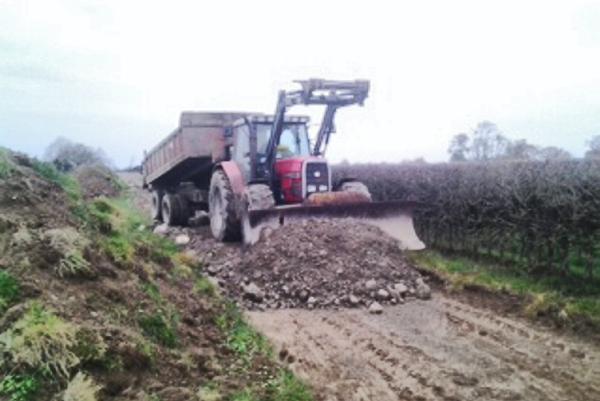
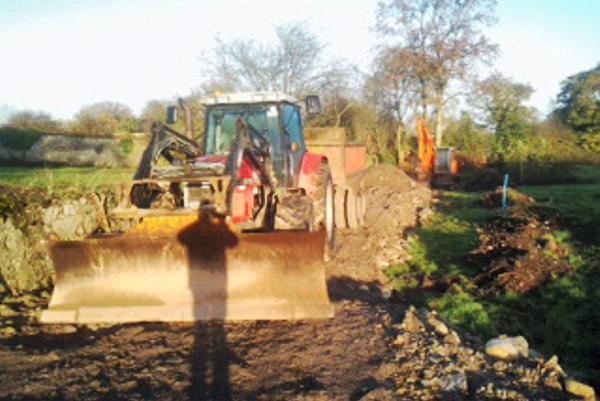
The roadways are well under way. Our farmyard, on the prospective milking platform, is situated on a section of the Esker Riada. This is a long narrow mound of sand, gravel and stone deposited during the ice-age (you’d know my mother was a geography teacher!). Prior to starting any construction in the yard, we decided to get it all on the one level. This involved a lot of excavation. Thankfully, the material excavated was ideal for roadways. My cousin, Pádraig Horan dug out the topsoil with a digger. We felt that removing the topsoil was the best thing to do as we did not want clay boiling-up through the surface with heavy traffic and we had the material to hand to make it a viable option. As Pádraig levelled the site he put the stone and gravel directly into trailers and hauled it on to the roadways. This eliminated any double-handling of material. Our neighbour Jack Dunne assisted him with the roadway construction.
Firstly Pádraig filled Jack’s trailer and he would drive out with a load. Then Pádraig filled his own trailer. By the time he had finished, Jack would be back for a second load. Thus three loads were brought out every time. Then Pádraig used a second-hand dozer bucket attached to the front of his tractor to level the heaps of gravel. They started at the end of the roadway closest to the yard and so they were compacting the roadway the whole way to the other end. This formed a solid foundation to the roadway. Pádraig then made a grader for the top of his trailer from lengths of angle-iron spaced roughly 6 inches apart. The grader was fixed at an angle, allowing the bigger stones roll off. This graded material was then drawn out to the roadway for a top surface. He is currently tracking this in with the digger and sloping it to the field side of the roadways to prevent rainwater from lodging. We are waiting to see the finished surface. It looks good so far, but it may require a further layer of quarry dust. The last thing we want is lame cows, so we’ll make that decision before calving begins.
When I was working in New Zealand, I was lucky enough to tag along with a discussion group tour from Ireland on a weekend off. We visited a number of farms. One thing struck me forcibly when talking to Kiwi farmers. This was the emphasis that they placed on working with good people. I really believe this is half the battle when it comes to farming. Everyone has to be on the one wave length and pulling in the same direction. I am extremely lucky that my parents are open minded and prepared to take a chance on me. My siblings and friends are also very supportive and willing to help whenever needed. In addition, my cousin Pádraig Horan is fountain of information with great ideas and my former lecturers, teachers, bosses and colleagues are always available with advice. I would not be where I am without these people and many more. My aim over my farming career is to surround myself with good people and hope that some of it will rub off on me.
Although this is my fourth calving season on a dairy farm, it is my first at home and my biggest test yet. With three weeks to go and an expected duration of one month, it won’t be long before I know if I have spent enough time with the right people to date.



SHARING OPTIONS