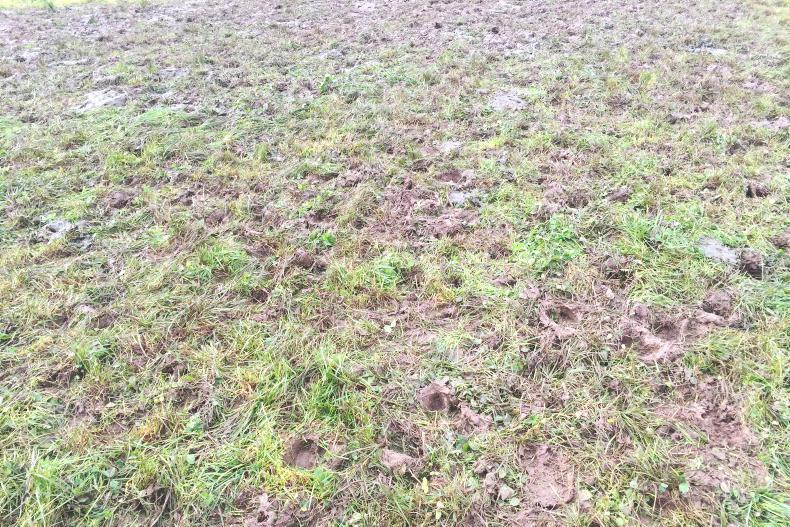
High-yielding fodder crops, such as beet, are the worst affected as the area allocated per day is small, so the number of cows per square metre is high and more damage is being done as a result.
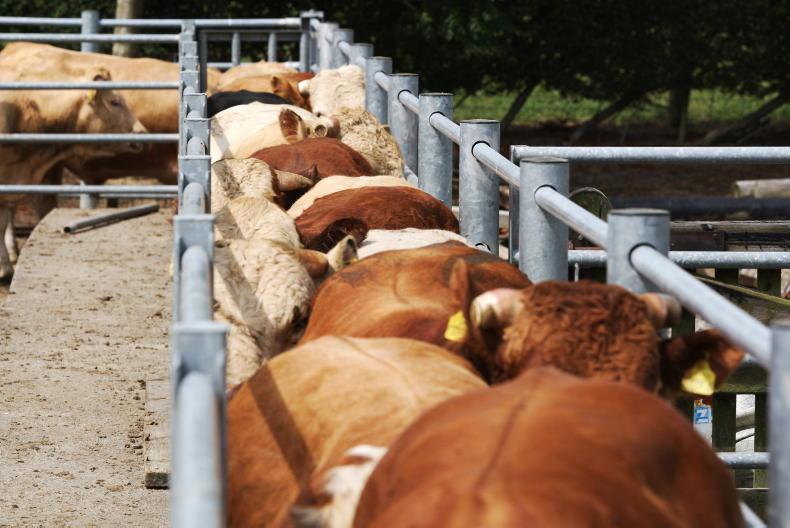
On-off grazing is the best way to avoid excess damage and to keep utilisation rates high. For dry cows, two two-hour grazing breaks should be sufficient for them to get over 90% of their daily feed allocation. When not grazing the crop, all they need is a dry lie. This could be on a roadway or a dry section of the field that was previously grazed, or else sacrifice a section of a relatively dry grass field. The same applies to those grazing kale or deferred grass. When on-off grazing, make sure that every cow has access to the crop when grazing. Longer feed faces work better in the wet and you must use a back-fence to fence off previously grazed areas.
Repair
ADVERTISEMENT
Make sure to repair any gutters or shoots that got blown off in the storms last weekend. Open slurry tanks and lagoons are filling up fast, and with a month to six weeks to go before the first of the slurry can be spread, the last thing you want is rainwater getting in. Where slurry is being exported to a different farm, forms must be with the Department of Agriculture by 31 December.
Of course, safety is paramount. Keep children and the elderly out of the farmyard during high winds and rain. Secure any swinging doors. Strip back enough plastic from the silage pit on good days, so you don’t have to go up on to the pit on windy days.
Click here to see the farming forecast for this week.
Register for free to read this story and our free stories.
This content is available to digital subscribers and loyalty code users only. Sign in to your account, use the code or subscribe to get unlimited access.
The reader loyalty code gives you full access to the site from when you enter it until the following Wednesday at 9pm. Find your unique code on the back page of Irish Country Living every week.
CODE ACCEPTED
You have full access to the site until next Wednesday at 9pm.
CODE NOT VALID
Please try again or contact support.
High-yielding fodder crops, such as beet, are the worst affected as the area allocated per day is small, so the number of cows per square metre is high and more damage is being done as a result.
On-off grazing is the best way to avoid excess damage and to keep utilisation rates high. For dry cows, two two-hour grazing breaks should be sufficient for them to get over 90% of their daily feed allocation. When not grazing the crop, all they need is a dry lie. This could be on a roadway or a dry section of the field that was previously grazed, or else sacrifice a section of a relatively dry grass field. The same applies to those grazing kale or deferred grass. When on-off grazing, make sure that every cow has access to the crop when grazing. Longer feed faces work better in the wet and you must use a back-fence to fence off previously grazed areas.
Repair
Make sure to repair any gutters or shoots that got blown off in the storms last weekend. Open slurry tanks and lagoons are filling up fast, and with a month to six weeks to go before the first of the slurry can be spread, the last thing you want is rainwater getting in. Where slurry is being exported to a different farm, forms must be with the Department of Agriculture by 31 December.
Of course, safety is paramount. Keep children and the elderly out of the farmyard during high winds and rain. Secure any swinging doors. Strip back enough plastic from the silage pit on good days, so you don’t have to go up on to the pit on windy days.
Click here to see the farming forecast for this week.
If you would like to speak to a member of our team, please call us on 01-4199525.
Link sent to your email address
We have sent an email to your address. Please click on the link in this email to reset your password. If you can't find it in your inbox, please check your spam folder. If you can't find the email, please call us on 01-4199525.
ENTER YOUR LOYALTY CODE:
The reader loyalty code gives you full access to the site from when you enter it until the following Wednesday at 9pm. Find your unique code on the back page of Irish Country Living every week.






SHARING OPTIONS