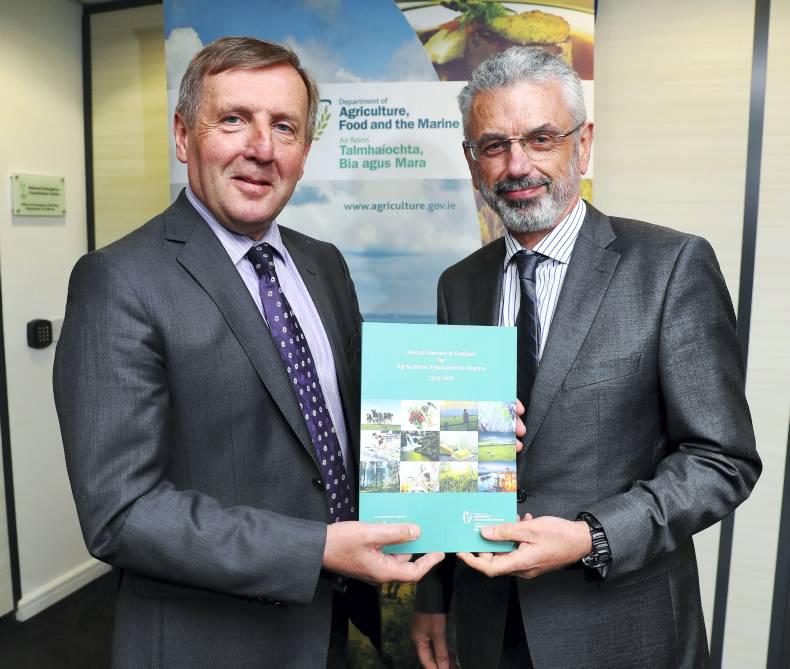
The Department warns that this year will be another tough one for dairy farmers. "There is no doubt that a softening of global dairy markets has had effects on dairy farmers in Ireland and throughout the EU and the possibility is that this will continue into late 2016," the Annual Review and Outlook reads.
The Department forecasts that the "the medium term outlook for dairy markets continues to be very bright, with growing global demand among a burgeoning middle class in fast growing developing countries with increasingly westernised, more protein based diets expected to support prices in the years ahead".
However, for 2016, global oversupply will continue to put pressure on milk prices. "Forecasts suggest a slowdown in supply for New Zealand but it is clear that this will not be of the magnitude
necessary to address global imbalances in the short term," the Department notes.
On the demand side, "declining international oil prices have weakened the spending power of countries reliant on oil revenues, while the buffer provided by favourable exchange rate movements cannot be taken for granted in 2016".
According to the Department, "falling demand in some continental markets, the ongoing economic uncertainty throughout the EU and an increased supply of cattle as a result of the expansion of the dairy herd due to the ending of the Milk Quota regime are concerns for the Irish beef sector in 2016". This will be counterbalanced by access to new international markets.
The Annual Review and Outlook confirms estimates of a rise in Irish cattle supplies by 60,000 to 80,000 this year compared with 2015.
After price rises in the first half of the year, is expected to be a more difficult period for producer prices.
On the live exports side, the Department cites Bord Bia's positive outlook for shipments to Spain and Italy, which are recovering from economic downturns. "Live exports to North Africa will depend on the political situations in countries in the region, along with our price competitiveness," the Department adds.
The Department expects EU sheepmeat production to remain stable, and New Zealand and Australian exports to tighten in 2016. "It is forecast that this will help to increase global prices," the Annual Review and Outlook reads, citing Teagasc's +3% estimate. The overall increase in Irish sheep numbers masks an actual reduction in the number of breeding ewes on farms last year, which is expected to lead to a small reduction in the 2016 lamb crop and higher resulting prices.
The Department cites predictions of a slightly bigger harvest in the EU this year and a small decrease in grain production worldwide, with global demand expected to increase. "In Ireland the total area sown to
winter crops for harvest in 2016 is estimated at 146,000 hectares a 10,000 hectare increase on the 2015
area," the Annual Review and Outlook reports.
"Following rebuilding and recovery efforts in recent years the future for the Irish pig sector remains
challenging," the Department warns, citing rising feed and energy costs as well as credit availability among the threats to the sector in the coming months.
Across the EU, "indications for the second half of the year suggest that there will be some reduction in supplies, as the effect of volatility and weak producer prices may lead to further culling in the EU breeding herd".Irish pig farmers, too, are expected to tighten supply in 2016.
The near future offers prospects for new markets opening in Asia, such as Vietnam and the Philippines, but also threats from diseases such as african swine fever and porcine epidemic diarrhoea, which have hit Europe in recent times without reaching Ireland so far.
The Department sees a stable poultry market throughout 2016, but as with pig producers, feed prices will be a major factor in farmers deciding how much to produce.
The Department notes that Irish mushrooms have come under increased pressure from Polish competition in the key UK market in the past year. "The mushroom sector continues to invest heavily in new technology to optimise production costs but it is facing a number of challenges," the Annual Review and Outlook reads. "In addition to on-going retailer pressure the sector is faced with more limited availability of labour due to the improving Irish economy."
The vegetable sector is suffered from the bad weather this past year, but has responded with investment in machinery capable of working on wet soil. "Looking to the future there is a need for
growers to consider further measures to reduce soil compaction, especially at harvest, if they going to
compete successfully at a reasonable price for conacre land," the Department advises.
Salad growers are under pressure from "retail multiples offering cheaper imported produce
on promotion adjacent to higher priced Irish product".
The outlook for soft fruit producers is bright, with increasing domestic demand.
The Department predicts a rise in apple output with new orchards coming into production in the coming years.
After a reduction in the area sown last year, the Department says the outlook for the potato sector hinges on the three-year industry co-funded promotion campaign under way since last Autumn.
Read more
Download the Department's Annual Review and Outlook
The Department warns that this year will be another tough one for dairy farmers. "There is no doubt that a softening of global dairy markets has had effects on dairy farmers in Ireland and throughout the EU and the possibility is that this will continue into late 2016," the Annual Review and Outlook reads.
The Department forecasts that the "the medium term outlook for dairy markets continues to be very bright, with growing global demand among a burgeoning middle class in fast growing developing countries with increasingly westernised, more protein based diets expected to support prices in the years ahead".
However, for 2016, global oversupply will continue to put pressure on milk prices. "Forecasts suggest a slowdown in supply for New Zealand but it is clear that this will not be of the magnitude
necessary to address global imbalances in the short term," the Department notes.
On the demand side, "declining international oil prices have weakened the spending power of countries reliant on oil revenues, while the buffer provided by favourable exchange rate movements cannot be taken for granted in 2016".
According to the Department, "falling demand in some continental markets, the ongoing economic uncertainty throughout the EU and an increased supply of cattle as a result of the expansion of the dairy herd due to the ending of the Milk Quota regime are concerns for the Irish beef sector in 2016". This will be counterbalanced by access to new international markets.
The Annual Review and Outlook confirms estimates of a rise in Irish cattle supplies by 60,000 to 80,000 this year compared with 2015.
After price rises in the first half of the year, is expected to be a more difficult period for producer prices.
On the live exports side, the Department cites Bord Bia's positive outlook for shipments to Spain and Italy, which are recovering from economic downturns. "Live exports to North Africa will depend on the political situations in countries in the region, along with our price competitiveness," the Department adds.
The Department expects EU sheepmeat production to remain stable, and New Zealand and Australian exports to tighten in 2016. "It is forecast that this will help to increase global prices," the Annual Review and Outlook reads, citing Teagasc's +3% estimate. The overall increase in Irish sheep numbers masks an actual reduction in the number of breeding ewes on farms last year, which is expected to lead to a small reduction in the 2016 lamb crop and higher resulting prices.
The Department cites predictions of a slightly bigger harvest in the EU this year and a small decrease in grain production worldwide, with global demand expected to increase. "In Ireland the total area sown to
winter crops for harvest in 2016 is estimated at 146,000 hectares a 10,000 hectare increase on the 2015
area," the Annual Review and Outlook reports.
"Following rebuilding and recovery efforts in recent years the future for the Irish pig sector remains
challenging," the Department warns, citing rising feed and energy costs as well as credit availability among the threats to the sector in the coming months.
Across the EU, "indications for the second half of the year suggest that there will be some reduction in supplies, as the effect of volatility and weak producer prices may lead to further culling in the EU breeding herd".Irish pig farmers, too, are expected to tighten supply in 2016.
The near future offers prospects for new markets opening in Asia, such as Vietnam and the Philippines, but also threats from diseases such as african swine fever and porcine epidemic diarrhoea, which have hit Europe in recent times without reaching Ireland so far.
The Department sees a stable poultry market throughout 2016, but as with pig producers, feed prices will be a major factor in farmers deciding how much to produce.
The Department notes that Irish mushrooms have come under increased pressure from Polish competition in the key UK market in the past year. "The mushroom sector continues to invest heavily in new technology to optimise production costs but it is facing a number of challenges," the Annual Review and Outlook reads. "In addition to on-going retailer pressure the sector is faced with more limited availability of labour due to the improving Irish economy."
The vegetable sector is suffered from the bad weather this past year, but has responded with investment in machinery capable of working on wet soil. "Looking to the future there is a need for
growers to consider further measures to reduce soil compaction, especially at harvest, if they going to
compete successfully at a reasonable price for conacre land," the Department advises.
Salad growers are under pressure from "retail multiples offering cheaper imported produce
on promotion adjacent to higher priced Irish product".
The outlook for soft fruit producers is bright, with increasing domestic demand.
The Department predicts a rise in apple output with new orchards coming into production in the coming years.
After a reduction in the area sown last year, the Department says the outlook for the potato sector hinges on the three-year industry co-funded promotion campaign under way since last Autumn.
Read more
Download the Department's Annual Review and Outlook





SHARING OPTIONS