


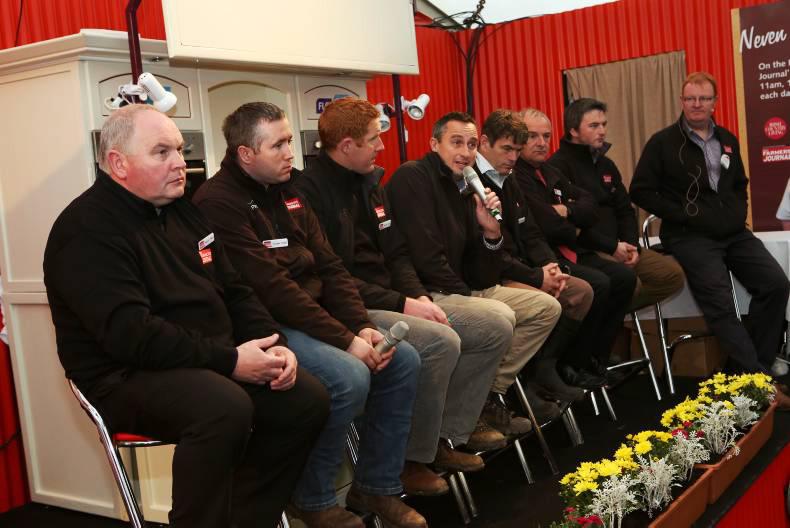
Conditions in the US and in China were high on the agenda of the Irish Farmers Journal breakfast briefing at the National Ploughing Championships in Ratheniska, Co Laois, on Wednesday.
With grain markets underpinning prices and margins in most other agricultural sectors, the current low prices are being watched closely for a potential rebound. But Irish Farmers Journal tillage editor Andy Doyle said that large-scale increases in storage capacities, especially in the US, had the potential to soften any increase. “We will not see a very high top price in the near future, because there is so much grain in sheds around the world,” he said.
Dairy editor Jack Kennedy said that the US milk output was likely to remain high, too, with “low grain rices and market protection” encouraging American farmers to milk more cows.
Sluggish demand in China
Yet agribusiness editor Eoin Lowry warned that demand in China, now the world’s second largest economy, remained a cause of concern. “Just like we did here, ordinary people have been investing in property and stocks, with banks lending to them,” he explained. But the recent crash of the Chinese stock market had spooked local individual investors. “People feel poorer, and when you feel poorer, you do not buy as much meat and milk,” Lowry said.
Global volatility resulting from all these factors also affects the beef trade. “The protected price premium on European markets is disappearing,” said markets specialist Phelim O’Neill. Although the weakening of the euro against sterling has helped Ireland maintain a strong position, O’Neill said that Ireland’s holy grail of unrestricted access to the US remained to be attained.
While current price pressure at beef factories has not affected the mart trade, this may change in the coming months. “There is a short-term limited supply of forward store cattle,” said western livestock specialist Nathan Tuffy. However, he added that additional cattle from the dairy herd would fill any gaps within one to two years. Livestock specialist Darren Carty said he was concerned to see some farmers buy livestock without budgeting for those considerations.
Differentiation and renewables to address volatility
To make it through the volatile times ahead, Jack Kennedy said accelerating the differentiation of Irish food products was key. While this is being done on environmental grounds, he said more reasearch should go into promoting the specific nutritional value of Irish food.
On farms, editor Justin McCarthy said the current conversation was very much centred around generating additional income streams. Renewable energy could be one option.
CAP specialist Peter Young said that countries such as Germany had led the way in subsidising the anaerobic digestion of animal waste to produce gas. However, he said early signals on government policy expected later this year to incentivise renewables remained focus on wind and solar energy. Comments from the audience highlighted the additional advantage of producing on-farm fertiliser from anaerobic digestion and the need for more education to help farmers develop alternative sources of income.
Justin McCarthy said the issues debated at the breakfast briefing have become more acute since public support for agriculture has shifted away from production. “But there is a realisation that our supply of food cannot continue under the current conditions,” he said. “It may be idealistic, but I see CAP going back to more support for production,” he added.



SHARING OPTIONS