


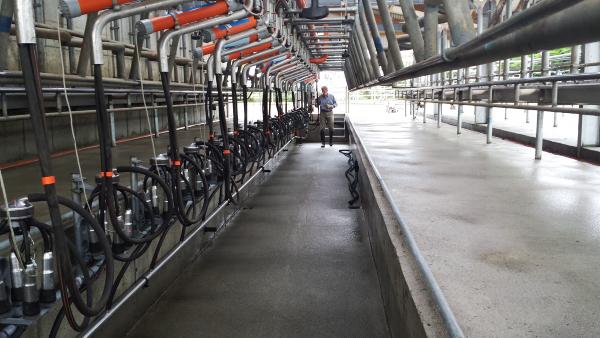
Over-quota farmers should try to do everything they can to reduce potential costs while maintaining income this spring. Here I don’t review milk feeding to stock which can reduce milk sent to processor but I review leasing or milking cows once a day.
Leasing freshly calved cows to under-quota farmers can create a “win-win” situation for both farmers. You must adhere to all testing/health requirements and a simple leasing agreement should be drawn up.
Should you charge?
Look at Table 1 and you will see the farmer taking the cows is saving you money by feeding your cows. You will be avoiding a superlevy bill of €4 to €5 per cow per day. Therefore, if he is a good operator, has his milking machine in good order and has good grass/silage, let him have the cows for free.
Once-a-day milking
Many farmers will go for this option as it will reduce milk yield by approximately 25% over the February/March period. On average, the herd will lose less weight after calving and will go in-calf easier.
After reverting back to twice-per-day milking in April, the cow will recover to almost her full potential yield depending on the type of cow, the age of the cow and the length of time spent on once-a-day milking.
This option is being considered by many farmers this year because, as Table 1 highlights, the financial outcome favours once-a-day milking over twice-a-day milking.
Table 1 compares two farmers, selling 15litres/cow/day in spring, with very different fat and protein percentages – these are actual figures from 2014 for two farmers. The penalty of €4.20 per cow/day, the cost of the feed input, all grass except the quantity of silage and meal listed are subtracted from milk sales, adjusted for butterfat increase, with a base price for milk of 32c/litre.
Due to poor milk solids and low price, farmer number one will lose money on all feed options. Losses will be minimised when he feeds cows all grass plus 1kg meal and does it on once-a-day milking.
For example if, while on twice-a-day milking, he feeds grass plus 20% silage plus 3kg meal he will be losing €1.59 and €1.15 per cow per day on twice-a-day and once-a-day respectively. This works out at €79.5 and €57.5 respectively per day for every 50 cows. Farmer number two will lose less money on all feed options but he will be losing money at 25c/l base milk price.
Therefore, all dairy farmers who are over-quota should go on once-a-day milking to minimise financial losses, particularly if other factors on the farm suit this option.
By selling as little milk as possible, daily losses per cow are minimised. Another strong recommendation arising from Table 1 is that providing cows with an all-grass diet is the most economical.
Therefore, during the February-March period, farmers should make as much grazed grass as possible available to milking cows by having the first rotation end on 31 March in the spring rotation planner – as a general suggestion 12-16 days earlier than usual. The chances are that this will leave grass tight on the second rotation in April but extra supplementation, if required, with meal or conserved forage could then be justified if the need arises to slow down the rotation length.





SHARING OPTIONS