


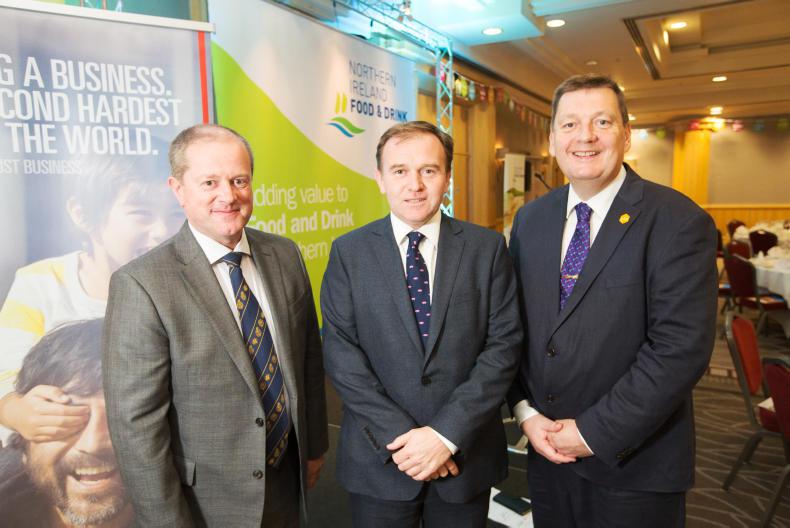
DEFRA Farm Minister George Eustice was in NI this week, addressing the annual NIFDA dinner followed by an industry breakfast hosted by MEP Diane Dodds.
Unsurprisingly, Brexit was the topic of discussion at both events. While the same messages were conveyed at each event, much of the content offered little in the way of new information as formal negotiations on exiting the EU have yet to begin.
Reading between the lines, the British government is a long way off knowing what will happen once negotiations start.
In his opening remarks, Minister Eustice stated that the time has come to stop talking about the referendum result and focus on shaping a new partnership with the EU that would benefit UK farmers.
He remarked that the UK is in a new era of opportunities to build markets and implement our own production regulations. These will be aimed at incentivising farming rather than stifling progress, he said. But current EU regulations that UK farmers must abide by, will only see a gradual change into UK law, mainly to prevent potential trade partners citing falling production standards when negotiating new markets.
Farm support
Farm support has already been guaranteed by the British Government for all Pillar I and Pillar II schemes until 2020.
Beyond that date, Eustice said the UK has an opportunity to develop new support schemes that are less bureaucratic for UK farmers.
While he would not be drawn on the likely levels of support, he said DEFRA will focus primarily on developing a new regime. Once finalised, they would then consider the level of funding required to make a scheme work.
In terms of some initial ideas for a new farm support framework being explored by DEFRA officials, Eustice talked about farm insurance schemes similar to those in the US, or in Australia and Canada, where government-backed schemes aim to spread risk.
Such schemes involve farmers paying into a central pot when markets are good and reclaiming from the pot when markets are depressed.
Eustice also appears to favour models involving forward-pricing and supply contracts, which offer a possible solution to market volatility, but have always been difficult to implement in certain livestock sectors.
He also stated that the UK should be looking to reduce antibiotic resistance across all livestock sectors to create a unique marketing edge.




SHARING OPTIONS