The working group reviewing the Department of Agriculture’s general laboratory services has backed rationalising the regional veterinary labs and relocating other laboratory services. It recommends restructuring the Backweston central lab complex outside Dublin city.
Its recommendation would see closure of the Kilkenny, Limerick and Sligo vet labs. The remaining labs at Backweston, Athlone, and in Co Cork would be enlarged.
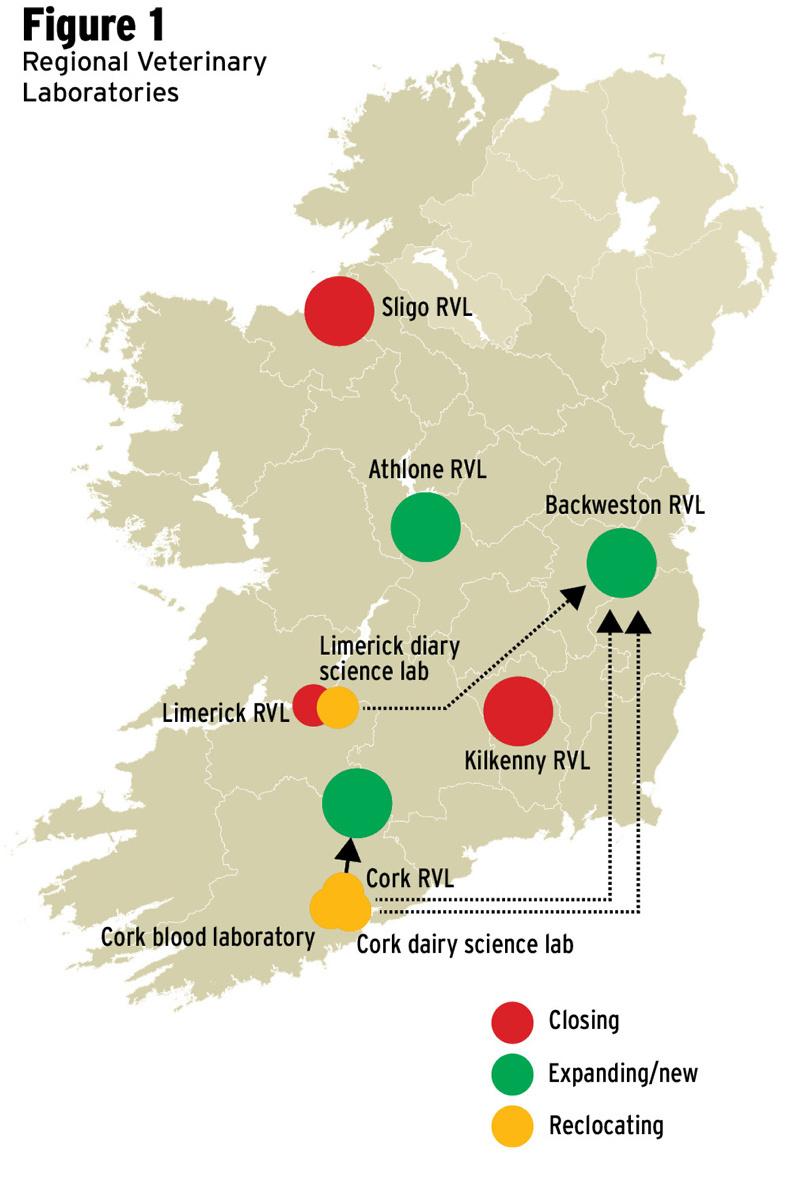
The ten-year plan would see multiple changes in Co Cork, where currently a regional vet lab, a dairy science lab and a blood-testing lab are based in the Model Farm area of the city.
In the short term, the dairy science and blood-testing labs would amalgamate. These services, and the dairy science lab in Limerick, would eventually relocate to Backweston.Likewise, the regional veterinary service now in Cork city would relocate to a new purpose-built facility in North Co Cork, becoming a centre for investigation and surveillance of disease in dairy cattle. Services at Backweston would be modernised and divided into two new divisions. One would cover food safety and plant sciences, the other animal health. That would be phase one of the overall plan and would take up to three years. Next would be restructuring of the regional labs.
Shortlisted
For the regional labs, the group favours rationalisation over the other two options it had shortlisted.
They were investing in all six existing regional veterinary labs or centralising all lab services at Backweston.
Consolidating the regional labs would make best use of available staff while producing larger, better resourced centres with greater expertise and a wider range of services.
The report strongly recommends that current staff structures in the laboratory services be modernised.
Costings
Option 1: Modernising the existing regional veterinary labs would have a capital cost of €6.4m and annual running cost of €6.5m. Best for disease surveillance, but the centres smaller than ideal.
Option 2: The three-centre model (recommended) would require €3.2m capital spend on regional labs and running cost would be €6.5m annually. It’s not stated if this figure would include the cost of carcase collection for farmers. Labs could offer a wider range of specialised services.
But it would be relatively costly and see some loss of contact with farmers and private vets, reducing “soft intelligence”.
Option 3: Centralising activity at Backweston would require capital spending of €3.9m to purchase collection trucks and enlarge post mortem facilities. Annual running cost would be €5.1m. There would be many benefits from scale and “improved farmer experience with carcase collection replacing farmer delivery”.
However, there would be huge loss of geographical coverage, loss of contact with the industry and soft intelligence.
Reacting to the report, IFA animal health chair Bert Stewart said that the focus of Minister for Agriculture Michael Creed must be on enhancing services to farmers in all regional sites. The report acknowledges that the current RVL structure is optimal for animal disease surveillance, he said.
“Farmers have made enormous investments in progressing the health status of the national herd, which benefits the agri-sector and wider rural economy,” he said.
“For an investment of €6.4m over eight years, the existing structures can be maintained and the service enhanced.”
Read more
Staff fight to protect RVL services
Full coverage: Regional Veterinary Laboratories
The working group reviewing the Department of Agriculture’s general laboratory services has backed rationalising the regional veterinary labs and relocating other laboratory services. It recommends restructuring the Backweston central lab complex outside Dublin city.
Its recommendation would see closure of the Kilkenny, Limerick and Sligo vet labs. The remaining labs at Backweston, Athlone, and in Co Cork would be enlarged.
The ten-year plan would see multiple changes in Co Cork, where currently a regional vet lab, a dairy science lab and a blood-testing lab are based in the Model Farm area of the city.
In the short term, the dairy science and blood-testing labs would amalgamate. These services, and the dairy science lab in Limerick, would eventually relocate to Backweston.Likewise, the regional veterinary service now in Cork city would relocate to a new purpose-built facility in North Co Cork, becoming a centre for investigation and surveillance of disease in dairy cattle. Services at Backweston would be modernised and divided into two new divisions. One would cover food safety and plant sciences, the other animal health. That would be phase one of the overall plan and would take up to three years. Next would be restructuring of the regional labs.
Shortlisted
For the regional labs, the group favours rationalisation over the other two options it had shortlisted.
They were investing in all six existing regional veterinary labs or centralising all lab services at Backweston.
Consolidating the regional labs would make best use of available staff while producing larger, better resourced centres with greater expertise and a wider range of services.
The report strongly recommends that current staff structures in the laboratory services be modernised.
Costings
Option 1: Modernising the existing regional veterinary labs would have a capital cost of €6.4m and annual running cost of €6.5m. Best for disease surveillance, but the centres smaller than ideal.
Option 2: The three-centre model (recommended) would require €3.2m capital spend on regional labs and running cost would be €6.5m annually. It’s not stated if this figure would include the cost of carcase collection for farmers. Labs could offer a wider range of specialised services.
But it would be relatively costly and see some loss of contact with farmers and private vets, reducing “soft intelligence”.
Option 3: Centralising activity at Backweston would require capital spending of €3.9m to purchase collection trucks and enlarge post mortem facilities. Annual running cost would be €5.1m. There would be many benefits from scale and “improved farmer experience with carcase collection replacing farmer delivery”.
However, there would be huge loss of geographical coverage, loss of contact with the industry and soft intelligence.
Reacting to the report, IFA animal health chair Bert Stewart said that the focus of Minister for Agriculture Michael Creed must be on enhancing services to farmers in all regional sites. The report acknowledges that the current RVL structure is optimal for animal disease surveillance, he said.
“Farmers have made enormous investments in progressing the health status of the national herd, which benefits the agri-sector and wider rural economy,” he said.
“For an investment of €6.4m over eight years, the existing structures can be maintained and the service enhanced.”
Read more
Staff fight to protect RVL services
Full coverage: Regional Veterinary Laboratories





SHARING OPTIONS