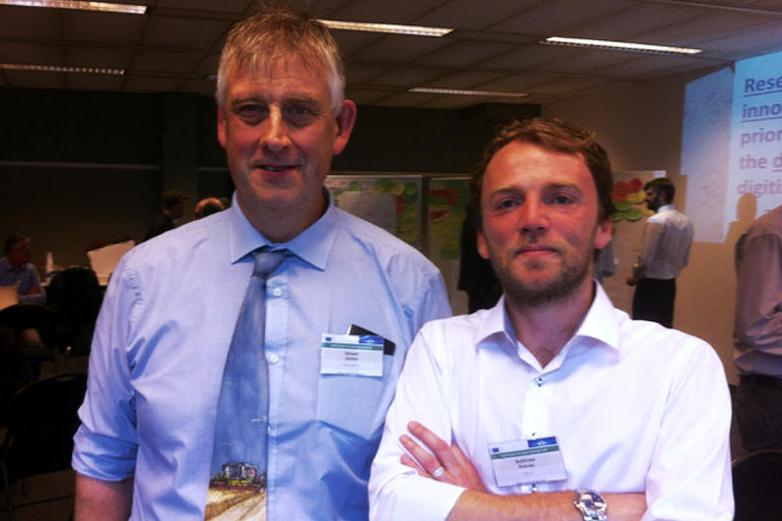
I was in Brussels last week for a workshop on what different “demand-side users” in the agrifood sector want from information and communications technology (ICT). In other words, the European Commission wanted to get an idea of what farmers and agrifood businesses want from new computer technologies.
English is always the language spoken at these meetings, but the phrase “divided by a common language” came to mind more than once. However, after an introduction to the topic from various speakers, we got down to business.
From high-level ideas like affordable and usable technology, we also heard about specific opportunities for using ICT. This included more structured online platforms to allow farmers sell directly to consumers, using traceability to reduce food waste, and the increasingly popular use of farm data.
Another common topic is that of using technology to reduce the amount of administration and paperwork a farmer has to do. However, I wouldn’t be too hopeful here – as one person said, asking bureaucrats to reduce paperwork is like asking turkeys to vote for Christmas.
But let’s go back to the more realistic concept of big data and farmers benefiting from making their data available, which is fast becoming the key topic at these workshops. Discussions at this workshop eventually boiled to a number of headline topics.
Standards – roughly means people using a data collection template that others can also use.Infrastructure – where will the information be stored and how can it be accessed?Benefits – what does this data business really do for the farmer? Trust – in the process and the people involved.Education – what training do different people require to get involved?Hard evidence needed
For me, the notion of benefits stands out. We’re all busy people, so why should we do something on top of the daily grind just because someone in an office says we’ll gain theoretical benefits from it? One of my contributions to the workshop was to suggest that farmers need hard evidence, generated in their own locality or region, to show the benefits of their involvement in data gathering.
Back home, anecdotal evidence suggests that one of the issues dairy farmers in particular have with the new Knowledge Transfer Programme is that of access to and ownership of data.
There’s an opportunity for farm organisations like the IFA to show leadership here. They have a key role to play with respect to informing and advising farmers on how best to proceed. As they have done in other enterprises, the IFA needs to represent and lead farmers in this data enterprise too.
It’s early days for this new idea of farmers making money from their data, but at least the work has started with drawing up a list of relevant issues. And the farmers’ voice now has an opportunity to be heard in the room, even if our words have to be translated into several different EU languages.
Kieran Sullivan and his brother farm part-time in Co Waterford. You can follow him on Twitter: @kieran_sullivan
Read more of Kieran’s articles here.
I was in Brussels last week for a workshop on what different “demand-side users” in the agrifood sector want from information and communications technology (ICT). In other words, the European Commission wanted to get an idea of what farmers and agrifood businesses want from new computer technologies.
English is always the language spoken at these meetings, but the phrase “divided by a common language” came to mind more than once. However, after an introduction to the topic from various speakers, we got down to business.
From high-level ideas like affordable and usable technology, we also heard about specific opportunities for using ICT. This included more structured online platforms to allow farmers sell directly to consumers, using traceability to reduce food waste, and the increasingly popular use of farm data.
Another common topic is that of using technology to reduce the amount of administration and paperwork a farmer has to do. However, I wouldn’t be too hopeful here – as one person said, asking bureaucrats to reduce paperwork is like asking turkeys to vote for Christmas.
But let’s go back to the more realistic concept of big data and farmers benefiting from making their data available, which is fast becoming the key topic at these workshops. Discussions at this workshop eventually boiled to a number of headline topics.
Standards – roughly means people using a data collection template that others can also use.Infrastructure – where will the information be stored and how can it be accessed?Benefits – what does this data business really do for the farmer? Trust – in the process and the people involved.Education – what training do different people require to get involved?Hard evidence needed
For me, the notion of benefits stands out. We’re all busy people, so why should we do something on top of the daily grind just because someone in an office says we’ll gain theoretical benefits from it? One of my contributions to the workshop was to suggest that farmers need hard evidence, generated in their own locality or region, to show the benefits of their involvement in data gathering.
Back home, anecdotal evidence suggests that one of the issues dairy farmers in particular have with the new Knowledge Transfer Programme is that of access to and ownership of data.
There’s an opportunity for farm organisations like the IFA to show leadership here. They have a key role to play with respect to informing and advising farmers on how best to proceed. As they have done in other enterprises, the IFA needs to represent and lead farmers in this data enterprise too.
It’s early days for this new idea of farmers making money from their data, but at least the work has started with drawing up a list of relevant issues. And the farmers’ voice now has an opportunity to be heard in the room, even if our words have to be translated into several different EU languages.
Kieran Sullivan and his brother farm part-time in Co Waterford. You can follow him on Twitter: @kieran_sullivan
Read more of Kieran’s articles here.






SHARING OPTIONS