


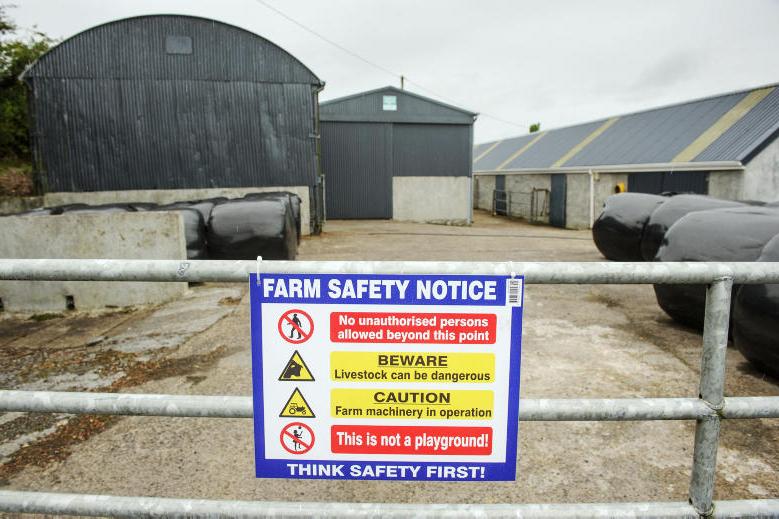
Fourteen people have lost their lives on Irish farms so far this year, keeping farming in the most dangerous spot of all occupations with a fatality rate eight times higher than that of the general working population. In half of those cases, machinery was involved.
Prof James Phelan of the Heath and Safety Authority (HSA), who chairs the Farm Safety Partnership, bringing together state agencies and farming organisations, took a longer view of those grim statistics. His presentation on the 504 fatal accidents recorded on Irish farms between 1989 and 2015 showed that two-thirds of those killed were self-employed farmers themselves. “The second largest group were non-farm workers,” Phelan pointed out: visitors who could not be expected to have a professional approach to farm safety.
He also noted that 81 children under 16 and 107 people over 70 had died on farms over the 16-year period, accounting for more than one in three fatal accidents. “Maybe these two groups shouldn’t be on the farm at all,” he wondered.
Table: fatalities classified by age of victim (1989-2015)
| Age of victim | Number | % |
|---|---|---|
| 15 or under | 81 | 16.1 |
| 16 to 35 | 74 | 14.7 |
| 36 to 70 | 246 | 48.9 |
| Over 70 | 102 | 20.3 |
| Total | 503 | 100 |
Source: HSA. Note: one fatality not classified by age above.
In the tillage sector, he said that the majority of fatalities concerned contractors.
“The farm workplace is not like the industrial workplace or even a building site in terms of the complexity and diversity of people that are there,” Phelan said, stressing the challenge this poses to preventing accidents.
’Postponing decisions’ can cause accidents
Teagasc’s director of knowledge transfer, Prof Tom Kelly, said that “90% of accidents have behavioural causes”. He highlighted “the issue of farmers postponing decisions – it can be about soil testing, but it can also be something more serious like changing a PTO shaft”.
Minister @PatBreen1 opens national farm safety conference in Mullingar: be careful not to take your familiar environment for granted pic.twitter.com/NSQxGuIXtI
— Farmers Journal (@farmersjournal) November 3, 2016
In some cases, there are no excuses for poor decisions. “Excuses account for nothing following an accident,” ICMSA president John Comer said. Yet, several speakers blamed time pressure on farmers, whether as a result of bureaucracy or financial stress, which causes them to take shortcuts in terms of safety.
Both Kelly and Phelan linked low farm incomes to increased safety risks. “For some low-income farmers maybe the next step is to get out of farming; it’s hard to get them to invest in safety,” he said. Phelan, too, argued that many of the most at-risk farmers were those on low incomes. With only 40% of the income of farm households now coming from farming, he said that a separate safety strategy should be targeted at part-time farmers. “The messages should be different,” he said.



SHARING OPTIONS