


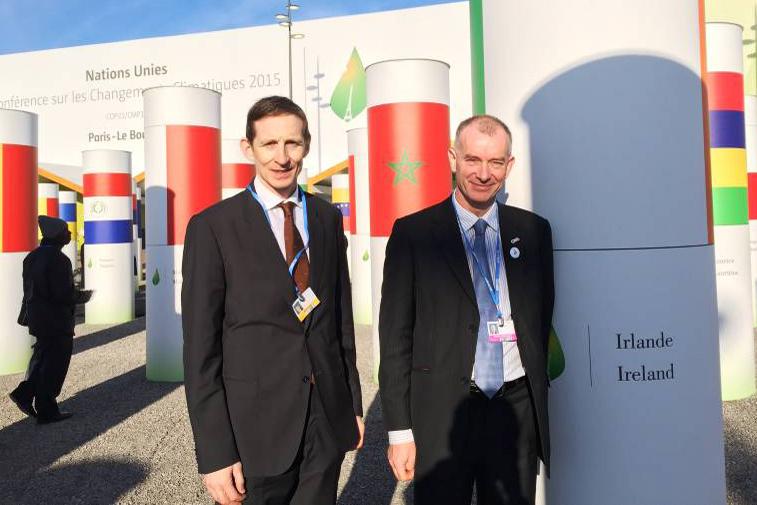
The IFA’s Environment Committee chair Harold Kingston and director of European affairs Liam MacHale have been coordinating with other members of the global umbrella group World Farmers’ Organisation (WFO) to follow the proceedings.
Simultaneous negotiations are in progress on various sections of the draft agreement expected to set global rules for the fight against climate change. It would be impossible for one single organisation to monitor all the activity unfolding in the aviation hangars converted into a conference centre outside Paris.
“We have a meeting with the WFO every morning to discuss the items on the agenda, and each organisation provides feedback to their national delegation,” MacHale said.
This is particularly important for Ireland, which has been seen as leading efforts to have agriculture taken on board in the upcoming climate agreement. Farming organisations and other civil society and lobby groups are not directly involved in the negotiations.
Farming representatives also take part in side events organised in parallel to the official talks to gauge how other countries, scientists and other interest groups approach various issues.
Funding for developing countries a sticking point
At this stage, they say funding to help developing countries tackle climate change is a major sticking point, especially with African states. “The Irish government has been lambasted on the amount of money put in,” said Kingston. “But most of what Ireland has to offer is technology and knowledge,” he added, explaining that Irish development funding is usually used to send experts on training missions overseas.
He referenced greenhouse gas emission measurements as part of programmes such as Bord Bia’s Origin Green as an example of techniques Ireland could export to help others in combating climate change.
One proposal that has seen support from African countries and seems on track to be included in the final agreement is a reference to food security, to ensure cuts to greenhouse gas emissions do not put food production at risk.
The biggest outcome is to have brought all these countries together and recognise the issues
Agreement on balancing different types of land use such as agriculture and forestry in calculating net emissions, however, seems more difficult to secure.
Yet Kingston added that this climate conference is showing more understanding for the role of agriculture than previous ones. “Farmers used to be looked at as a problem to be solved, now we are increasingly seen as part of the solution,” he said.
The direction given by the Paris conference will probably remain quite general. “The biggest outcome is to have brought all these countries together and recognise the issues,” Kingston said.
Meanwhile, the Oireachtas passed legislation committing Ireland to plan its actions to combat climate change on Thursday afternoon, and talks are due at EU level next year to share the effort between member states.
For more views from Harold Kingston on those various steps and their implications for farmers, listen to our podcast below:



SHARING OPTIONS