



A challenge has been put to NI dairy producers that fundamental change is required if the industry is to emerge from the current financial crisis gripping local dairy farms.
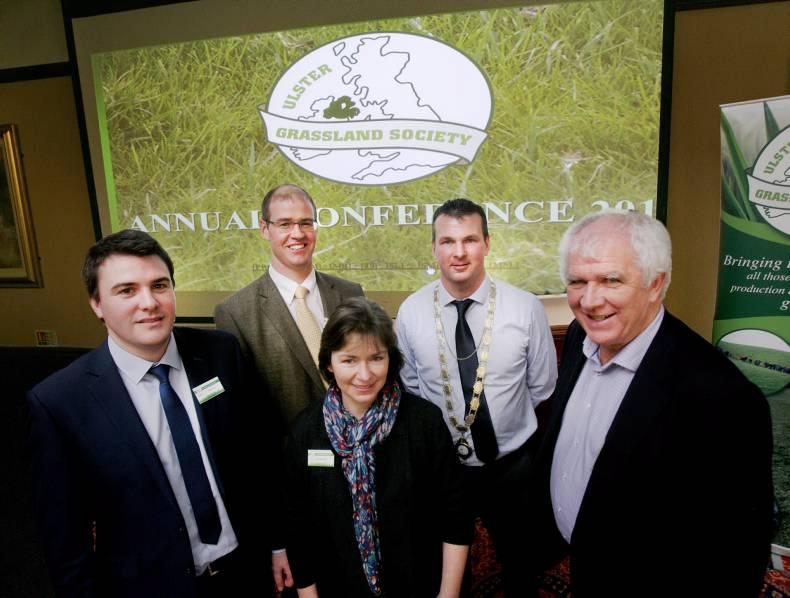
Speaking at the annual conference of the Ulster Grassland Society (UGS) earlier this week, Cork businessman Michael Murphy told over 160 delegates that farmers in NI must focus on low-cost milk production.
“I have the height of respect for all you dairy farmers, but are your systems serving you well? If this dip extends well into 2016 or 2017, are you just relying on the charity of banks to survive – that is never a good place to be,” he said.
Murphy has dairy farming interests in Ireland, north America, south America and New Zealand.
“From my experience, the best farmers anywhere have clear goals – they know what works and don’t get distracted. They are all focused on low-cost systems as it is the single best predictor of profit. It is all about low cost, not output per cow,” he said.
According to Murphy, a focus on milk yield per cow is driven by “slick salesmen”, which invariably means that money ends up in their pocket, not the pocket of farmers. He also questioned the lifestyle of many local farmers, working 85 hours per week, and rarely taking a break from the farm. “You are existing, not flourishing. Your first target should always be to have a good lifestyle. Are your children happy to go farming?” he questioned. He maintained that the low-cost model can also bring with it low labour requirements of 14 to 18 hours per cow per year.
New Zealand
While the Irish dairy industry often looks to New Zealand (NZ) as an example to follow, Murphy acknowledged that 70% of farmers there are losing money. “Many have lost the plot. Some farmers there have been chasing yield which has driven up their costs. But the top farmers in NZ are still the best in the world, and are still profitable and still relaxed about the current situation in markets,” he said.
He also maintained that it is possible on good land anywhere in Ireland to grow 14 to 18 tonnes of dry matter per hectare of grass. The aim should then be to utilise 85% of this grass by grazing down to 3.5cm, he said.
However, grassland management is one area probably now lacking on many local dairy farms. That prompted a young farmer finishing a degree in agricultural technology jointly awarded by CAFRE and Queens University, to speak out. During his studies, he had spent time on the dairy farm of the late Eddie Glass in New Zealand where he said his eyes had been opened to the potential of grazed grass.
“I am currently completing my degree, but during my studies we have spent a total of one hour measuring grass. Change needs to start with the education system. We are currently brainwashing young people into high-yielding systems,” he said.
Products which contain bacteria and enzymes to be added to slurry have been on the market for a number of years. Advocating their use, Jo Scamell, who runs a farm consultancy business in England told the UGS conference that slurry additives are now much more reliable than they were previously.
According to Scamell, the bugs act to kickstart the composting process in-store, eating away at any slurry crust (making mixing easier) and reducing smell when the slurry is applied to land. She reported results which suggested that treated slurry had up to 30% more nitrogen than untreated material, which would result in a significant saving in chemical fertiliser.
She also maintained that grazing livestock are less likely to reject subsequent grass after slurry spreading when bugs have been added.
Earthworms
However, perhaps the greatest benefit from the treated slurry, claimed Scamell, is that it is less harmful to earthworms, which are crucial for soil aeration, porosity and root development.
She suggested that farmers should dig a small hole to just below the grass roots to assess the earthworm population. If worms are a deep red colour it suggests they are feeding and active, but if they are small, narrow and slightly anaemic it suggests they are under stress from either excessive water or slurry, said Scamell.
While it should be noted that her claims that slurry kills earthworms is a widely held belief among farmers, this is not necessarily backed up by local science. A recent AFBI study showed that continuous applications of slurry over a 33-year period had no detrimental long-term effect on earthworm populations.
Soil – get the basics right
Encouraging farmers to think differently about their soil, Dr Stan Lalor from Grassland Agro told the UGS conference that having land only gives a farmer access to soil. It is the soil that is the key value component.
To illustrate his point, Lalor quoted 2013 soil test results from the Republic of Ireland, which involved up to 40,000 samples. It showed that 90% of soils were deficient in phosphorus (P) and/or potash (K) and/or lime. “If you are not testing your soils, there is a 90% chance that your assumption that everything is ok on your farm is wrong,” said Lalor.
With a soil analysis completed, he said that the next step is to correct any issues with soil pH by applying lime. Irish soils are naturally acidic and fertiliser uptake and organic matter breakdown also produces acidity, so it is not something to be corrected only once in a lifetime. The optimum soil pH is 6 to 6.5, and soils below this have reduced biological activity, and key nutrients such as phosphorus, potassium, sulphur, calcium and magnesium are all less readily available at below optimum pH levels. Ryegrass is less persistent in acidic soil. “If pH is wrong, and you are putting on P fertiliser it will just be locked up in the soil. Don’t waste money on nutrients that won’t be used efficiently,” said Lalor.
Once pH is corrected, it is then necessary to think about what needs to be added to meet crop requirements. “Firstly, think about what you can do with the nutrients within your farm gate such as slurry. The balance should then be made up with the chemical fertilisers you buy,” said Lalor. He said that too often farmers just buy in what they bought in the previous year, without questioning whether it is the right product for the farm.
Where there is a need for P and K application on grazing areas determined by soil analysis he suggested that 50% to 75% of the P and K requirement should be applied early in the season.
The new president of the UGS is Crumlin dairy farmer Mark Blelock. He takes over from AFBI grass specialist Dr David Johnston.
Listen to an interview with Mark Blelock in our podcast below:
The president elect for 2016 is Sam Watson from United Feeds.
At the UGS conference, honorary membership was given to Dr Scott Laidlaw in recognition of over 40 years of research work into grass and clover conducted at the Agri-Food and Biosciences Institute (AFBI).


SHARING OPTIONS