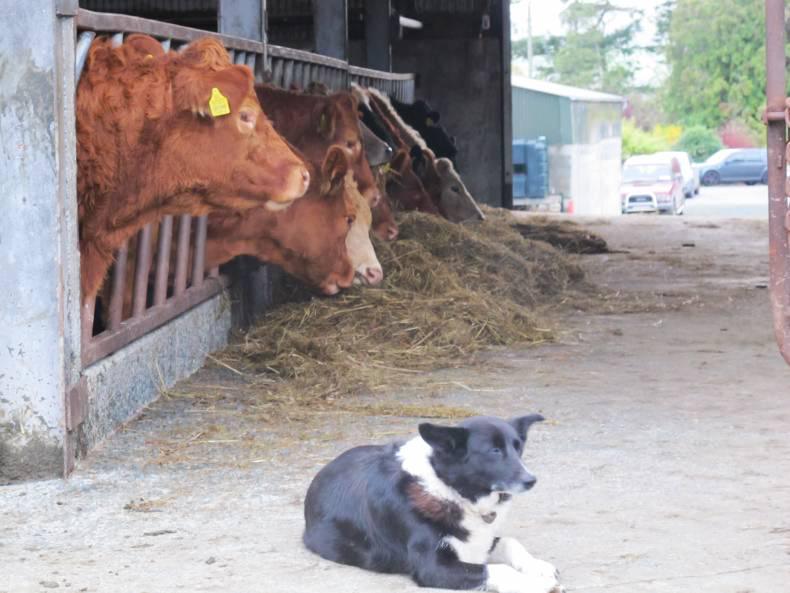
The harsh and wet weather has caused farmers on dry land to house stock that were out grazing.
In some cases, where heavy grass covers exist, light stock may be returned to grass in a few weeks to finish grazing.
However, for many, with land now saturated, returning cattle to grass is looking much less likely. Silage analysis has been carried out on all farms and supplementation rates have been formulated based on these.
Where supplementation is taking place for cattle that will return to grass, meal is being frontloaded and will be removed for the last month prior to turnout in early spring.
In some cases, where silage quality is above 74DMD, some farmers with store cattle are opting to store cattle over the winter with no concentrate supplementation. The target is to have a liveweight gain of 0.5-0.7kg/head per day over the housing period for these cattle before returning to grass.
With cattle being housed in the last week, the current focus is on lice and fluke control. In many cases, farmers in the programme have opted to treat for fluke prehousing, where faecal samples show an issue. Depending on the cattle type, a second treatment may be required.
In other instances, cattle are being dosed soon after housing with products covering mature and immature fluke. To control lice and reduce sweating, the backs of weanlings and finishing cattle have been clipped on some farms and lice treatment applied.
Cattle and, in particular, weanlings that have been housed are being watched carefully for any signs of pneumonia.
Fodder budgets have been completed on most farms in the past month, with particular focus on fodder budgets on those farms with the highest stocking rates. No issues with fodder supplies have been highlighted.
Housing has continued on dry farms.Frontloading of meal is taking place on most farms.Cattle housed have had backs clipped to reduce sweating.Treatment for fluke and lice has taken place.Billy Gilmore
Co Galway
Farming system Beef/replacement
Land type Dry to heavy
Growth rate (kgDm/Ha) -
Average farm cover (kgDm/ha) -
I have all the heifers housed on the farm at the moment. I took faecal samples from them prior to housing. I treated them for fluke and worms at housing. I clipped the heifers’ backs and treated for lice. I think this is one of the most important tasks at housing as I find it a great help to control lice.
As all the heifers were purchased, I vaccinated them for clostridial diseases. Heifers that I have selected for breeding and I intend to AI were vaccinated for Lepto. Silage sample analysis results were very good this year. The pit is 73 DMD and baled silage had an average of 71 DM.
The heifers are being fed bales of silage ad-lib at the moment. I have enough bales to feed until mid-December and I will open the pit then. The ewes will be housed at that stage and will be fed pit silage also.
Billy Glasheen
Co Tipperary
Farming system Store to beef
Land type Dry
Growth rate (kgDm/Ha) -
Average farm cover (kgDm/ha) -
I have almost all stock housed currently. Wet weather brought my grazing season to an abrupt end. I still have 16 light weanlings grazing the last of the silage ground, but they will be housed next week.
I am feeding my heavy steers to slaughter in the next six weeks. They are eating 4kg ration plus 74 DMD silage. They will be built up to 6kg in the next week. I have the rest of my stores on silage only and will aim to turn out early and finish off grass in May and June.
The only stock to be killed out of the shed will be my under-16-month bulls which will be killed next May.
They are eating 4kg of ration plus silage and will be built to ad-lib ration after Christmas. I slaughtered my 20-month bulls yesterday and they averaged 400kg carcase weight. They were purchased in March and had 145 days at grass and a 70-day indoor finishing period.
Willie Treacy
Co Louth
Farming system Suckler to beef
Land type Dry
Growth rate (kgDm/Ha) -
Average farm cover (kgDm/ha) -
Most cattle are now housed. There are a few weanlings still out, but the majority of them were housed in the past two weeks. At housing, their backs were clipped and they were treated for lice and worms with a pour on. I have not treated any cattle for fluke yet, I will wait a few weeks and treat them. Although I sometimes have some cattle show up positive for fluke, I don’t really have any fluke issues on the farm. I have a batch of autumn-born bulls inside for finishing and heifers also. The heifers came into the shed carrying good condition and will not require much feeding to finish. The bulls were weighed a month ago and came in at about 600kg on average. I am planning to start drafting the first of these for slaughter in about a month. Dry cows are housed on ad-lib 73DMD silage for the last two weeks. Once some bulls are slaughtered and there is more feed space, I will restrict the cows to 2/3 silage and 1/3 straw.
Adam Woods
Derrypatrick Herd,
Teagasc, Grange
Farming system Suckler to beef
Land type Dry to heavy
Growth rate (kgDm/Ha) -
Average farm cover (kgDm/ha) 640
We housed all cattle on 9 November as ground conditions deteriorated. We had about 5ha left to graze but we will graze this first in the spring. Our closing farm cover was 640 kg/DM/ha. We started closing on 5 October and finished on 9 November. Finishing cattle are on 6kg concentrates and ad-lib first-cut silage. Heifer weanlings are on 1.5kg/day concentrates and bull weanlings are on 2kg/day concentrates and good-quality first-cut silage. We hope to have all remaining progeny slaughtered by Christmas. Our silage analysed well, with first-cut coming in at 78DMD and 11.8% protein, second-cut at 72DMD and 11% protein and our surplus bales at 73DMD and 11.8% protein. We will feed the second-cut to our dry cows and pen according to condition score, with some restricted and some supplemented with straw. Weanlings were vaccinated prior to housing for IBR/RSV and PI3.
Read more
Grass+ dairy: With flooding in many parts, grazing is limited to very dry and high farms
The harsh and wet weather has caused farmers on dry land to house stock that were out grazing.
In some cases, where heavy grass covers exist, light stock may be returned to grass in a few weeks to finish grazing.
However, for many, with land now saturated, returning cattle to grass is looking much less likely. Silage analysis has been carried out on all farms and supplementation rates have been formulated based on these.
Where supplementation is taking place for cattle that will return to grass, meal is being frontloaded and will be removed for the last month prior to turnout in early spring.
In some cases, where silage quality is above 74DMD, some farmers with store cattle are opting to store cattle over the winter with no concentrate supplementation. The target is to have a liveweight gain of 0.5-0.7kg/head per day over the housing period for these cattle before returning to grass.
With cattle being housed in the last week, the current focus is on lice and fluke control. In many cases, farmers in the programme have opted to treat for fluke prehousing, where faecal samples show an issue. Depending on the cattle type, a second treatment may be required.
In other instances, cattle are being dosed soon after housing with products covering mature and immature fluke. To control lice and reduce sweating, the backs of weanlings and finishing cattle have been clipped on some farms and lice treatment applied.
Cattle and, in particular, weanlings that have been housed are being watched carefully for any signs of pneumonia.
Fodder budgets have been completed on most farms in the past month, with particular focus on fodder budgets on those farms with the highest stocking rates. No issues with fodder supplies have been highlighted.
Housing has continued on dry farms.Frontloading of meal is taking place on most farms.Cattle housed have had backs clipped to reduce sweating.Treatment for fluke and lice has taken place.Billy Gilmore
Co Galway
Farming system Beef/replacement
Land type Dry to heavy
Growth rate (kgDm/Ha) -
Average farm cover (kgDm/ha) -
I have all the heifers housed on the farm at the moment. I took faecal samples from them prior to housing. I treated them for fluke and worms at housing. I clipped the heifers’ backs and treated for lice. I think this is one of the most important tasks at housing as I find it a great help to control lice.
As all the heifers were purchased, I vaccinated them for clostridial diseases. Heifers that I have selected for breeding and I intend to AI were vaccinated for Lepto. Silage sample analysis results were very good this year. The pit is 73 DMD and baled silage had an average of 71 DM.
The heifers are being fed bales of silage ad-lib at the moment. I have enough bales to feed until mid-December and I will open the pit then. The ewes will be housed at that stage and will be fed pit silage also.
Billy Glasheen
Co Tipperary
Farming system Store to beef
Land type Dry
Growth rate (kgDm/Ha) -
Average farm cover (kgDm/ha) -
I have almost all stock housed currently. Wet weather brought my grazing season to an abrupt end. I still have 16 light weanlings grazing the last of the silage ground, but they will be housed next week.
I am feeding my heavy steers to slaughter in the next six weeks. They are eating 4kg ration plus 74 DMD silage. They will be built up to 6kg in the next week. I have the rest of my stores on silage only and will aim to turn out early and finish off grass in May and June.
The only stock to be killed out of the shed will be my under-16-month bulls which will be killed next May.
They are eating 4kg of ration plus silage and will be built to ad-lib ration after Christmas. I slaughtered my 20-month bulls yesterday and they averaged 400kg carcase weight. They were purchased in March and had 145 days at grass and a 70-day indoor finishing period.
Willie Treacy
Co Louth
Farming system Suckler to beef
Land type Dry
Growth rate (kgDm/Ha) -
Average farm cover (kgDm/ha) -
Most cattle are now housed. There are a few weanlings still out, but the majority of them were housed in the past two weeks. At housing, their backs were clipped and they were treated for lice and worms with a pour on. I have not treated any cattle for fluke yet, I will wait a few weeks and treat them. Although I sometimes have some cattle show up positive for fluke, I don’t really have any fluke issues on the farm. I have a batch of autumn-born bulls inside for finishing and heifers also. The heifers came into the shed carrying good condition and will not require much feeding to finish. The bulls were weighed a month ago and came in at about 600kg on average. I am planning to start drafting the first of these for slaughter in about a month. Dry cows are housed on ad-lib 73DMD silage for the last two weeks. Once some bulls are slaughtered and there is more feed space, I will restrict the cows to 2/3 silage and 1/3 straw.
Adam Woods
Derrypatrick Herd,
Teagasc, Grange
Farming system Suckler to beef
Land type Dry to heavy
Growth rate (kgDm/Ha) -
Average farm cover (kgDm/ha) 640
We housed all cattle on 9 November as ground conditions deteriorated. We had about 5ha left to graze but we will graze this first in the spring. Our closing farm cover was 640 kg/DM/ha. We started closing on 5 October and finished on 9 November. Finishing cattle are on 6kg concentrates and ad-lib first-cut silage. Heifer weanlings are on 1.5kg/day concentrates and bull weanlings are on 2kg/day concentrates and good-quality first-cut silage. We hope to have all remaining progeny slaughtered by Christmas. Our silage analysed well, with first-cut coming in at 78DMD and 11.8% protein, second-cut at 72DMD and 11% protein and our surplus bales at 73DMD and 11.8% protein. We will feed the second-cut to our dry cows and pen according to condition score, with some restricted and some supplemented with straw. Weanlings were vaccinated prior to housing for IBR/RSV and PI3.
Read more
Grass+ dairy: With flooding in many parts, grazing is limited to very dry and high farms






SHARING OPTIONS