‘Is the dairy industry ready for take-off’ was the topic addressed recently at the Dublin Economics Workshop (www.dublineconomics.com).
Assuming the group had limited knowledge of dairying, I explained how milk quotas had prevented growth in Irish dairy output for 30 years, but that we were now in an exciting expansion phase.
In fact, it is 40 years since the last greenfield primary dairy processing plant was opened here — Listowel, Co Kerry and Ballaghadereen, Co Roscommon in 1973.
We are a small player in global terms — at five billion litres, we produce less than 1% of the world’s milk. This places us 29th in the world in terms of cow’s milk output.
In most regions, milk is consumed where it is produced, but we export 85% of production. As a result, we ranked seventh in the global dairy trade league table for 2011.
There is a general assumption that milk output will expand rapidly here after quotas are removed. The Government and industry plan, Food Harvest 2020, targets 50% growth by 2020.
Is this wildly optimistic? I don’t think so. While price and weather will play a huge part, there is a lot of evidence to suggest the growth will happen. ICBF figures show it’s already happening, with more dairy replacements and increasing herd sizes.
Past performance is no guarantee of future success, but our performance in the years prior to the introduction of milk quotas suggests milk output growth should happen. Figure 1 calculates compound annual growth rate (CAGR) in milk output in key milk producing countries. For the 23 years prior to the introduction of milk quotas, Ireland’s annual rate of dairy expansion was one of the highest in the world, at 3.66%. During that period, we expanded milk output at twice the speed of the much heralded New Zealanders (1.81%).
Over the following 23 years, New Zealand expanded milk output at 2.9% per year, while we were static.
The real rapid growth in Ireland came after we joined the EEC — the compound annual growth rate in our milk production between 1975 and 1984 was 6% thanks to generous grant aid and new markets.
Ireland’s milk output was 3,212 million litres in 1975. Nine years later, when the shackles of milk quotas were placed on the country, output was 5,422 million litres. Twenty-nine years later, that’s more or less where it still sits.
The Dublin economists were particularly interested in milk processing and were visibly shocked to realise that we still have a fragmented processing structure — see map on opposite page.
In terms of weaknesses in our processing structure, I identified the following:
Lack of scale reducing efficiency in commodities. We are competing against ourselves in some areas, such as when selling to the infant formula sector. Much of the value added is being captured after we sell the ingredients — infant formula manufactured in Limerick by Nestlé sells for over €50,000 per tonne on Chinese retail shelves.There is duplication in transport, milk testing, quality assurance, etc.There is a low level of new product development due to sub-optimal research and development investment. Limited international brand strength (apart from Kerrygold in Germany and some niches).Of course, it is not all bad and I highlighted the strong positions in specific areas that the individual processors have developed.
On the global pitch where we are playing, our fragmentation means that we are small in scale. Among Irish processors, only Glanbia with 5.5 billion litres makes the world’s top 20 dairy processors (at 14). However, the majority of its milk pool is actually in the United States, rather than Ireland. New Zealand’s Fonterra tops the league, at 20 billion litres — four times the entire Irish milk pool. Dutch co-op, FrieslandCampina, is twice the size of Ireland, with 10 billion litres annually.
When New Zealand was faced with a similar dairy growth opportunity, the government put through legislation facilitating the formation of a ‘super co-op’, Fonterra, which processes 90% of the country’s milk. Their pragmatic view is that a monopoly is needed at home to achieve the scale required to compete in global markets.
In Ireland, we have a different approach. The IDB is a commercial co-operative, established by the State, but owned by the industry. All participants — apart from Kerry Group — use the IDB to export varying proportions of their commodities, such as butter, cheese and milk powder.
The IDB reports a dairy turnover of €1.3bn and is working hard under chief executive Kevin Lane to find new markets for the higher volumes of butter, milk powder and cheese, which it expects will come its way post 2015. It announced an investment in the Middle East recently and more is expected in the coming months. However, members are free to trade outside the IDB, which they do to a varying degree.
In China, Glanbia, Kerry, Lakeland, Dairygold and the IDB all participate in the market, even if they avoid competing directly. Dairygold is one of the leading suppliers of infant formula ingredients to global giant Danone and, also, directly to customers in China. GIIL also has strong market access across the globe and has stated an intention to sell more product on a direct business to business basis.
Our fragmented selling operation is best illustrated by the fact that Danone in Ireland is supplied with ingredients from Dairygold, Tipperary, Glanbia, Kerry and Lakeland.
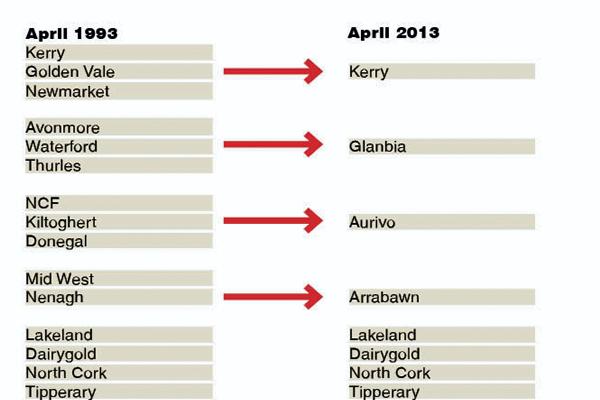
Change happens very slowly in Irish dairy processing. In the table below, I compare the April 2013 milk league with Joe Rea’s milk league from 20 years ago (1993). Twenty-three have become 16, with lots of room for further consolidation. While welcome in terms of preparation for growth, the €114m Dairy Investment Fund allocated in 2007 by the then Minister for Agriculture, Mary Coughlan, helped to preserve the status quo by allocating grant aid to 19 projects across 12 companies.
It could also be argued that the presence of the IDB has preserved the status quo; it has allowed smaller co-ops to remain viable as they can access international markets via this route. IDB banking arrangements also provide small co-ops with access to facilities generally preserved for multi-billion euro companies.
Dealing with static milk volumes is one thing; it is less clear how the smaller co-ops will survive in the volatile post quota world where new markets will have to be found for more milk each year.
Indeed, some believe that bankers rather than farmers may dictate the next evolution in Irish processing by refusing to fund working capital to multiple organisations.
Dairy expansion post 2015 has the potential to deliver huge economic benefit to rural Ireland. Thousands of farmers are revving up for growth. However, farmers need to be cautious as expansion can be a shortcut to going bust. There will be casualties. Many of our dairy farmers urgently need to learn from their pig farming neighbours, who have shown that technical efficiency generates the ability to survive and thrive through the peaks and troughs of price volatility. In pigs, farmers with high costs of production have simply disappeared.
If farmers can maximise efficiency and processors and the IDB successfully deliver higher value markets, we can achieve the targeted 50% volume growth, probably by 2021 or 2022. With annual exports of over €4bn, Ireland can then be one of top five dairy trading nations in the world.
‘Is the dairy industry ready for take-off’ was the topic addressed recently at the Dublin Economics Workshop (www.dublineconomics.com).
Assuming the group had limited knowledge of dairying, I explained how milk quotas had prevented growth in Irish dairy output for 30 years, but that we were now in an exciting expansion phase.
In fact, it is 40 years since the last greenfield primary dairy processing plant was opened here — Listowel, Co Kerry and Ballaghadereen, Co Roscommon in 1973.
We are a small player in global terms — at five billion litres, we produce less than 1% of the world’s milk. This places us 29th in the world in terms of cow’s milk output.
In most regions, milk is consumed where it is produced, but we export 85% of production. As a result, we ranked seventh in the global dairy trade league table for 2011.
There is a general assumption that milk output will expand rapidly here after quotas are removed. The Government and industry plan, Food Harvest 2020, targets 50% growth by 2020.
Is this wildly optimistic? I don’t think so. While price and weather will play a huge part, there is a lot of evidence to suggest the growth will happen. ICBF figures show it’s already happening, with more dairy replacements and increasing herd sizes.
Past performance is no guarantee of future success, but our performance in the years prior to the introduction of milk quotas suggests milk output growth should happen. Figure 1 calculates compound annual growth rate (CAGR) in milk output in key milk producing countries. For the 23 years prior to the introduction of milk quotas, Ireland’s annual rate of dairy expansion was one of the highest in the world, at 3.66%. During that period, we expanded milk output at twice the speed of the much heralded New Zealanders (1.81%).
Over the following 23 years, New Zealand expanded milk output at 2.9% per year, while we were static.
The real rapid growth in Ireland came after we joined the EEC — the compound annual growth rate in our milk production between 1975 and 1984 was 6% thanks to generous grant aid and new markets.
Ireland’s milk output was 3,212 million litres in 1975. Nine years later, when the shackles of milk quotas were placed on the country, output was 5,422 million litres. Twenty-nine years later, that’s more or less where it still sits.
The Dublin economists were particularly interested in milk processing and were visibly shocked to realise that we still have a fragmented processing structure — see map on opposite page.
In terms of weaknesses in our processing structure, I identified the following:
Lack of scale reducing efficiency in commodities. We are competing against ourselves in some areas, such as when selling to the infant formula sector. Much of the value added is being captured after we sell the ingredients — infant formula manufactured in Limerick by Nestlé sells for over €50,000 per tonne on Chinese retail shelves.There is duplication in transport, milk testing, quality assurance, etc.There is a low level of new product development due to sub-optimal research and development investment. Limited international brand strength (apart from Kerrygold in Germany and some niches).Of course, it is not all bad and I highlighted the strong positions in specific areas that the individual processors have developed.
On the global pitch where we are playing, our fragmentation means that we are small in scale. Among Irish processors, only Glanbia with 5.5 billion litres makes the world’s top 20 dairy processors (at 14). However, the majority of its milk pool is actually in the United States, rather than Ireland. New Zealand’s Fonterra tops the league, at 20 billion litres — four times the entire Irish milk pool. Dutch co-op, FrieslandCampina, is twice the size of Ireland, with 10 billion litres annually.
When New Zealand was faced with a similar dairy growth opportunity, the government put through legislation facilitating the formation of a ‘super co-op’, Fonterra, which processes 90% of the country’s milk. Their pragmatic view is that a monopoly is needed at home to achieve the scale required to compete in global markets.
In Ireland, we have a different approach. The IDB is a commercial co-operative, established by the State, but owned by the industry. All participants — apart from Kerry Group — use the IDB to export varying proportions of their commodities, such as butter, cheese and milk powder.
The IDB reports a dairy turnover of €1.3bn and is working hard under chief executive Kevin Lane to find new markets for the higher volumes of butter, milk powder and cheese, which it expects will come its way post 2015. It announced an investment in the Middle East recently and more is expected in the coming months. However, members are free to trade outside the IDB, which they do to a varying degree.
In China, Glanbia, Kerry, Lakeland, Dairygold and the IDB all participate in the market, even if they avoid competing directly. Dairygold is one of the leading suppliers of infant formula ingredients to global giant Danone and, also, directly to customers in China. GIIL also has strong market access across the globe and has stated an intention to sell more product on a direct business to business basis.
Our fragmented selling operation is best illustrated by the fact that Danone in Ireland is supplied with ingredients from Dairygold, Tipperary, Glanbia, Kerry and Lakeland.
Change happens very slowly in Irish dairy processing. In the table below, I compare the April 2013 milk league with Joe Rea’s milk league from 20 years ago (1993). Twenty-three have become 16, with lots of room for further consolidation. While welcome in terms of preparation for growth, the €114m Dairy Investment Fund allocated in 2007 by the then Minister for Agriculture, Mary Coughlan, helped to preserve the status quo by allocating grant aid to 19 projects across 12 companies.
It could also be argued that the presence of the IDB has preserved the status quo; it has allowed smaller co-ops to remain viable as they can access international markets via this route. IDB banking arrangements also provide small co-ops with access to facilities generally preserved for multi-billion euro companies.
Dealing with static milk volumes is one thing; it is less clear how the smaller co-ops will survive in the volatile post quota world where new markets will have to be found for more milk each year.
Indeed, some believe that bankers rather than farmers may dictate the next evolution in Irish processing by refusing to fund working capital to multiple organisations.
Dairy expansion post 2015 has the potential to deliver huge economic benefit to rural Ireland. Thousands of farmers are revving up for growth. However, farmers need to be cautious as expansion can be a shortcut to going bust. There will be casualties. Many of our dairy farmers urgently need to learn from their pig farming neighbours, who have shown that technical efficiency generates the ability to survive and thrive through the peaks and troughs of price volatility. In pigs, farmers with high costs of production have simply disappeared.
If farmers can maximise efficiency and processors and the IDB successfully deliver higher value markets, we can achieve the targeted 50% volume growth, probably by 2021 or 2022. With annual exports of over €4bn, Ireland can then be one of top five dairy trading nations in the world.






SHARING OPTIONS