



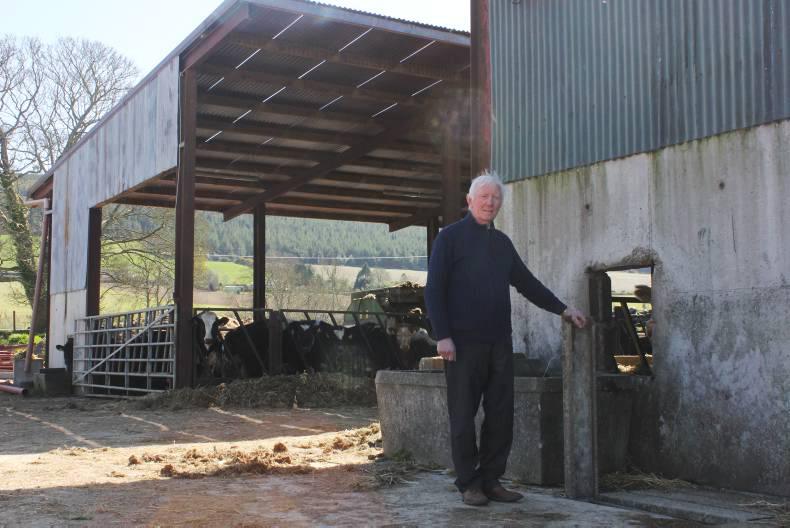
Suckler and sheep farmer Joe Kinsella from Wicklow recently spent five days in hospital after being overcome by toxic fumes produced from agitated slurry.
On the morning of 27 March 2015, Joe was busy with calving and lambing. Earlier that morning, the suckler and sheep farmer had arranged that his local contractor come to agitate his two slatted tanks.
“The contractor arrived around nine. Being aware of the risk these deadly gases could cause, I was very conscious seeing he was on his own working the machine.”
Joe went over at one stage when the agitation was going on to check progress in the second tank, as the first was done. After that he didn’t feel well. He had passed by the agitation opening for a very short period of time – “Seconds rather than minutes,” he said
Well-ventilated
His farm has two high, well-ventilated slatted tank houses which both have agitation points outside. Joe described the day of the incident: “It was a very calm day, a sunny day, a real good day but there was certainly very little wind, if any.”
The lack of wind had allowed the toxic fumes to linger around, and, without realising it, Joe had inhaled a few breaths of the deadly gas hydrogen sulphide, which had been produced during the agitation process.
He described how the events after this unfolded: “I just felt a bit dizzy, and then I started to feel much worse quite suddenly. I phoned my wife to come down and get me as I didn’t feel well. I got into the car then to see if I would get better, and tried to breathe normally.”
However, Joe felt he was getting worse even as he sat in the car, away from the toxic fumes. It was decided that a trip to A&E was needed before the situation got worse.
“I felt very unwell. I felt I was feverish. I was shivering and it appeared to me that the sudden shock had caused something like pneumonia,” Joe said.
The hospital journey took about an hour and a quarter. Joe’s wife had spoken with the doctor who in turn had phoned the hospital and told them there was an emergency case coming in, that this patient had to be seen promptly.
As a result, within 10 minutes of arriving in hospital he was on a drip.
“I was put on the initial drip for 24 hours to stabilise my temperature and after that I was put on another drip for two days. In total, I was in hospital for five days,” he said.
Joe said when they stabilised his temperature things eased a bit. But he didn’t feel the same and his speech has not fully recovered, because the toxic gasses affected his vocal cords. “I’m told that may take some time to get right – maybe many weeks.”
Joe was traumatised by the whole experience. “I felt a huge deal of fear. For the couple of days in hospital, every time I’d wake up I was thanking God that I was alive.”
Joe’s wife Maria said: “I knew he was in good care and was over the worst of it. Doctors telling you he was so lucky – that has to sink in with you.”
After surviving this chilling experience, Joe has some advice for other farmers working with slurry: “There’s no one that can be half careful enough when in the vicinity of agitating slurry. It’s a silent killer. There’s no smell off it and only a couple of intakes of breath with these deadly gases could be enough. I think people need to be much more aware and alert.”
Silent killer
Farm safety is high on the agenda after 30 deaths on farms in 2014 as well as a number of slurry-related deaths in recent times. Ireland stores, handles and spreads over 40m tonnes of slurry each year.





SHARING OPTIONS