All the dairy co-ops have set their milk price for June, with the majority issuing cuts.
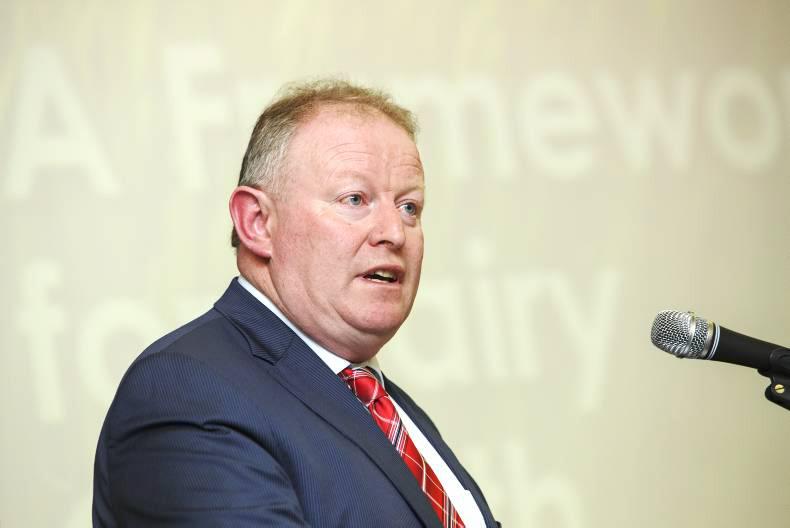
In the wake of the latest price cut by milk purchaser Town of Monaghan, IFA National Dairy Chairman Sean O’Leary called on co-ops to arrest the milk price slide.
The IFA chairman said co-ops need to focus on internal efficiencies, lower margins, and, where necessary, consolidation with other co-ops to offset the kind of long-term market downturn which from time to time will be a feature of volatility.
"Milk prices are down around 11 c/l since last April, that’s a 28% fall top to bottom, but it is equivalent to a 78% cut in our margins," he said.
"This means most farmers are now in loss making territory, with massive demands on their cashflow from superlevy and tax liabilities, repayments and contributions to their co-ops’ development plans.”
O'Leary said the situation is unsustainable, adding that the industry needs to start coming up with better strategies to offset poor market returns, especially in terms of internal efficiencies, including lowering their margins, and not shying away from consolidation decisions, where necessary.
"We know that we live in a more globalised dairy market, where wide price variations are influenced not just by global supply and demand, but also by demographics, weather events, geopolitical factors, currencies, economic trends, etc," he said.
"Our industry has invested heavily to partake in the growing global dairy demand, now it must equip itself with strategies to improve efficiency and value adding to ensure that, in times of poor returns, it does not rely on the soft option of unsustainable farm gate prices."
Last week, the Carbery group of co-ops in west Cork cut its price to 1c/l to 28.9c/l. Elsewhere, Aurivo cut but supported the price to 28c/l using its stability fund, Lakeland cut by 0.75c/l to 28c/l, Dairygold cut by 1c/l to 27c/l, Arrabawn cut to 27.87c/l, Glanbia Ingredients Ireland (GII) cut its price from 27.5c/l to 26c/l – this is then supplemented by 1c/l from its stability fund and 1c/l from the Glanbia co-op.
Kerry held at the same as its May price. All prices are VAT inclusive.
Overall, July has not been a good month for dairy farmers, with the last two Global Dairy Trade auctions seeing the average product price fall by 5.9% in the first week of July and a further 10.7% last week.
European Commissioner for Agriculture Phil Hogan is still coming under pressure from both the IFA and Minister for Agriculture Simon Coveney to raise the intervention price. However, the Commissioner is standing firmly over his refusal to intervene, saying there is an onus upon farmers to “follow market signals” with regard to supply.
Related stories
What is the GDT and how does it work?
Half of over quota farmers take superlevy scheme
All the dairy co-ops have set their milk price for June, with the majority issuing cuts.
In the wake of the latest price cut by milk purchaser Town of Monaghan, IFA National Dairy Chairman Sean O’Leary called on co-ops to arrest the milk price slide.
The IFA chairman said co-ops need to focus on internal efficiencies, lower margins, and, where necessary, consolidation with other co-ops to offset the kind of long-term market downturn which from time to time will be a feature of volatility.
"Milk prices are down around 11 c/l since last April, that’s a 28% fall top to bottom, but it is equivalent to a 78% cut in our margins," he said.
"This means most farmers are now in loss making territory, with massive demands on their cashflow from superlevy and tax liabilities, repayments and contributions to their co-ops’ development plans.”
O'Leary said the situation is unsustainable, adding that the industry needs to start coming up with better strategies to offset poor market returns, especially in terms of internal efficiencies, including lowering their margins, and not shying away from consolidation decisions, where necessary.
"We know that we live in a more globalised dairy market, where wide price variations are influenced not just by global supply and demand, but also by demographics, weather events, geopolitical factors, currencies, economic trends, etc," he said.
"Our industry has invested heavily to partake in the growing global dairy demand, now it must equip itself with strategies to improve efficiency and value adding to ensure that, in times of poor returns, it does not rely on the soft option of unsustainable farm gate prices."
Last week, the Carbery group of co-ops in west Cork cut its price to 1c/l to 28.9c/l. Elsewhere, Aurivo cut but supported the price to 28c/l using its stability fund, Lakeland cut by 0.75c/l to 28c/l, Dairygold cut by 1c/l to 27c/l, Arrabawn cut to 27.87c/l, Glanbia Ingredients Ireland (GII) cut its price from 27.5c/l to 26c/l – this is then supplemented by 1c/l from its stability fund and 1c/l from the Glanbia co-op.
Kerry held at the same as its May price. All prices are VAT inclusive.
Overall, July has not been a good month for dairy farmers, with the last two Global Dairy Trade auctions seeing the average product price fall by 5.9% in the first week of July and a further 10.7% last week.
European Commissioner for Agriculture Phil Hogan is still coming under pressure from both the IFA and Minister for Agriculture Simon Coveney to raise the intervention price. However, the Commissioner is standing firmly over his refusal to intervene, saying there is an onus upon farmers to “follow market signals” with regard to supply.
Related stories
What is the GDT and how does it work?
Half of over quota farmers take superlevy scheme







SHARING OPTIONS