


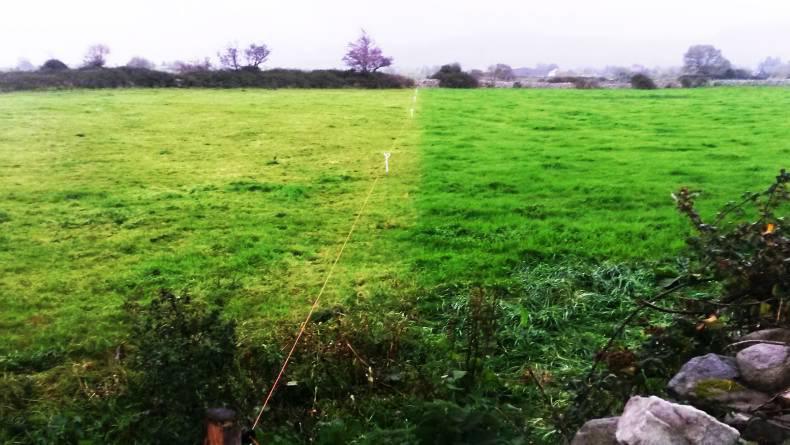
Grazing is associated with low nitrogen use efficiency, which means that, typically, only 15% to 30% of the nitrogen applied is captured in farm produce. The remainder of the nitrogen is either stored in the soil or lost to water or the atmosphere. Of particular concern is the loss of nitrous oxide (N2O), which is a powerful greenhouse gas responsible for approximately a third of greenhouse gas emissions in Ireland.
According to Teagasc, research to date has focused on the loss of nitrogen gases that are directly detrimental to our health, the climate and the environment. Losses of dinitrogen (N2), which comprises 78% of the air we breathe, are still poorly understood, due to difficulties in measuring them and the complexities of the processes involved. That means that, thus far, our scientific understanding of both nitrogen losses and greenhouse gas emissions from agriculture has been incomplete.
This collaborative research has found that grazed grassland soils account for 57% of the nitrogen applied in the form of cow urine to soil. The source of these benign emissions is a little known process called codenitrification. By contrast, emissions of the potent greenhouse gas nitrous oxide (N2O), accounted for merely 0.7% of the applied nitrogen.
“This discovery suggests that our grassland soils are able to convert a large part of the nitrogen losses into benign dinitrogen (N2) gas,” said Dr Karl Richards, principal investigator on the research project.
“However, we have to keep in mind that this nitrogen loss, while not environmentally damaging, still represents a significant economic loss of nitrogen to the farmer. Further research is required to see if this soil process can be manipulated to increase nitrogen use efficiency in grazed grasslands.”
According to Dr Gary Lanigan, coordinator of the Irish Agricultural Greenhouse Gas Network, there is still work to be done to gain further understanding.
“If we can understand the process further, then manipulation of codenitrification in soil may be a feasible option for reducing greenhouse gas emissions from grazed grasslands,” said Lanigan.
“This underlines the advances by the Irish agricultural greenhouse gas network in finding solutions for low carbon-agriculture, as highlighted at the COP21 in Paris this week.”
The research, published in the respected Nature Scientific Reports Journal, was led by Teagasc’s Environment, Soils and Land Use Research Department at Johnstown Castle in collaboration with partners in Northern Ireland (Agri-Food and Biosciences Institute) and New Zealand (Lincoln University and AgResearch). For a full version of the research paper “Confirmation of co-denitrification in grazed grassland” click here.



SHARING OPTIONS