




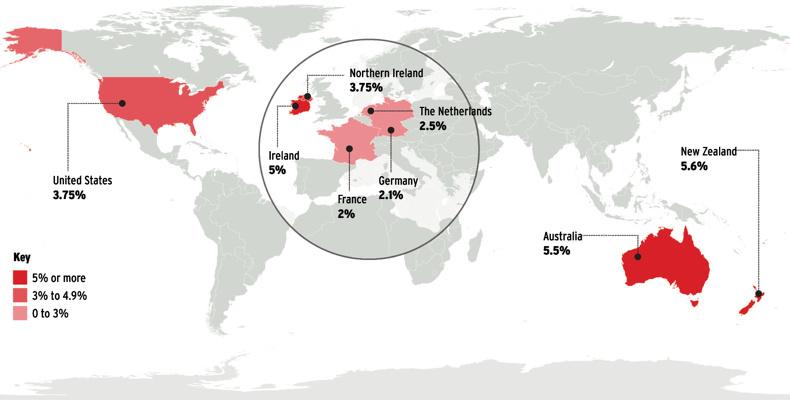
Our international survey of interest rates show Irish interest rates are among the higher rates available across Europe at the moment (see Figure 1).
Typically in Ireland, the average-risk farmer looking to borrow on a term loan, interest rates are over 6.75% unsecured or 5.75% secured. For on-farm investment over €100,000, rates of 5% are typcially on offer, while for investments to the value of over €300,000 rates can be negotiated downwards.
If a farmer is doing farm development then a variable rate of 4.5% to 4.6% is available to good clients with a 10-year repayment period. In France and the Netherlands, interest rates of 2% to 2.5% are available for on-farm development.
What does this rate difference mean?
While variable rates will of course go up and down over time, if we rolled that 2.5% to 3% difference in interest rates out over 10 years the Irish farmer will have repaid over €17,000 more to the bank on €100,000 borrowed for the period of the loan.
Effectively this means there is a difference in repayment of over €1,700 per year on this one loan. Many farmers will have multiple loans and many will have borrowings far in excess of €100,000 if completing farm infrastructure work or stock building.
International survey
We surveyed a number of other key countries that we compete with on global trade and most had lower interest rate options available to farmers with an average risk profile.
What we asked
We asked bankers if a farmer from that country was looking for €100,000 at a variable interest rate to be repaid over 10 years typcially what would the interest rate be. We were not looking for the best negotiated rate, rather what the average or typcial borrower can expect to pay if they walked into the bank at the moment to borrow €100,000 for on-farm development, whether that is to build a shed, milking parlour or grain store.
European neighbours France and the Netherlands had some very competive interest rates for on-farm development, with rates down under 2% for the best deals, but the average farmer able to achieve variable interest rates around 2%.
Northern Ireland
There is a lot of banking competition in Northern Ireland, with eight to 10 banks scrambling for farmer borrowing. A number of English banks creep into Northern Ireland and often cherrypick the large-scale operators that have a high borrowing requirement. AIB, Ulster Bank, Bank of Ireland, Danske bank, Barclays, HSBC, Santander, Lloyds, as well as a whole host of credit unions and leasing companies, are available for borrowing funds.
The typical agri package rate is in the order of 3.75%. Better rates are achieved if the borrowing requirement goes over €150,000 and 0.25 to 0.5% can be negotiated off. However, the standard rate is 3.75% plus the Bank of England base which currently stands at 0% or very close to 0.1%.
The Netherlands
Our Dutch source said: “It depends on the vision of the bank towards the farmer. I would expect some will not get money at all and they are already over-borrowed and instead will get the advice to sell some land. The others will pay 1.8% up until about 3.8 % variable interest and this depends on the risk they bring towards the bank’s financial goals, client track record and current borrowing, etc.
“The average customer not heavily borrowed, making good profits, and technically good can get money at 2.5%, which is not the best rate available.”
New Zealand and Australia
Interest rates in New Zealand and Australia have increased for a number of reasons not too dissimilar to Ireland. Rural agri banks have been asked to increase the capital they hold by central reserve banks and with a scarcity of funding this has pushed interest rates up and is likely to push them further according to some sources.
Shaun Crofskey from Westpac in New Zealand said: “Yes, banks in New Zealand have money to lend. Various banks do have varying amounts to lend given their strength of business. Over here, 10-year loans are very uncommon in the agri world. Depending on strength of the agri deal, there may be a seven- to eight-year fix rate offered (but would have to be a very strong client in equity and cashflow).
“So a typical five-year rate in NZ is 5.60%, based on a moderate risk. Short-term or floating would be 4.50%. The above fixed rate would have been mid-fours in August last year.
“With liquidity premiums, scarcity of funding occurring and other events around the world, we have seen rates rise accordingly. Australian rates are very similar to what I have quoted. Another couple of things in New Zealand is that the Reserve Bank has made us banks hold more capital.
“Also, with low term deposit rates currently, the mums and dads have taken money out of the bank and have been fuelling the housing markets, shares and gold. So, we need more money and we need to go overseas for that, and liquidity premiums have gone up. So as you can see there are lots of factors determining interest rates but when you look long-term, they are still good rates.”
America
American interest rates have lifted slightly (0.5%) in the last 15 months and some are suggesting they will do the same in the next six months. Typically, US farmers with an average track record will be paying variable interest rates of 3.75% to 4% for on-farm development. There is a range of government guaranteed programmes for younger farmers so they’d get money at less than 2%.
How to finance building a milking parlour, slatted tank or grain store in Ireland
Irrespective of which of the main agri-lending banks you go to in Ireland, the best rate is in the range of 4.5% to 4.75% variable interest rate over a period of 10 years. For the likes of Bank of Ireland, the maximum term for on-farm capital investment is in the region of 15 years, with maybe 20 years available for land purchase.
Yes, a VAT/grant bridging loan is possible and for some investment a 12-month interest-free option for year one might be available.
Typically for a €250,000 loan the bank would like to see 30% up front. If not then the bank will need to see evidence of what capital investment was made in last three or four years or what investment was made in generating a larger number of replacements, etc. AIB has similar constraints and conditions.






SHARING OPTIONS