Willie Treacy farms 65ha at Hackballscross, Co Louth. He calves 120 suckler cows annually, with 85 calving in the spring from January to March and 35 in the autumn from July to September.
A Limousin cross is the cow of choice, though there is a mixture of continental genetics throughout the herd.
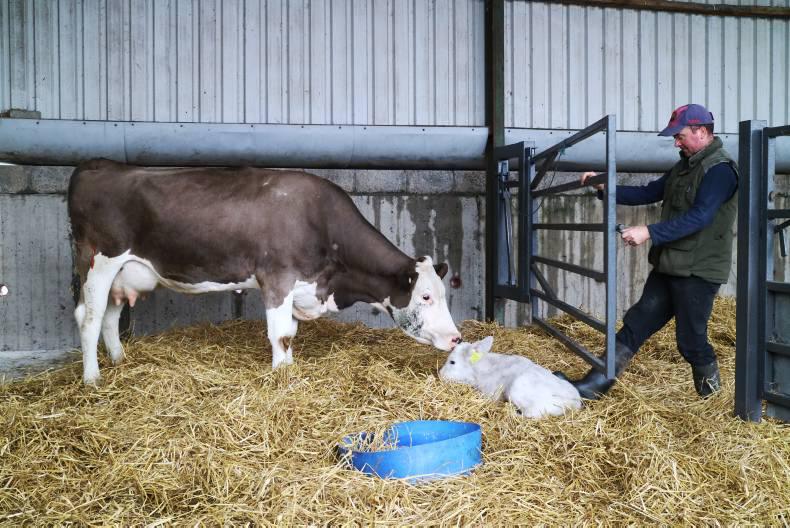 Recognisable sires such as Ronick Hawk (LM), Blelack Digger (CH), Malibu (LM), Seepa Tee Jay (SIM), Ardlea Dan (LM) and Tintin De My (BB) are prominent in the breeding herd. Willie uses a mixture of AI and stock bulls. Two easy-calving terminal Charolais bulls run with the cows and the Salers AI sire RIO was used on heifers in 2015, producing fine calves thus far. This year Willie has purchased 20 Limousin (ZGM) x Friesian heifer calves to rear and eventually incorporate into his breeding herd.
New heifers
“I want to inject some milk back into the herd, as well as docility. I’m upping numbers here and need a quiet cow to help keep the job an easy one. Docility is something that can suffer with these continental genetics. I have no fear of it affecting the performance of my calves beef-wise. Plenty of BETTER farmers have dairy-cross suckler cows and produce calves that hit big weights at young ages with good conformation scores. The Limousin sire (ZGM) is a good terminal type too – they should make ideal cows.
Bull progeny are finished on the grid under 16 months, but Willie is open to the idea of taking them to the mart as weanlings, depending on the strength of trade. Any heifer calves not earmarked as replacements are brought to beef at 20 months of age. Target carcase weights for bulls and heifers are 400kg and 350kg, respectively.
Willie Treacy has been one of the stalwarts of the BETTER farm programme since its inception eight years ago, having taken part in both phases one and two. The farm’s rise to success during that time has been staggering.
The path to success
Output is the name of the game in beef production – getting as much beef as possible out the gate each year. High levels of efficient output lead to healthy margins.
What is the main driver of output? Stocking rate. At 3.11 LU/ha, Willie Treacy is carrying close to three times the average Irish beef stocking rate. Since joining the programme in 2008, his stocking rate has almost doubled.
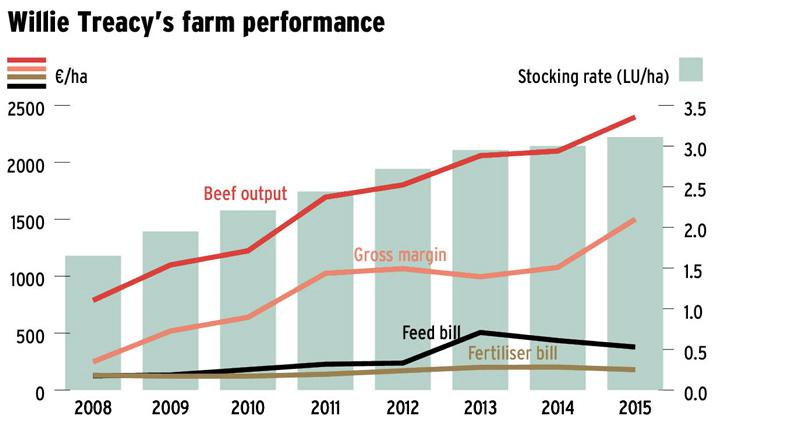
Sceptics who lament the increased feed and fertiliser costs required to run with such a high stocking rate need only look at the graphic. Willie Treacy has achieved this doubling of stocking rate, a trebling of output and increased his total gross margin by €81,380 in eight years and in the meantime kept feed and fertiliser bills, the two biggest variable costs in beef farming, relatively static.
The land at Hackballscross is dry in nature and Willie takes full advantage of this. When designing a farm plan, the BETTER farm team identified the potential that his farm had to grow grass and carry stock.
“I knew I had to push the farm in terms of getting more from my grass. Looking back, I couldn’t have imagined the heights we would reach just by getting the basics right. I started splitting paddocks, worked on correcting soil P, K and pH (lime) and measuring the farm weekly. When the figures are in front of you, it gives you the confidence to push the farm on and grow stock numbers. I’ve increased numbers that much, it’s like having two farms.
“When you have your grass right, everything else falls into place and things are much easier. Take this year for example; across the country people were complaining about how difficult it was to manage their grass quality when the growth spike came. Here, it was quite a comfortable year. When you’ve got the numbers to eat the grass it isn’t hard. The autumn-calving cows also help by acting as toppers if the spring herd needs to move early in times of high growth rates.”
The split herd also gives Willie some options in the shoulders of the year. In the spring, autumn cows can stay indoors and he can get calves out in February if conditions are wet. Likewise, spring-calvers can be weaned early and housed, leaving lighter calves grazing in the back-end of the year if needs be.
Cashflow and Willie’s workload are also spread out more evenly throughout the year.
Willie Treacy’s grass guide
I asked Willie for a five-step programme that any beef farmer can implement to get more from their grass.
1 Buy reels – splitting fields gives us options. Split plots, graze tight and do not be afraid to skip the next plot if things are strong. All will become clear when measurement begins.
2 Soil test – if soil nutrient and pH levels are below optimum, your farm’s grass growing ability will be too. Target slurry effectively and implement a ‘CAN ban’ for a few years if needs be.
3 Measure – get a grass programme, or a simple excel sheet. Then work out your stocking rate, daily grass demand, paddock areas and begin measuring weekly to see what your farm is growing. Adhere to spring- and autumn-grazing planners to build grass in the year’s shoulders.
4 Begin increasing numbers – there is no point growing extra grass and not eating it. Producing beef is more lucrative than producing bales.
5 Drinkers and fencing – Once comfortable with temporary paddock areas, install permanent fixtures.
Grassland management has been the cornerstone of Willie’s success in achieving both a very high gross and net margin since joining the programme. The main change with Willie was how his confidence grew in pushing the stocking rate as his grassland management skills improved. No major expense was incurred in achieving this apart from improving soil fertility, reseeding and dividing up paddocks which any successful farmer grass will be doing.
Read more
All BETTER farm reports
Willie Treacy farms 65ha at Hackballscross, Co Louth. He calves 120 suckler cows annually, with 85 calving in the spring from January to March and 35 in the autumn from July to September.
A Limousin cross is the cow of choice, though there is a mixture of continental genetics throughout the herd.
Recognisable sires such as Ronick Hawk (LM), Blelack Digger (CH), Malibu (LM), Seepa Tee Jay (SIM), Ardlea Dan (LM) and Tintin De My (BB) are prominent in the breeding herd. Willie uses a mixture of AI and stock bulls. Two easy-calving terminal Charolais bulls run with the cows and the Salers AI sire RIO was used on heifers in 2015, producing fine calves thus far. This year Willie has purchased 20 Limousin (ZGM) x Friesian heifer calves to rear and eventually incorporate into his breeding herd.
New heifers
“I want to inject some milk back into the herd, as well as docility. I’m upping numbers here and need a quiet cow to help keep the job an easy one. Docility is something that can suffer with these continental genetics. I have no fear of it affecting the performance of my calves beef-wise. Plenty of BETTER farmers have dairy-cross suckler cows and produce calves that hit big weights at young ages with good conformation scores. The Limousin sire (ZGM) is a good terminal type too – they should make ideal cows.
Bull progeny are finished on the grid under 16 months, but Willie is open to the idea of taking them to the mart as weanlings, depending on the strength of trade. Any heifer calves not earmarked as replacements are brought to beef at 20 months of age. Target carcase weights for bulls and heifers are 400kg and 350kg, respectively.
Willie Treacy has been one of the stalwarts of the BETTER farm programme since its inception eight years ago, having taken part in both phases one and two. The farm’s rise to success during that time has been staggering.
The path to success
Output is the name of the game in beef production – getting as much beef as possible out the gate each year. High levels of efficient output lead to healthy margins.
What is the main driver of output? Stocking rate. At 3.11 LU/ha, Willie Treacy is carrying close to three times the average Irish beef stocking rate. Since joining the programme in 2008, his stocking rate has almost doubled.
Sceptics who lament the increased feed and fertiliser costs required to run with such a high stocking rate need only look at the graphic. Willie Treacy has achieved this doubling of stocking rate, a trebling of output and increased his total gross margin by €81,380 in eight years and in the meantime kept feed and fertiliser bills, the two biggest variable costs in beef farming, relatively static.
The land at Hackballscross is dry in nature and Willie takes full advantage of this. When designing a farm plan, the BETTER farm team identified the potential that his farm had to grow grass and carry stock.
“I knew I had to push the farm in terms of getting more from my grass. Looking back, I couldn’t have imagined the heights we would reach just by getting the basics right. I started splitting paddocks, worked on correcting soil P, K and pH (lime) and measuring the farm weekly. When the figures are in front of you, it gives you the confidence to push the farm on and grow stock numbers. I’ve increased numbers that much, it’s like having two farms.
“When you have your grass right, everything else falls into place and things are much easier. Take this year for example; across the country people were complaining about how difficult it was to manage their grass quality when the growth spike came. Here, it was quite a comfortable year. When you’ve got the numbers to eat the grass it isn’t hard. The autumn-calving cows also help by acting as toppers if the spring herd needs to move early in times of high growth rates.”
The split herd also gives Willie some options in the shoulders of the year. In the spring, autumn cows can stay indoors and he can get calves out in February if conditions are wet. Likewise, spring-calvers can be weaned early and housed, leaving lighter calves grazing in the back-end of the year if needs be.
Cashflow and Willie’s workload are also spread out more evenly throughout the year.
Willie Treacy’s grass guide
I asked Willie for a five-step programme that any beef farmer can implement to get more from their grass.
1 Buy reels – splitting fields gives us options. Split plots, graze tight and do not be afraid to skip the next plot if things are strong. All will become clear when measurement begins.
2 Soil test – if soil nutrient and pH levels are below optimum, your farm’s grass growing ability will be too. Target slurry effectively and implement a ‘CAN ban’ for a few years if needs be.
3 Measure – get a grass programme, or a simple excel sheet. Then work out your stocking rate, daily grass demand, paddock areas and begin measuring weekly to see what your farm is growing. Adhere to spring- and autumn-grazing planners to build grass in the year’s shoulders.
4 Begin increasing numbers – there is no point growing extra grass and not eating it. Producing beef is more lucrative than producing bales.
5 Drinkers and fencing – Once comfortable with temporary paddock areas, install permanent fixtures.
Grassland management has been the cornerstone of Willie’s success in achieving both a very high gross and net margin since joining the programme. The main change with Willie was how his confidence grew in pushing the stocking rate as his grassland management skills improved. No major expense was incurred in achieving this apart from improving soil fertility, reseeding and dividing up paddocks which any successful farmer grass will be doing.
Read more
All BETTER farm reports






SHARING OPTIONS