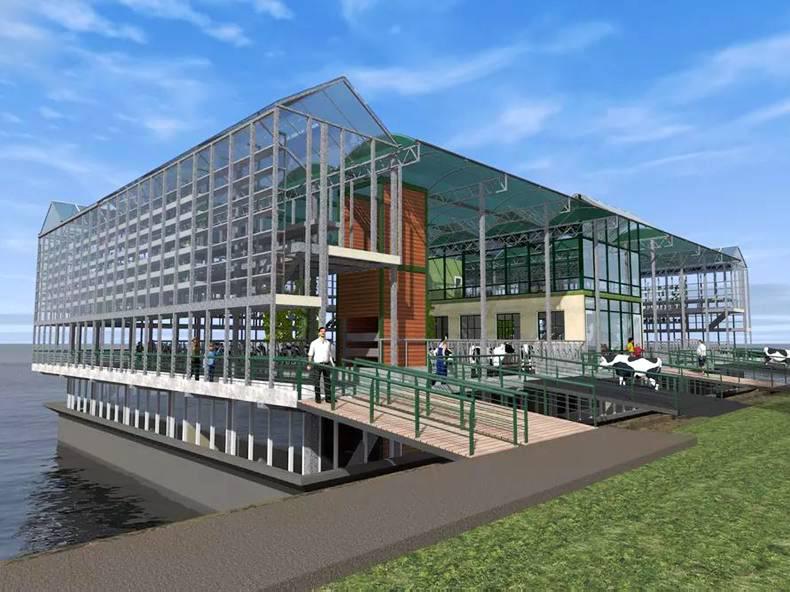
Docked in the port of Rotterdam, construction gets underway in June on the Floating Farm, a new project in the Netherlands which aims to address the need to feed growing city populations despite the decreasing amount of land for food production.
Floating Farm is a collaboration between three Dutch companies: Courage, the innovation institute of the Dutch agriculture and dairy sector; Uit Je Eigen Stad, the national frontrunner on city farming; and Beladon, the leading Dutch company on floating concepts.
With space for 40 cows to produce around 1,500kg of milk every day, the idea is that fresh dairy products will be produced daily. The farm will be powered by solar and wind, while the grass for feeding the cattle will be grown in short cycles on special beds using LED lights.
Renewable energy
A special floor where the cows are housed will separate urine and manure. Nutrients will be recovered for agriculture, energy production and for materials for the construction industry. A biodigester will be employed to turn the manure into biogas and fertilisers, which in turn can be used to help grow the grass used to feed the cows. Rainwater, too, will be collected and filtered for the cows to drink.
Floating Farm will also include a high-tech living lab, where research will be carried out on a range of sustainable agricultural methods. It will be open to visitors, as well as research companies and universities, who are welcome to test and experiment on sustainable, self-sufficient dairy farm production.
By producing fresh milk and dairy products very close to the consumers in the city, the farm will reduce transport and logistics while reducing greenhouse gas emissions.
“The world’s population is growing very fast, especially in Asia and Africa. The demand for food will grow automatically with the growth of the population and the increasing welfare. More and more people are able to buy food. The big question is actually how and where are we going to produce this food and how healthy is the food we massively need to produce. On the other hand, we know that there are still 1bn people who suffer from malnutricious food.
“Food production for a growing world population is an immense challenge. The number of arable land is decreasing while cities are growing to cope with the demand for housing,” it reads on the Floating Farm website.
Read more
Why should farmers consider solar panels?
Docked in the port of Rotterdam, construction gets underway in June on the Floating Farm, a new project in the Netherlands which aims to address the need to feed growing city populations despite the decreasing amount of land for food production.
Floating Farm is a collaboration between three Dutch companies: Courage, the innovation institute of the Dutch agriculture and dairy sector; Uit Je Eigen Stad, the national frontrunner on city farming; and Beladon, the leading Dutch company on floating concepts.
With space for 40 cows to produce around 1,500kg of milk every day, the idea is that fresh dairy products will be produced daily. The farm will be powered by solar and wind, while the grass for feeding the cattle will be grown in short cycles on special beds using LED lights.
Renewable energy
A special floor where the cows are housed will separate urine and manure. Nutrients will be recovered for agriculture, energy production and for materials for the construction industry. A biodigester will be employed to turn the manure into biogas and fertilisers, which in turn can be used to help grow the grass used to feed the cows. Rainwater, too, will be collected and filtered for the cows to drink.
Floating Farm will also include a high-tech living lab, where research will be carried out on a range of sustainable agricultural methods. It will be open to visitors, as well as research companies and universities, who are welcome to test and experiment on sustainable, self-sufficient dairy farm production.
By producing fresh milk and dairy products very close to the consumers in the city, the farm will reduce transport and logistics while reducing greenhouse gas emissions.
“The world’s population is growing very fast, especially in Asia and Africa. The demand for food will grow automatically with the growth of the population and the increasing welfare. More and more people are able to buy food. The big question is actually how and where are we going to produce this food and how healthy is the food we massively need to produce. On the other hand, we know that there are still 1bn people who suffer from malnutricious food.
“Food production for a growing world population is an immense challenge. The number of arable land is decreasing while cities are growing to cope with the demand for housing,” it reads on the Floating Farm website.
Read more
Why should farmers consider solar panels?






SHARING OPTIONS