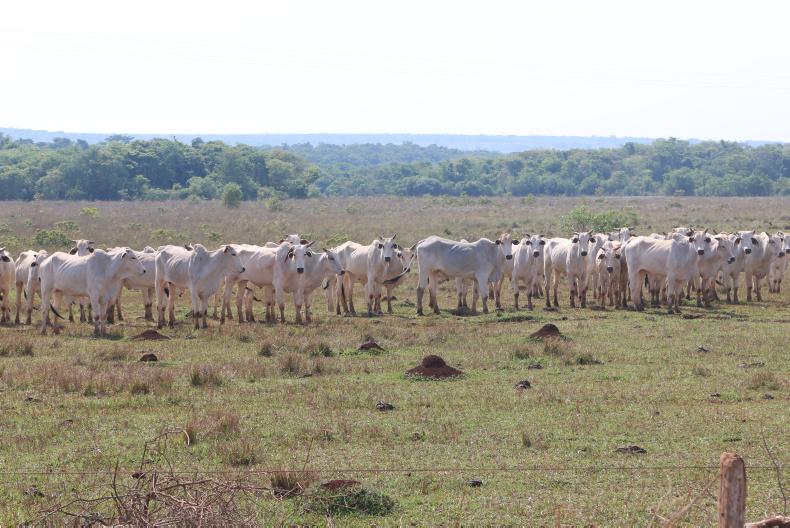
While the vast land area of Brazil is an advantage in relation to productive capacity, it naturally presents serious challenges for a country where so much of its focus is on exports. The logistical challenges are further compounded by the fact that its main production states are inland and therefore well away from Brazil’s network of ports.
Having overcome the production challenges inside the farm gate, there is no doubt that the biggest barrier now facing Brazil in relation to realising the full potential of its agricultural sector is getting product to port.
At present, this is facilitated by a highly inefficient convoy of trucks which account for between 65-60% of internal freight – this compares with just 20% in the US.
While there is a rail network, it is not only lacking investment but controlled by a single rail operator. As a result, the price of rail freight is conveniently aligned to the costs of road freight and not the 50% reduction that would be evident in other parts of the world.
Efficiencies
This environment seriously erodes much of the production cost efficiencies inside the farm gate. For example, as shown in Figure 3, exporting one tonne of soya from Brazil to China currently costs US$90/t, broken down into $63/t for road freight to port and US$27/t for shipping. This compares with $45/t in Argentina and $44/t in the US.
While Brazil may be one of the lowest cost producers, by the time the product reaches port it struggles to remain competitive.
Farmers and the agri-business sector are hopeful that the recent removal of President Rousseff and her Workers’ Party from government should see the introduction of more business-friendly policy and recognise the need for infrastructural development.
Plans for a major rail investment were outlined for 2025, but deep down there is a realisation that such a major project will only be undertaken if backed financially by the Chinese.
It is more likely that the response to high internal transport costs will be found at farm and industry level by trading the protein pyramid. At almost US$70/t, internal freight costs represent 30% of the port value of corn. Clearly, moving higher-value proteins such as pork, beef or chicken would represent a much better value proposition. US$70/t in freight cost is a much better value proposition for a product worth $2,000-3,000/t.
The move is already starting, with a growing number of farms integrating intensive livestock systems into arable enterprise either in the form of poultry units, beef feedlots, high-input dairy units and even fish ponds.
This is perhaps a window into the future of Brazilian exports. While grain production will undoubtedly continue to increase, the export profile is likely to continue to diversify across the range of proteins.
Read more
Brazil’s outdoor glass house turns on production tap
While the vast land area of Brazil is an advantage in relation to productive capacity, it naturally presents serious challenges for a country where so much of its focus is on exports. The logistical challenges are further compounded by the fact that its main production states are inland and therefore well away from Brazil’s network of ports.
Having overcome the production challenges inside the farm gate, there is no doubt that the biggest barrier now facing Brazil in relation to realising the full potential of its agricultural sector is getting product to port.
At present, this is facilitated by a highly inefficient convoy of trucks which account for between 65-60% of internal freight – this compares with just 20% in the US.
While there is a rail network, it is not only lacking investment but controlled by a single rail operator. As a result, the price of rail freight is conveniently aligned to the costs of road freight and not the 50% reduction that would be evident in other parts of the world.
Efficiencies
This environment seriously erodes much of the production cost efficiencies inside the farm gate. For example, as shown in Figure 3, exporting one tonne of soya from Brazil to China currently costs US$90/t, broken down into $63/t for road freight to port and US$27/t for shipping. This compares with $45/t in Argentina and $44/t in the US.
While Brazil may be one of the lowest cost producers, by the time the product reaches port it struggles to remain competitive.
Farmers and the agri-business sector are hopeful that the recent removal of President Rousseff and her Workers’ Party from government should see the introduction of more business-friendly policy and recognise the need for infrastructural development.
Plans for a major rail investment were outlined for 2025, but deep down there is a realisation that such a major project will only be undertaken if backed financially by the Chinese.
It is more likely that the response to high internal transport costs will be found at farm and industry level by trading the protein pyramid. At almost US$70/t, internal freight costs represent 30% of the port value of corn. Clearly, moving higher-value proteins such as pork, beef or chicken would represent a much better value proposition. US$70/t in freight cost is a much better value proposition for a product worth $2,000-3,000/t.
The move is already starting, with a growing number of farms integrating intensive livestock systems into arable enterprise either in the form of poultry units, beef feedlots, high-input dairy units and even fish ponds.
This is perhaps a window into the future of Brazilian exports. While grain production will undoubtedly continue to increase, the export profile is likely to continue to diversify across the range of proteins.
Read more
Brazil’s outdoor glass house turns on production tap
SHARING OPTIONS