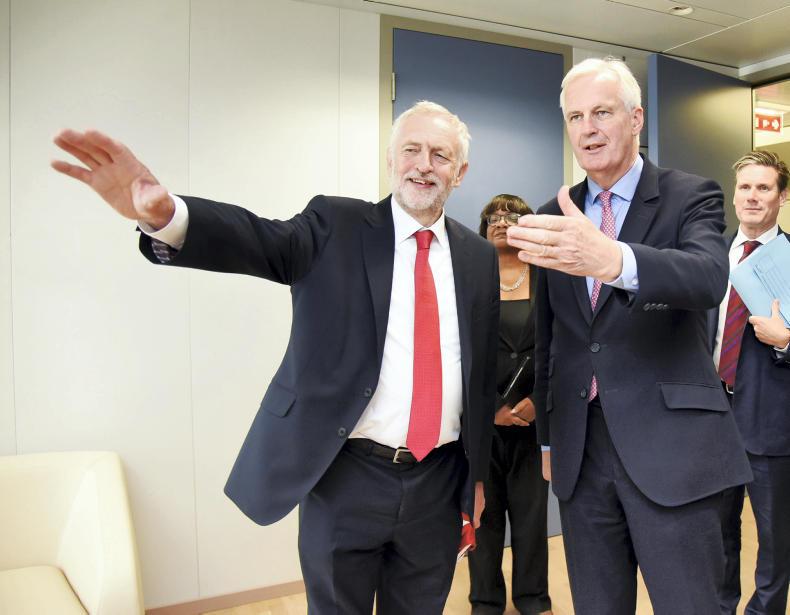
UK Labour party leader Jeremy Corbyn meeting with Michael Barnier, the EU Commission's lead negotiator in July.
ADVERTISEMENT
David Davis, the UK cabinet Minister leading the Brexit negotiations, arrived in Brussels on Monday afternoon for the third round of negotiations on the UK’s exit from the EU. Davis and Michel Barnier, the EU lead negotiator, made a media appearance ahead of talks commencing and it was clear that the focus of each side remains very different.
For the UK, it is about the future trade arrangement; for the EU, it is about the terms of leaving first. With the heads of state due to meet in October to assess progress on this before moving to the next stage, time is running out.
Watch an interview with UUP MEP Jim Nicholson in Brussels in our video below:
ADVERTISEMENT
Assuming that the negotiators can get over this first hurdle and that could well take more than this week’s talks, the fault lines between the EU and UK are becoming clearer but the route to reconciling them remains unclear. The Labour Party, which is the main opposition party in the UK Parliament, provided a twist to the Brexit debate at the weekend with the announcement of a new policy that would see the UK remain part of the Customs Union and Single Market for a transition period, and accepting the current rules for membership.
They also held out the possibility of longer-term participation if they could reach a satisfactory arrangement with the EU on migration. This will make the passage of the Repeal Bill in the UK parliament this autumn, where the Government has a wafer-thin majority, very interesting indeed.
Arrangements
All of the position papers published so far indicate that the UK wants to retain all of the present trading arrangements while at the same time following the three big ideas of the Brexit ideology. These are taking back control of the borders, meaning an end to the freedom of movement of people with the EU, making its own trade deals outside the EU framework and withdrawal of jurisdiction of the European Court of Justice, the ECJ. On the ECJ, the UK position paper did demonstrate some flexibility by tabling the “Mantua option”, which is arbitration followed by referral to the ECJ for final ruling.
Even on the thorny issue of the “Brexit bill”, UK foreign secretary Boris Johnson has moved from his earlier position of suggesting that the EU go and whistle to a recognition that there would be a cost that had to be met. The Brexit bill is one of the EU red line issues, so it is possible to visualise some movement on it and the ECJ issue, despite murmurings of a reluctance by the UK to provide their methodology for calculating.
It is impossible to reconcile the present UK and EU negotiating positions on trade and people movement without a hard border on the island of Ireland.
The UK was idealistic in stating that it would not be responsible for imposing a border of any sort, never mind a hard border. Just how an open Irish border with an equally open Ireland to citizens of the other 26 members of the EU fits is impossible to explain. It could be claimed that employment records and registration for social services would act as a control.
Outside the system
While that may be, in turn that would create a huge undocumented economy, similar to what has existed in the US for several decades. Low-paid jobs would attract workers who would operate outside the system without the protection of employment law and, more importantly from a UK perspective, be completely unknown to the authorities. At least the present official entry system provides a measure of control with its checking of passports at the point of entry. Therefore, the UK position paper on the Irish border arguably puts it in a position with even less control on the movement of people into the UK.
On the movement of goods, it is the EU that will be imposing checks as the Irish border will be only land frontier between the UK and EU. If the UK is trading with other third countries, then it is impossible to visualise the EU allowing the Republic of Ireland to be a back door into the other 26 members for products.
It is also difficult to visualise how a “fudge” can be found that satisfies both parties on something as definitive as being part of the Customs Union.
Border controls
Even in what the UK considers an ideal arrangement, a comprehensive free trade agreement (FTA), there remains the issue of border controls. The Canadian-EU agreement, often presented as the ideal FTA, still has border controls and strict quota allocation for sensitive agricultural products such as beef and dairy.
Adherence to agreed standards has to be demonstrated and quotas complied with. Also in this “ideal” outcome, the cost of doing business was estimated to increase by 5% in work carried out on behalf of the UK regional agriculture departments.
Many positions have been stated on the EU and UK sides but negotiations are only just beginning. The publication of the UK Labour Party’s alternative position also means that there is a way to go within the UK before a final position on what they will settle for is fully decided.
This content is available to digital subscribers and loyalty code users only. Sign in to your account, use the code or subscribe to get unlimited access.
The reader loyalty code gives you full access to the site from when you enter it until the following Wednesday at 9pm. Find your unique code on the back page of Irish Country Living every week.
CODE ACCEPTED
You have full access to the site until next Wednesday at 9pm.
CODE NOT VALID
Please try again or contact support.
David Davis, the UK cabinet Minister leading the Brexit negotiations, arrived in Brussels on Monday afternoon for the third round of negotiations on the UK’s exit from the EU. Davis and Michel Barnier, the EU lead negotiator, made a media appearance ahead of talks commencing and it was clear that the focus of each side remains very different.
For the UK, it is about the future trade arrangement; for the EU, it is about the terms of leaving first. With the heads of state due to meet in October to assess progress on this before moving to the next stage, time is running out.
Watch an interview with UUP MEP Jim Nicholson in Brussels in our video below:
Assuming that the negotiators can get over this first hurdle and that could well take more than this week’s talks, the fault lines between the EU and UK are becoming clearer but the route to reconciling them remains unclear. The Labour Party, which is the main opposition party in the UK Parliament, provided a twist to the Brexit debate at the weekend with the announcement of a new policy that would see the UK remain part of the Customs Union and Single Market for a transition period, and accepting the current rules for membership.
They also held out the possibility of longer-term participation if they could reach a satisfactory arrangement with the EU on migration. This will make the passage of the Repeal Bill in the UK parliament this autumn, where the Government has a wafer-thin majority, very interesting indeed.
Arrangements
All of the position papers published so far indicate that the UK wants to retain all of the present trading arrangements while at the same time following the three big ideas of the Brexit ideology. These are taking back control of the borders, meaning an end to the freedom of movement of people with the EU, making its own trade deals outside the EU framework and withdrawal of jurisdiction of the European Court of Justice, the ECJ. On the ECJ, the UK position paper did demonstrate some flexibility by tabling the “Mantua option”, which is arbitration followed by referral to the ECJ for final ruling.
Even on the thorny issue of the “Brexit bill”, UK foreign secretary Boris Johnson has moved from his earlier position of suggesting that the EU go and whistle to a recognition that there would be a cost that had to be met. The Brexit bill is one of the EU red line issues, so it is possible to visualise some movement on it and the ECJ issue, despite murmurings of a reluctance by the UK to provide their methodology for calculating.
It is impossible to reconcile the present UK and EU negotiating positions on trade and people movement without a hard border on the island of Ireland.
The UK was idealistic in stating that it would not be responsible for imposing a border of any sort, never mind a hard border. Just how an open Irish border with an equally open Ireland to citizens of the other 26 members of the EU fits is impossible to explain. It could be claimed that employment records and registration for social services would act as a control.
Outside the system
While that may be, in turn that would create a huge undocumented economy, similar to what has existed in the US for several decades. Low-paid jobs would attract workers who would operate outside the system without the protection of employment law and, more importantly from a UK perspective, be completely unknown to the authorities. At least the present official entry system provides a measure of control with its checking of passports at the point of entry. Therefore, the UK position paper on the Irish border arguably puts it in a position with even less control on the movement of people into the UK.
On the movement of goods, it is the EU that will be imposing checks as the Irish border will be only land frontier between the UK and EU. If the UK is trading with other third countries, then it is impossible to visualise the EU allowing the Republic of Ireland to be a back door into the other 26 members for products.
It is also difficult to visualise how a “fudge” can be found that satisfies both parties on something as definitive as being part of the Customs Union.
Border controls
Even in what the UK considers an ideal arrangement, a comprehensive free trade agreement (FTA), there remains the issue of border controls. The Canadian-EU agreement, often presented as the ideal FTA, still has border controls and strict quota allocation for sensitive agricultural products such as beef and dairy.
Adherence to agreed standards has to be demonstrated and quotas complied with. Also in this “ideal” outcome, the cost of doing business was estimated to increase by 5% in work carried out on behalf of the UK regional agriculture departments.
Many positions have been stated on the EU and UK sides but negotiations are only just beginning. The publication of the UK Labour Party’s alternative position also means that there is a way to go within the UK before a final position on what they will settle for is fully decided.
If you would like to speak to a member of our team, please call us on 01-4199525.
Link sent to your email address
We have sent an email to your address. Please click on the link in this email to reset your password. If you can't find it in your inbox, please check your spam folder. If you can't find the email, please call us on 01-4199525.
ENTER YOUR LOYALTY CODE:
The reader loyalty code gives you full access to the site from when you enter it until the following Wednesday at 9pm. Find your unique code on the back page of Irish Country Living every week.






SHARING OPTIONS