


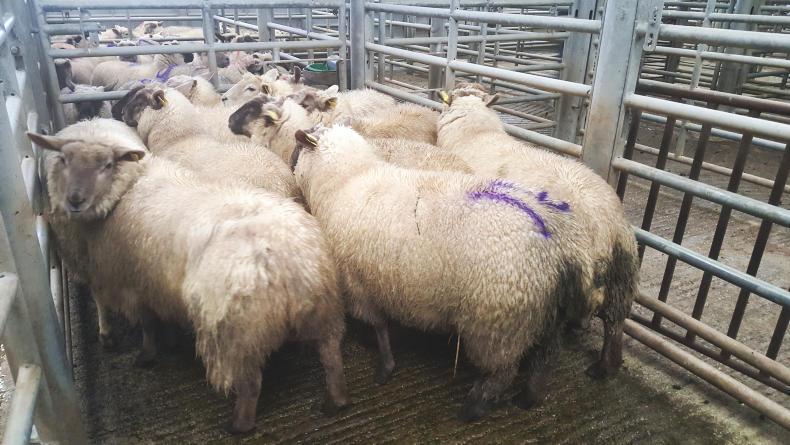
Local meat factories that process lambs want to kill a greater proportion of NI’s lamb crop, chief executive of the NI Meat Exporters Association (NIMEA) Conall Donnelly has said.
With Foyle Campsie and WD Meats both stopping their lamb kills over the past 12 years it has left four factories in NI (Dunbia, ABP Lurgan, Linden Foods and Primestock) with part-time lamb kill lines. Just under half of the NI lamb crop is slaughtered in the Republic of Ireland.
“Our members [NI factories] are strongly committed to the sector and want to process more sheep. We would like to take a bigger share of the market,” Donnelly said at last week’s efficient lamb production conference at CAFRE Greenmount.
With NI processors able to sell into the high-value UK retail market, Donnelly maintained that lambs need to be no more than 21kg to 22kg carcase weight, and farm quality assured, to get the highest price. “We need a conversation at an industry level about how to get more sheep farmers into the Farm Quality Assurance Scheme,” he said.
He also maintained that lamb legs are popular in the UK market, but legs from overweight carcases can be too heavy and expensive for many consumers.
When asked if processors should change the payment structure to incentivise lighter lambs, he suggested that this could lead to factories losing lambs to southern Irish competitors. “An incentive has to come from a cut somewhere else. It is very difficult with a competitive live market,” he said.
Brexit
In the event of a hard Brexit and no EU-UK trade deal, Donnelly said that WTO tariffs would increase the cost of NI lambs to southern Irish processors by around 20% and would most likely stop the live export market. However, he maintained that there would be enough capacity in NI factories to process the entire NI lamb crop.
Selling the product would be another issue, especially with WTO tariffs likely to also cut off important sheepmeat export markets in the EU, such as France. The focus would have to be on the domestic UK market and third countries in that scenario.
He pointed out that the NI lamb kill equates to only 2% of the UK lamb kill and so an additional 400,000 lambs processed in NI would not increase the total UK kill as much as perhaps thought.
However, third-country markets would still be vital for selling lamb products not consumed in the UK market and Donnelly singled out China as a key priority. “Work to get into the Chinese market has started and it will take another few years at least. Some estimates suggest it could be 2022,” he said.
Several speakers at the event predicted that lamb prices would drop in the event of a hard Brexit, with the only positive being that cheaper lamb might get UK consumers buying more.
Read more from the event on page 37



SHARING OPTIONS