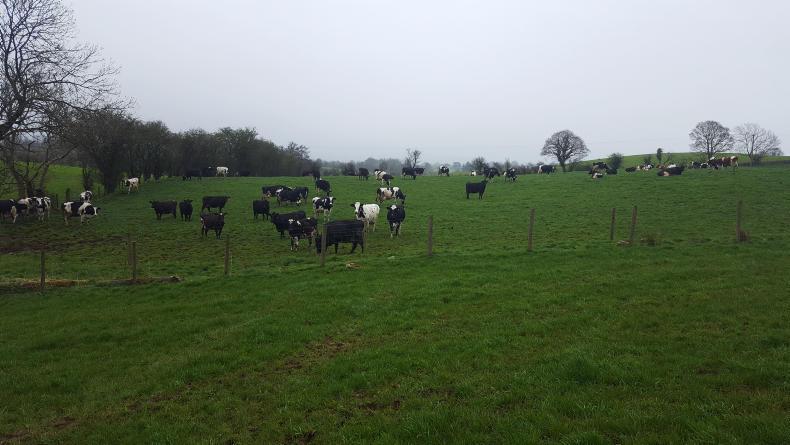
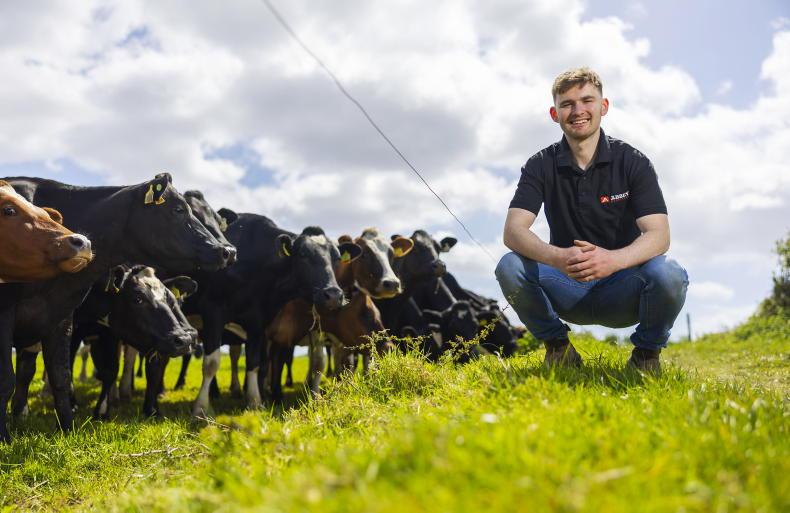
Reducing concentrate feed levels and increasing milk production from grazed grass is the focus for David Hunter on his farm near Newtownstewart, Co Tyrone.
Last year, the 75-cow herd averaged 6,147 litres from 1.5t of concentrates, equating to a milk from forage figure of 2,814 litres. However, the target for David is to produce over 3,750 litres from forage, with cows yielding 6,000 litres from 1t of concentrates.
The Hunter farm was converted from sucklers to dairying six years ago when David finished his studies at Greenmount. At that time, there was significant investment made in reseeding the entire grazing block, constructing laneways, renovating existing buildings, erecting new sheds and installing a second-hand parlour.
“We went for a grass-based system because this is a relatively dry farm and I had been to New Zealand in my placement year and got experience on a spring-calving farm,” David said at an event on his farm last week organised by LacPatrick Co-op.
“‘I liked the efficiency of the system. You calve the cows in the spring and focus mainly on grazing for the rest of the year,” he said.
The dairy herd was started by buying in a mixture of Holstein and Friesian-type heifers. However, Jersey semen is now being used, with the long-term aim of developing a crossbred herd.
David wants to breed a cow that will produce milk from grass, go in calf within a 12-week breeding period, and produce milk with high fat and protein levels for additional component payments. Solids have increased in recent years, and last year’s rolling average was 4.04% butterfat and 3.39% protein.
Cow numbers have gradually increased on the Hunter farm and there will be 80 cows milking this year. However, David said that land availability is the limiting factor, and between 80 to 85 cows is his maximum potential herd size at present.
Grass and silage
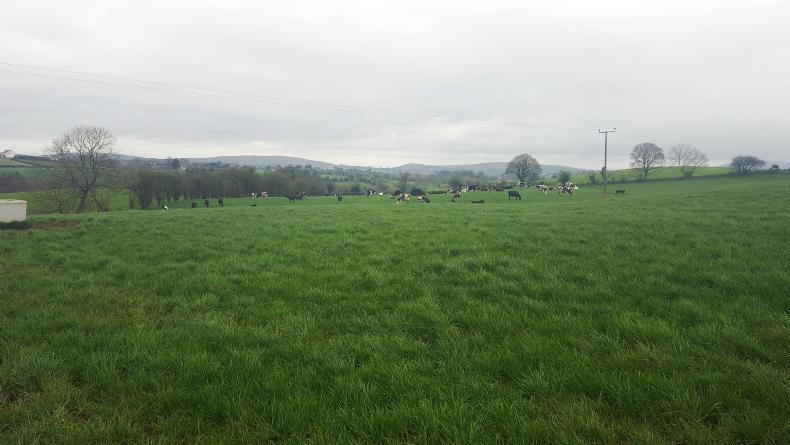
Grass growth on the Hunter farm last year was 15.3tDM/ha and soil analysis carried out over the winter shows that pH across the farm ranges from 5.8 to 6.7, with the average sitting at the recommended level for grassland at 6.3.
Cows got to grass in the last week of February this year, but were housed again in mid-March for a few weeks. Full time grazing started again last week and concentrate levels will gradually be reduced from an average rate of 7.5kg/cow/day to 1kg to 2kg/cow/day by peak grass growth.
Although grazed grass is central to David’s system, he is also focusing on making better-quality silage this year so that less meal needs to be fed when milking cows are housed. In 2017, first-cut and second-cut had dry matter of 22.2% and 38%, metabolisable energy of 10.9 and 10.5MJ/kgDM and crude protein of 13.0% and 13.5%, respectively.
“Three weeks ago, I wished I had better-quality silage because it was hard to get milk out of cows,” David acknowledged.
Top farms perform better across the board
The most profitable dairy farms in NI are achieving the best results across a broad range of performance benchmarks, according to CAFRE dairy technologist Jason McFerran.
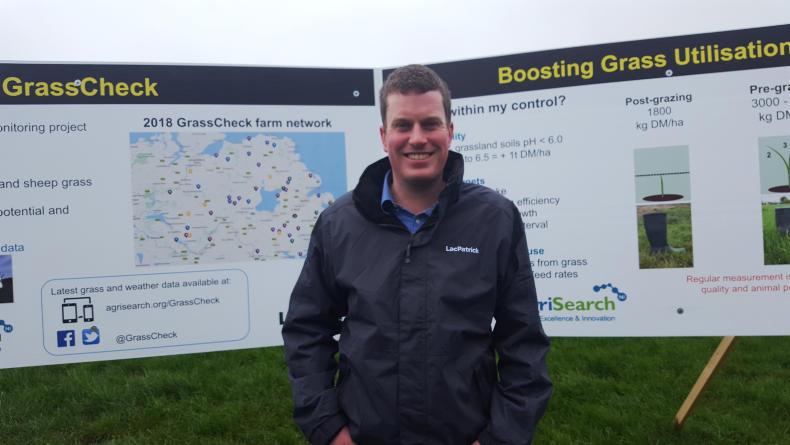
“CAFRE benchmarking figures consistently show that the top performers are doing everything better,” he said at last week’s event near Newtownstewart.
Figures for around 500 NI dairy farmers in the 2016/17 financial year show that the top 25% of farms fed 2,100kg concentrates and produced 2,599 litres from forage. This compares with 2,494kg of concentrates and 1,509 litres from forage among the bottom 25% performing farms.
Replacement rates were 27% in the top quartile of farms and 32% in the bottom quartile of benchmarking dairy farms.
In the 2016/17 year, the top 25% of farms received a milk price of 23.04p/l, which was 1.33p/l more than the bottom 25% due to better-quality payments. Butterfat, protein and bactoscan was 4.07%, 3.27% and 30,000/ml among the top quartile and 3.98%, 3.21% and 34,000/ml in the bottom 25% of farms.
Costs were lower on the most profitable farms with variable costs of £762 and overhead costs of £371 recorded in the top 25%, compared with £790 and £487 in the bottom quartile, respectively. This equates to net margins of £631/cow and £47/cow in the two groups in 2016/17.
“Unless you are recording you won’t know where you are. You need to be able to look at your own figures and make decisions based on them. It is not good enough to look at someone else’s figures,” McFerran said.
Read more
Grass growth double NI average on Tyrone dairy farm
Dairylink Ireland: breeding the right cow for the system
Reducing concentrate feed levels and increasing milk production from grazed grass is the focus for David Hunter on his farm near Newtownstewart, Co Tyrone.
Last year, the 75-cow herd averaged 6,147 litres from 1.5t of concentrates, equating to a milk from forage figure of 2,814 litres. However, the target for David is to produce over 3,750 litres from forage, with cows yielding 6,000 litres from 1t of concentrates.
The Hunter farm was converted from sucklers to dairying six years ago when David finished his studies at Greenmount. At that time, there was significant investment made in reseeding the entire grazing block, constructing laneways, renovating existing buildings, erecting new sheds and installing a second-hand parlour.
“We went for a grass-based system because this is a relatively dry farm and I had been to New Zealand in my placement year and got experience on a spring-calving farm,” David said at an event on his farm last week organised by LacPatrick Co-op.
“‘I liked the efficiency of the system. You calve the cows in the spring and focus mainly on grazing for the rest of the year,” he said.
The dairy herd was started by buying in a mixture of Holstein and Friesian-type heifers. However, Jersey semen is now being used, with the long-term aim of developing a crossbred herd.
David wants to breed a cow that will produce milk from grass, go in calf within a 12-week breeding period, and produce milk with high fat and protein levels for additional component payments. Solids have increased in recent years, and last year’s rolling average was 4.04% butterfat and 3.39% protein.
Cow numbers have gradually increased on the Hunter farm and there will be 80 cows milking this year. However, David said that land availability is the limiting factor, and between 80 to 85 cows is his maximum potential herd size at present.
Grass and silage
Grass growth on the Hunter farm last year was 15.3tDM/ha and soil analysis carried out over the winter shows that pH across the farm ranges from 5.8 to 6.7, with the average sitting at the recommended level for grassland at 6.3.
Cows got to grass in the last week of February this year, but were housed again in mid-March for a few weeks. Full time grazing started again last week and concentrate levels will gradually be reduced from an average rate of 7.5kg/cow/day to 1kg to 2kg/cow/day by peak grass growth.
Although grazed grass is central to David’s system, he is also focusing on making better-quality silage this year so that less meal needs to be fed when milking cows are housed. In 2017, first-cut and second-cut had dry matter of 22.2% and 38%, metabolisable energy of 10.9 and 10.5MJ/kgDM and crude protein of 13.0% and 13.5%, respectively.
“Three weeks ago, I wished I had better-quality silage because it was hard to get milk out of cows,” David acknowledged.
Top farms perform better across the board
The most profitable dairy farms in NI are achieving the best results across a broad range of performance benchmarks, according to CAFRE dairy technologist Jason McFerran.
“CAFRE benchmarking figures consistently show that the top performers are doing everything better,” he said at last week’s event near Newtownstewart.
Figures for around 500 NI dairy farmers in the 2016/17 financial year show that the top 25% of farms fed 2,100kg concentrates and produced 2,599 litres from forage. This compares with 2,494kg of concentrates and 1,509 litres from forage among the bottom 25% performing farms.
Replacement rates were 27% in the top quartile of farms and 32% in the bottom quartile of benchmarking dairy farms.
In the 2016/17 year, the top 25% of farms received a milk price of 23.04p/l, which was 1.33p/l more than the bottom 25% due to better-quality payments. Butterfat, protein and bactoscan was 4.07%, 3.27% and 30,000/ml among the top quartile and 3.98%, 3.21% and 34,000/ml in the bottom 25% of farms.
Costs were lower on the most profitable farms with variable costs of £762 and overhead costs of £371 recorded in the top 25%, compared with £790 and £487 in the bottom quartile, respectively. This equates to net margins of £631/cow and £47/cow in the two groups in 2016/17.
“Unless you are recording you won’t know where you are. You need to be able to look at your own figures and make decisions based on them. It is not good enough to look at someone else’s figures,” McFerran said.
Read more
Grass growth double NI average on Tyrone dairy farm
Dairylink Ireland: breeding the right cow for the system






SHARING OPTIONS