The initial results from a lamb from grass study on six lowland farms which are part of the AgriSearch GrassCheck project has highlighted the significant potential benefits to be had from rotational grazing of ewes and lambs.
The study seeks to evaluate four versus eight paddock rotational grazing systems in mid-season lambing flocks.
The aim is to go into swards that are 8 to 10cm and graze down to 4cm. In the four-paddock system, sheep are generally in each paddock for seven to eight days. In the eight-paddock system, they are usually in each paddock for three to four days.
Later in the season, when lambs are weaned, the plan is to graze ewes behind lambs.
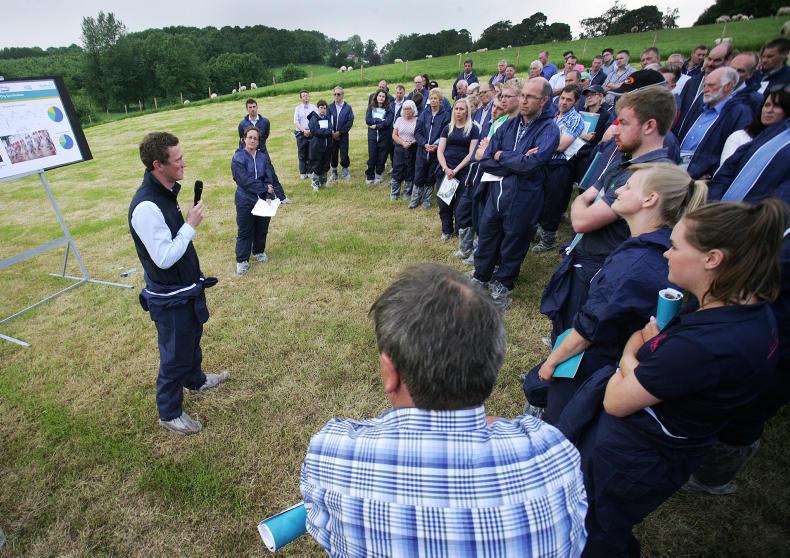
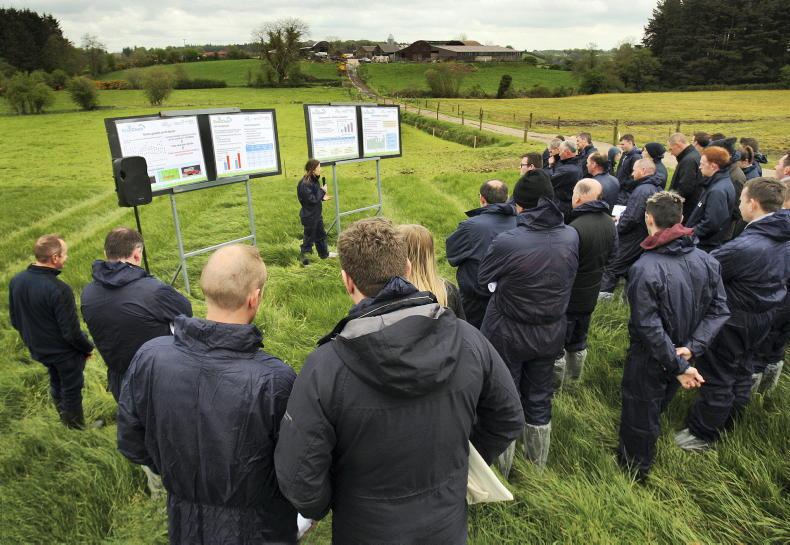
Speaking at a sheep farm walk held at AFBI Loughgall this week, Elizabeth Earle from AgriSearch said that rotational grazing provides the opportunity to grow more grass, and therefore increase stocking rate and liveweight gain per hectare.
One of those participating in the study is Saintfield sheep producer, Crosby Cleland.
He has split two areas of 6ha. The first is in four paddocks, the second in eight. Both blocks are carrying 15 ewes per hectare, plus lambs. At six weeks, growth rate of lambs was virtually identical on both grazing blocks (246 and 244g/day).
Despite the high stocking rate, surplus grass has been removed as silage on both grazing areas.
However, more surplus has been taken off the eight-paddock system, with weekly grass measurements indicating that it has yielded an extra 0.7t grass dry matter/ha to date.
“It really shows the benefit of rotational grazing. You will have more production and more silage,” said Earle.
While acknowledging that rams must be structurally sound and be characteristic of the breed, Dr Liz Genever from AHDB encouraged more sheep farmers to also select on the basis of estimated breeding values (EBVs).
During her presentation at the sheep event at AFBI Loughgall, she provided an update on the Ram Compare project, run by AHDB along with various industry partners including AgriSearch and Dunbia. It is the UK’s first commercial progeny test of rams, and in its first two years compared the progeny from five terminal sires (Texel; Suffolk; Meatlinc; Hampshire Down; Charollais) on six commercial farms.
Expansion
For 2018, the project has been expanded on to eight commercial farms in Britain, and also the 340-ewe flock at AFBI. More breeds have been added this year, to include South Down and polled Dorset.
The farms involved in the project collect performance data, while data is also obtained at slaughter, allowing a new carcase merit index to be calculated across the various breeds. Future plans include converting this index into a financial index that should be more meaningful to farmers, and to produce an EBV for days to slaughter, which should be possible as more data becomes available.
Evaluation
In NI, while the AFBI sheep flock is taking part in Ram Compare, using Texel and Suffolk rams from the UK Signet performance recording system, it is also assessing Texel and Suffolk rams evaluated using the Sheep Ireland system. This could help develop links between both systems.
Researchers at AFBI are also calculating net feed efficiency in lambs, which could ultimately lead to the development of EBVs for this trait.
Read more
Watch: AFBI investigates genetic potential of NI sheep
NI hoggets compare favourably with NZ lamb
The initial results from a lamb from grass study on six lowland farms which are part of the AgriSearch GrassCheck project has highlighted the significant potential benefits to be had from rotational grazing of ewes and lambs.
The study seeks to evaluate four versus eight paddock rotational grazing systems in mid-season lambing flocks.
The aim is to go into swards that are 8 to 10cm and graze down to 4cm. In the four-paddock system, sheep are generally in each paddock for seven to eight days. In the eight-paddock system, they are usually in each paddock for three to four days.
Later in the season, when lambs are weaned, the plan is to graze ewes behind lambs.
Speaking at a sheep farm walk held at AFBI Loughgall this week, Elizabeth Earle from AgriSearch said that rotational grazing provides the opportunity to grow more grass, and therefore increase stocking rate and liveweight gain per hectare.
One of those participating in the study is Saintfield sheep producer, Crosby Cleland.
He has split two areas of 6ha. The first is in four paddocks, the second in eight. Both blocks are carrying 15 ewes per hectare, plus lambs. At six weeks, growth rate of lambs was virtually identical on both grazing blocks (246 and 244g/day).
Despite the high stocking rate, surplus grass has been removed as silage on both grazing areas.
However, more surplus has been taken off the eight-paddock system, with weekly grass measurements indicating that it has yielded an extra 0.7t grass dry matter/ha to date.
“It really shows the benefit of rotational grazing. You will have more production and more silage,” said Earle.
While acknowledging that rams must be structurally sound and be characteristic of the breed, Dr Liz Genever from AHDB encouraged more sheep farmers to also select on the basis of estimated breeding values (EBVs).
During her presentation at the sheep event at AFBI Loughgall, she provided an update on the Ram Compare project, run by AHDB along with various industry partners including AgriSearch and Dunbia. It is the UK’s first commercial progeny test of rams, and in its first two years compared the progeny from five terminal sires (Texel; Suffolk; Meatlinc; Hampshire Down; Charollais) on six commercial farms.
Expansion
For 2018, the project has been expanded on to eight commercial farms in Britain, and also the 340-ewe flock at AFBI. More breeds have been added this year, to include South Down and polled Dorset.
The farms involved in the project collect performance data, while data is also obtained at slaughter, allowing a new carcase merit index to be calculated across the various breeds. Future plans include converting this index into a financial index that should be more meaningful to farmers, and to produce an EBV for days to slaughter, which should be possible as more data becomes available.
Evaluation
In NI, while the AFBI sheep flock is taking part in Ram Compare, using Texel and Suffolk rams from the UK Signet performance recording system, it is also assessing Texel and Suffolk rams evaluated using the Sheep Ireland system. This could help develop links between both systems.
Researchers at AFBI are also calculating net feed efficiency in lambs, which could ultimately lead to the development of EBVs for this trait.
Read more
Watch: AFBI investigates genetic potential of NI sheep
NI hoggets compare favourably with NZ lamb








SHARING OPTIONS