Kildare IFA chair and dairy farmer
We’ve had no significant rain since April and we’re really starting to see ground burn up now.
We started to increase concentrates a month ago and we are now feeding silage. The grass we have left is being rationed and the cows are now on 5kg of concentrates, 8kg of grass and 5kg of silage.
A big fallout from all this extreme weather is the farm has been busy since early March. Normally things would be quieting down now but we’re as busy as we were in spring.
New dairy farmer, Cork
We had been buffer-feeding maize silage three weeks ago in an effort to build up covers. We’ve stopped for the last week but it’s likely we will be starting to buffer-feed again shortly.
We’ve pushed ration from 2kg to 3kg and we’re looking at increasing it another kilo. It’s a cheaper option to use the maize silage though and we have a diet feeder on the farm. We acted early to have covers built up so we’re OK for the moment, but rain is needed soon.
Tillage farmer and contractor, Wexford
Here in Wexford it is a disaster. Spring barley is looking terrible. While it should be good-quality grain, the crops just didn’t tiller and they went through the growth stages far too quickly.
I would say that yields will be back by half and straw will be back by half. Outside of maize, which seems to be doing well, no other crop is benefiting from this weather.
In places that we have cut silage for guys they have already started to feed their first cuts and any second cuts are already being grazed. Many farmers are facing a winter with little or no feed.
Hill farmer, Tipperary
The hills are holding up reasonably well with the dry conditions. There’s naturally good vegetation and shading on the hills so moisture levels are OK compared to farmers with sandy loams. In saying that, I can see that the soil moisture is significantly reduced. The hills are drought-resistant really as they have ample free water. The cows have the natural water supply and then the trees for shading from the hot sun.
There has been no need for me to take any out of the ordinary action in regards farming. The hill farming scenario has its pros and cons. It works well with dealing with the heat.
Sheep and Cattle farmer, Clare
We are just starting to suffer now with the weather. We had localised rain two weeks ago, unlike many other places, so that has helped conditions. I have a small bit of heavy land which is hard now. This would usually be a very moist soil.
I have mostly loamy soil. That is thin now and starting to burn. We’ve lost 5-6ac handy and it’s pure yellow. Growth has stopped. There has been no comeback on growth from hay that was cut last week.
I’m not too worried. With the rain expected at the weekend, things will be fine. It’s not critical yet.
Sheep farmer, Leitrim
Ground is slighty dry but Leitrim has perfect weather at the moment. We got rain a little over a week ago. Before then, in mid-May, it was too wet to cut meadows. Preparation was impeded with high rainfall/wet conditions. Now, farmers are getting excellent wilt on silage and hay is being made.
In light of the adverse weather conditions since mid-2017, it’s important that the Department of Agriculture allows flexibility for farmers to get the optimum out of their crops and livestock out when the weather conditions are ideal or favourable. Farmers around the country will be wiser with regard to a reserve of fodder in the future after all this adverse weather.
Monitor water supplies closely
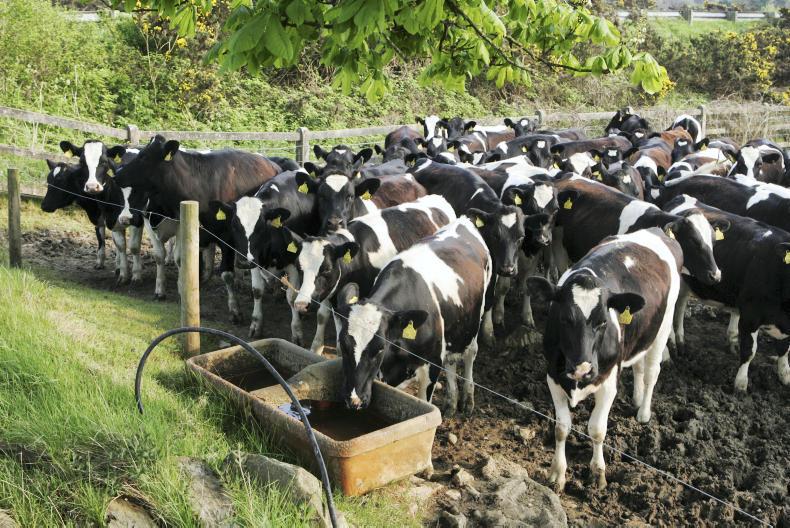
In high temperature conditions it is important that animals have sufficient access to water. Failure to provide animals with a sufficient source of water will impact performance, but can also lead to more serious consequences.
Checking all water sources regularly to ensure they are functioning correctly is advisable as they may have been impacted by lower water levels or reduced flow rates.
Animals may become distressed if their demands for water are not being met. By knowing the demand each animal has it is then possible to access whether troughs are meeting these demands.
The demands for water are:
Dairy cows: 90 to 140 litres of waterSuckler cows: 50 to 60 litres of waterTwo-year-old cattle: up to 50 litresYear-old cattle: 24 to 36 litres of waterLactating ewes: eight to 12 litres of water Read more
Tillage management: heatwave to accelerate winter crop ripening
Dairy management: finding alternatives to grass
Weekly weather: drought conditions in parts as temperatures soar
Kildare IFA chair and dairy farmer
We’ve had no significant rain since April and we’re really starting to see ground burn up now.
We started to increase concentrates a month ago and we are now feeding silage. The grass we have left is being rationed and the cows are now on 5kg of concentrates, 8kg of grass and 5kg of silage.
A big fallout from all this extreme weather is the farm has been busy since early March. Normally things would be quieting down now but we’re as busy as we were in spring.
New dairy farmer, Cork
We had been buffer-feeding maize silage three weeks ago in an effort to build up covers. We’ve stopped for the last week but it’s likely we will be starting to buffer-feed again shortly.
We’ve pushed ration from 2kg to 3kg and we’re looking at increasing it another kilo. It’s a cheaper option to use the maize silage though and we have a diet feeder on the farm. We acted early to have covers built up so we’re OK for the moment, but rain is needed soon.
Tillage farmer and contractor, Wexford
Here in Wexford it is a disaster. Spring barley is looking terrible. While it should be good-quality grain, the crops just didn’t tiller and they went through the growth stages far too quickly.
I would say that yields will be back by half and straw will be back by half. Outside of maize, which seems to be doing well, no other crop is benefiting from this weather.
In places that we have cut silage for guys they have already started to feed their first cuts and any second cuts are already being grazed. Many farmers are facing a winter with little or no feed.
Hill farmer, Tipperary
The hills are holding up reasonably well with the dry conditions. There’s naturally good vegetation and shading on the hills so moisture levels are OK compared to farmers with sandy loams. In saying that, I can see that the soil moisture is significantly reduced. The hills are drought-resistant really as they have ample free water. The cows have the natural water supply and then the trees for shading from the hot sun.
There has been no need for me to take any out of the ordinary action in regards farming. The hill farming scenario has its pros and cons. It works well with dealing with the heat.
Sheep and Cattle farmer, Clare
We are just starting to suffer now with the weather. We had localised rain two weeks ago, unlike many other places, so that has helped conditions. I have a small bit of heavy land which is hard now. This would usually be a very moist soil.
I have mostly loamy soil. That is thin now and starting to burn. We’ve lost 5-6ac handy and it’s pure yellow. Growth has stopped. There has been no comeback on growth from hay that was cut last week.
I’m not too worried. With the rain expected at the weekend, things will be fine. It’s not critical yet.
Sheep farmer, Leitrim
Ground is slighty dry but Leitrim has perfect weather at the moment. We got rain a little over a week ago. Before then, in mid-May, it was too wet to cut meadows. Preparation was impeded with high rainfall/wet conditions. Now, farmers are getting excellent wilt on silage and hay is being made.
In light of the adverse weather conditions since mid-2017, it’s important that the Department of Agriculture allows flexibility for farmers to get the optimum out of their crops and livestock out when the weather conditions are ideal or favourable. Farmers around the country will be wiser with regard to a reserve of fodder in the future after all this adverse weather.
Monitor water supplies closely
In high temperature conditions it is important that animals have sufficient access to water. Failure to provide animals with a sufficient source of water will impact performance, but can also lead to more serious consequences.
Checking all water sources regularly to ensure they are functioning correctly is advisable as they may have been impacted by lower water levels or reduced flow rates.
Animals may become distressed if their demands for water are not being met. By knowing the demand each animal has it is then possible to access whether troughs are meeting these demands.
The demands for water are:
Dairy cows: 90 to 140 litres of waterSuckler cows: 50 to 60 litres of waterTwo-year-old cattle: up to 50 litresYear-old cattle: 24 to 36 litres of waterLactating ewes: eight to 12 litres of water Read more
Tillage management: heatwave to accelerate winter crop ripening
Dairy management: finding alternatives to grass
Weekly weather: drought conditions in parts as temperatures soar





SHARING OPTIONS