
Grass
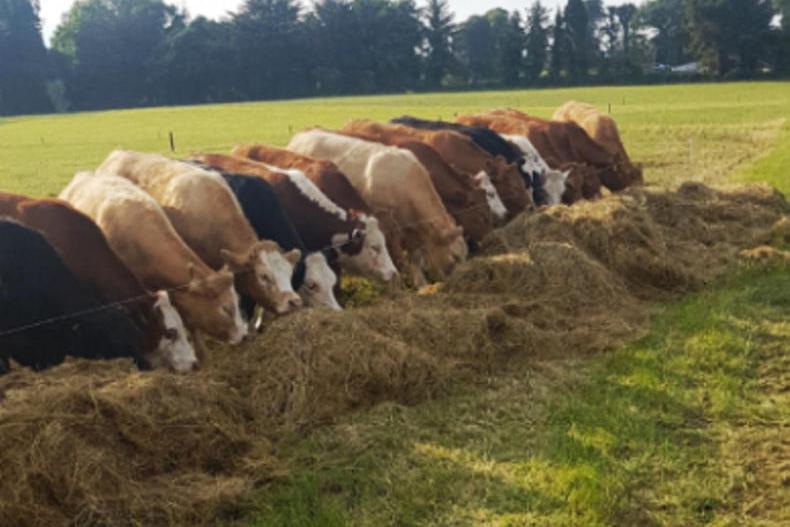
Measurements taken earlier this week make for pretty grim reading on Ricky Milligan’s farm in Kildare. With a farm cover of 393kg DM/ha and a growth rate of 14kg DM/ha/day, Ricky is now looking at a single-digit days ahead figure. To prolong grass growth as much as possible, low-quality hay is being fed to the suckling cows and calves. Usually paddocks are grazed for 24 to 48 hours, but the strategy now will be to keep cows in these paddocks for double that length of time, if possible. “We made 50 bales of poorer quality hay off some poorer ground recently. I have this earmarked as a buffer feed, which will hopefully stretch out the paddocks for the cows,” Ricky explained. The only positive that Ricky highlighted was that cows seem quite content. “The hay is filling the cows up alright,” he said. “The field they are grazing beside now is the silage ground and I’m sure that looks tempting to them, but right now the hay is keeping them this side of the electric fence.”
Fodder
Currently, Ricky has only one-third of his fodder requirements in the yard. He explained that a poor first-cut yield was the big culprit. “The yield in the first-cut was way down on what it should have been. I always aim to go for quality over quantity, but even still I was starting to see some stem and seed heads coming in the last week of May when I started cutting.
The story is equally as worrying for the second cut. “My second cut is really struggling now too,” Ricky said. “One field has a measurement of about 9cm – that is a reseeded field. The rest are back down at heights of 6cm and 7cm and all these fields were cut in the last week of May, bar one which was knocked 10 days later.” What is even more disappointing for Ricky is the fact that slurry and fertiliser were applied at reasonably good times and in an ideal manner. “I spread the slurry with a dribble bar so this didn’t do one bit of harm. After that, all the ground got 80 units of nitrogen, either in the form of CAN or compound fertilisers – depending on the field.”
Water
While feed demand falls slightly as cattle tend to have reduced appetites in the warmer weather, demand for water moves sharply in the opposite direction. So far, Ricky isn’t in major difficulty with water. However. with a reliance on a group water scheme, contingency planning for the worst-case scenario has already begun on the farm. “On our home block we have our own well. I’ve no idea how long it will last, but it was drilled in the mid 1990s after a very warm spell so I’m hopeful this will be alright,” he said. “On my outfarm, we are dependent on a group scheme, so I have no idea if this will be restricted or if it is facing shortages so I’m keeping an eye on the council website.” With that in mind, Ricky has now begun preparing for the worst – “there is an old well on the outfarm so this week I am going to have a look and see how much water is in it and get a sample tested. If it is clean or can be cleaned, I will then look at getting a solar-powered pump in.”
Strategy
Ricky’s focus has now turned to how he can lighten the load before the winter. Obviously, with fodder preservation already behind target and poor second-cut growth to date, the fewer animals housed for the winter the better. “Ideally, I would like to let all stock for finishing in for the winter and get as much weight on as possible. However, I’m now looking at getting as much stock as possible finished in August and September, with a few kilos of concentrates, off grass.” He went on to point out that selling a lighter animal might be better than trying to buy feed: “If they are 40kg or 50kg lighter, that will be about €160/head down on what I had planned – this might be the best €160 we could lose. You wouldn’t buy much silage or straw with €160 and, even at that, you don’t know what quality you’re buying.”

Grass
For Martin O’Hare in Co Louth, grass growth has almost been non-existent in the last number of weeks. With the farm situated on very dry, free-draining soil, Martin explained that the farm is “well burned up now” as the drought conditions take a tight hold of the situation. This week, Martin, along with his Teagasc BETTER Farm adviser Tommy Cox, has decided to graze his second-cut silage ground in the coming week. “We are probably going to graze it next week alright. It’s turning to pure stem at the moment so we came to the conclusion that it was a waste of time letting it grow any longer. Just over a month ago we put 2000 gallons per acre of cattle slurry and two bags of CAN on it.” Currently, Martin has 67 cows together in the one block and these are being fed 2.5t of silage daily under the electric fence using the diet feeder.
Fodder
The silage Martin is currently feeding was left over from last winter. “There is about 160t of last year’s left. With the rate I’m feeding it at, this will last about two months.” Without doubt, two months of feeding sounds ample, and the vast majority of farmers will be hoping that two months of feeding will not be required. The problem for Martin, however, is that this 160t of silage should be still in the pit for this winter. “We cut 39ac of first cut on 26 May which yielded 300t approximately, which works out at 7.5t per acre. It could be higher, but I was going for quality because I knew I had last year’s still in the pit. I reckon I need 700t in total so I’ll probably need another 300t before the winter.”
Water
The farm is supplied by a group water scheme and, for the foreseeable future at least, he is confident that there will be enough of a supply to service the farm.
Strategy
With the short-term plan being to graze the silage ground, the long-term strategy will need to be geared towards cutting those 300-odd tonnes of silage. “I’m hoping to get the second-cut taken up in August or September. It might not be great in quality but it will definitely be needed. Buying feeding in this area is just not an option.” Martin has 20 acres of reseeded ground coming back into play now after it was in spring barley last year. He is hoping this will kick on, allowing him to graze it and take up some extra ground for silage.
Read more
All BETTER Farm articles
Cracking hay and cracking ground
Watch: ground burning up on Tullamore Farm
Grass
Measurements taken earlier this week make for pretty grim reading on Ricky Milligan’s farm in Kildare. With a farm cover of 393kg DM/ha and a growth rate of 14kg DM/ha/day, Ricky is now looking at a single-digit days ahead figure. To prolong grass growth as much as possible, low-quality hay is being fed to the suckling cows and calves. Usually paddocks are grazed for 24 to 48 hours, but the strategy now will be to keep cows in these paddocks for double that length of time, if possible. “We made 50 bales of poorer quality hay off some poorer ground recently. I have this earmarked as a buffer feed, which will hopefully stretch out the paddocks for the cows,” Ricky explained. The only positive that Ricky highlighted was that cows seem quite content. “The hay is filling the cows up alright,” he said. “The field they are grazing beside now is the silage ground and I’m sure that looks tempting to them, but right now the hay is keeping them this side of the electric fence.”
Fodder
Currently, Ricky has only one-third of his fodder requirements in the yard. He explained that a poor first-cut yield was the big culprit. “The yield in the first-cut was way down on what it should have been. I always aim to go for quality over quantity, but even still I was starting to see some stem and seed heads coming in the last week of May when I started cutting.
The story is equally as worrying for the second cut. “My second cut is really struggling now too,” Ricky said. “One field has a measurement of about 9cm – that is a reseeded field. The rest are back down at heights of 6cm and 7cm and all these fields were cut in the last week of May, bar one which was knocked 10 days later.” What is even more disappointing for Ricky is the fact that slurry and fertiliser were applied at reasonably good times and in an ideal manner. “I spread the slurry with a dribble bar so this didn’t do one bit of harm. After that, all the ground got 80 units of nitrogen, either in the form of CAN or compound fertilisers – depending on the field.”
Water
While feed demand falls slightly as cattle tend to have reduced appetites in the warmer weather, demand for water moves sharply in the opposite direction. So far, Ricky isn’t in major difficulty with water. However. with a reliance on a group water scheme, contingency planning for the worst-case scenario has already begun on the farm. “On our home block we have our own well. I’ve no idea how long it will last, but it was drilled in the mid 1990s after a very warm spell so I’m hopeful this will be alright,” he said. “On my outfarm, we are dependent on a group scheme, so I have no idea if this will be restricted or if it is facing shortages so I’m keeping an eye on the council website.” With that in mind, Ricky has now begun preparing for the worst – “there is an old well on the outfarm so this week I am going to have a look and see how much water is in it and get a sample tested. If it is clean or can be cleaned, I will then look at getting a solar-powered pump in.”
Strategy
Ricky’s focus has now turned to how he can lighten the load before the winter. Obviously, with fodder preservation already behind target and poor second-cut growth to date, the fewer animals housed for the winter the better. “Ideally, I would like to let all stock for finishing in for the winter and get as much weight on as possible. However, I’m now looking at getting as much stock as possible finished in August and September, with a few kilos of concentrates, off grass.” He went on to point out that selling a lighter animal might be better than trying to buy feed: “If they are 40kg or 50kg lighter, that will be about €160/head down on what I had planned – this might be the best €160 we could lose. You wouldn’t buy much silage or straw with €160 and, even at that, you don’t know what quality you’re buying.”
Grass
For Martin O’Hare in Co Louth, grass growth has almost been non-existent in the last number of weeks. With the farm situated on very dry, free-draining soil, Martin explained that the farm is “well burned up now” as the drought conditions take a tight hold of the situation. This week, Martin, along with his Teagasc BETTER Farm adviser Tommy Cox, has decided to graze his second-cut silage ground in the coming week. “We are probably going to graze it next week alright. It’s turning to pure stem at the moment so we came to the conclusion that it was a waste of time letting it grow any longer. Just over a month ago we put 2000 gallons per acre of cattle slurry and two bags of CAN on it.” Currently, Martin has 67 cows together in the one block and these are being fed 2.5t of silage daily under the electric fence using the diet feeder.
Fodder
The silage Martin is currently feeding was left over from last winter. “There is about 160t of last year’s left. With the rate I’m feeding it at, this will last about two months.” Without doubt, two months of feeding sounds ample, and the vast majority of farmers will be hoping that two months of feeding will not be required. The problem for Martin, however, is that this 160t of silage should be still in the pit for this winter. “We cut 39ac of first cut on 26 May which yielded 300t approximately, which works out at 7.5t per acre. It could be higher, but I was going for quality because I knew I had last year’s still in the pit. I reckon I need 700t in total so I’ll probably need another 300t before the winter.”
Water
The farm is supplied by a group water scheme and, for the foreseeable future at least, he is confident that there will be enough of a supply to service the farm.
Strategy
With the short-term plan being to graze the silage ground, the long-term strategy will need to be geared towards cutting those 300-odd tonnes of silage. “I’m hoping to get the second-cut taken up in August or September. It might not be great in quality but it will definitely be needed. Buying feeding in this area is just not an option.” Martin has 20 acres of reseeded ground coming back into play now after it was in spring barley last year. He is hoping this will kick on, allowing him to graze it and take up some extra ground for silage.
Read more
All BETTER Farm articles
Cracking hay and cracking ground
Watch: ground burning up on Tullamore Farm







SHARING OPTIONS