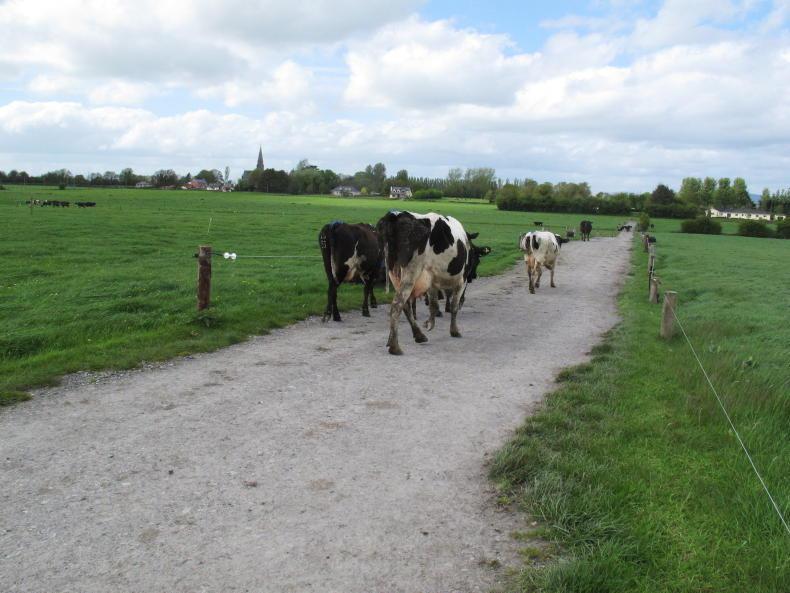
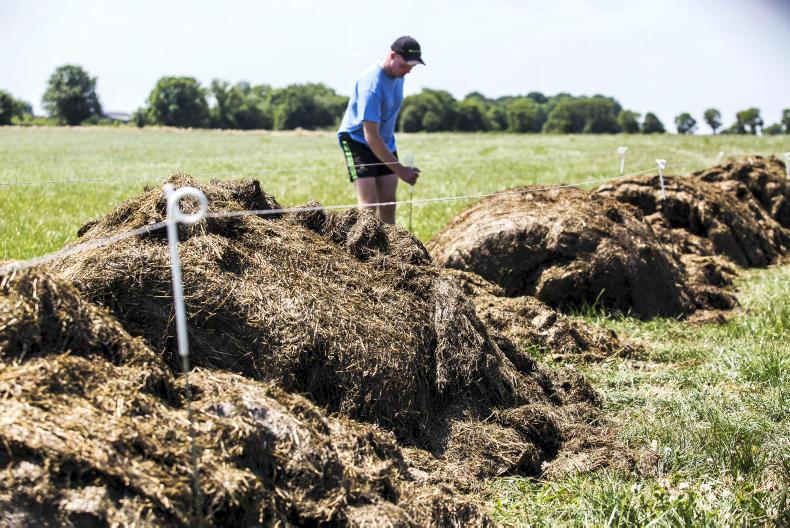
On Greenfield dairy farm, farm manager David Fogarty has been forced to feed silage to the herd due to the on going drought and lack of grass growth. He and the team prepare a paddock by bringing in silage and roping it off before moving the herd in to graze. (photo: Philip Doyle)
ADVERTISEMENT
Growth rate was measured at only 8kg per day on the Greenfield Farm in Kilkenny this week, down from 24kg/day the week before. All the area that was planned for second-cut silage is now back in the grazing ground. As a result, the stocking rate is down to 2.7 cows/ha. The diet is 4kg of dairy nuts, 6kg of quality round bale silage (fed in the fields) and grazed grass. There is about another week of grass left on the farm and then the amount of grass available will be very small.
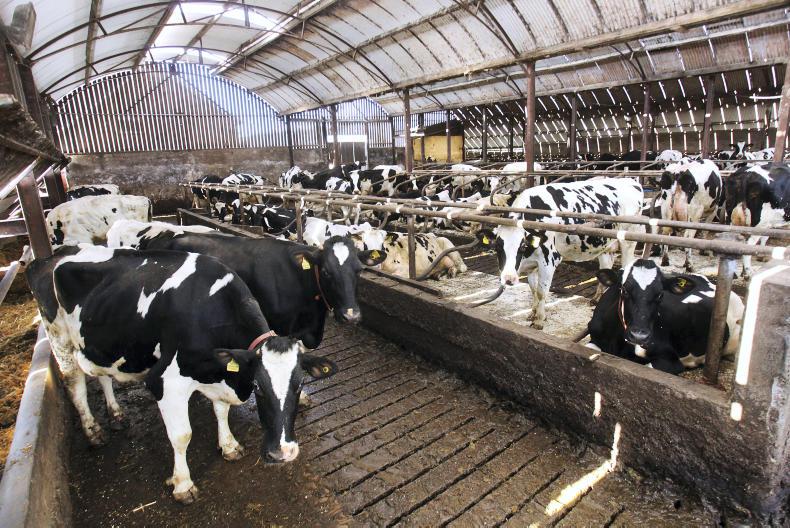
Bales were being fed out at the feed face but locking the cows in on the concrete and topless cubicles was not working well.
ADVERTISEMENT
Scrapers were struggling given the very dry conditions and there are no large-volume water troughs in this area. The contractor came in and delivered out bales to the paddocks and then as required the bales are opened and a strip wire is placed around them to prevent the cows walking up on the silage. This system is working very well and creates much less muck and hassle than feeding out at the feed face.
Grass availability
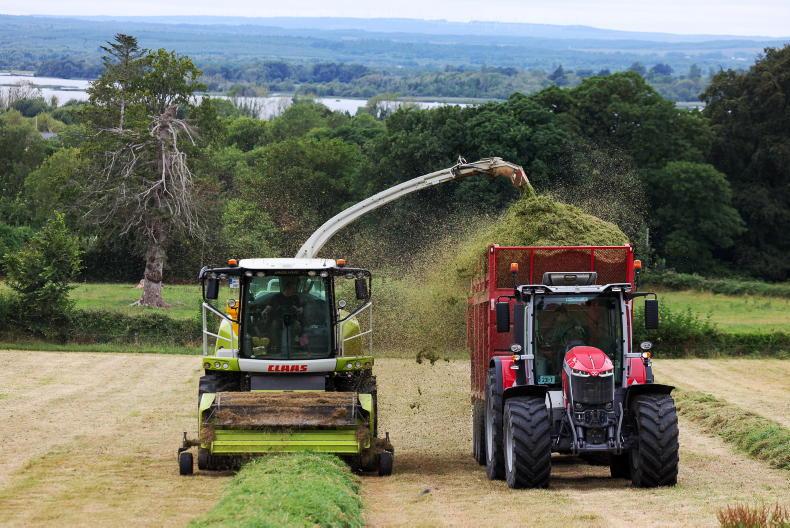
Depending on grass availability in the paddock, the cows are eating six to eight bales per day. There are enough round bales to continue this process for the next week to 10 days. After that, the option is to open the first-cut silage. Sourcing more round-bale silage is not possible in this part. There is plenty of hay available but again maybe that would be a better dry cow feed and keep silage in the diet for milkers if possible. David is researching other available feeds this week to plan for what might happen over coming days and weeks.
There is little or no point spreading artificial nitrogen on these bare soils in Kilkenny. The key will be to have it ready to go as soon as moisture returns to maxmise growth rates.
Water is so critical to milking cows in these extreme high temperatures. Some water leaks were being fixed last week and an air lock got into the water system.
The result was the cows had no water for maybe two hours and to see the stress that brought to herd you quickly realise that water is so critical at the moment. Farmers must ensure water is available when cows are in paddocks, on the way into and out of milking. Yes it might upset cow flow but cows need every opportunity to drink at the moment. The more meal you feed the more water is needed.
On some days there are still a good few cows coming on heat. On one particular day last week there were nine cows in heat. About five of those were six-week repeats while the others were more normal three-week repeats. The vasectomised bulls are still with the cows to help identify cows in heat. Whether the extreme high temperatures will have an impact on increased embryo loss or anything like that we will have to wait and see. All you can do at the moment is keep the cows as stress free as possible with plenty of water and feed.
Milk quality and volumes have suffered in the heat in the last number of days. The last milk tests (1 and 3 July) shows a result of about 17 kg (down from 19kg per cow) at 3.73% protein down from 3.86% the week before. Fat has held steady at 4.45% so it means milk solids are at about 1.4kg MS/cow at 238 cell count and 4.79% lactose.
This content is available to digital subscribers and loyalty code users only. Sign in to your account, use the code or subscribe to get unlimited access.
The reader loyalty code gives you full access to the site from when you enter it until the following Wednesday at 9pm. Find your unique code on the back page of Irish Country Living every week.
CODE ACCEPTED
You have full access to the site until next Wednesday at 9pm.
CODE NOT VALID
Please try again or contact support.
Growth rate was measured at only 8kg per day on the Greenfield Farm in Kilkenny this week, down from 24kg/day the week before. All the area that was planned for second-cut silage is now back in the grazing ground. As a result, the stocking rate is down to 2.7 cows/ha. The diet is 4kg of dairy nuts, 6kg of quality round bale silage (fed in the fields) and grazed grass. There is about another week of grass left on the farm and then the amount of grass available will be very small.
Bales were being fed out at the feed face but locking the cows in on the concrete and topless cubicles was not working well.
Scrapers were struggling given the very dry conditions and there are no large-volume water troughs in this area. The contractor came in and delivered out bales to the paddocks and then as required the bales are opened and a strip wire is placed around them to prevent the cows walking up on the silage. This system is working very well and creates much less muck and hassle than feeding out at the feed face.
Grass availability
Depending on grass availability in the paddock, the cows are eating six to eight bales per day. There are enough round bales to continue this process for the next week to 10 days. After that, the option is to open the first-cut silage. Sourcing more round-bale silage is not possible in this part. There is plenty of hay available but again maybe that would be a better dry cow feed and keep silage in the diet for milkers if possible. David is researching other available feeds this week to plan for what might happen over coming days and weeks.
There is little or no point spreading artificial nitrogen on these bare soils in Kilkenny. The key will be to have it ready to go as soon as moisture returns to maxmise growth rates.
Water is so critical to milking cows in these extreme high temperatures. Some water leaks were being fixed last week and an air lock got into the water system.
The result was the cows had no water for maybe two hours and to see the stress that brought to herd you quickly realise that water is so critical at the moment. Farmers must ensure water is available when cows are in paddocks, on the way into and out of milking. Yes it might upset cow flow but cows need every opportunity to drink at the moment. The more meal you feed the more water is needed.
On some days there are still a good few cows coming on heat. On one particular day last week there were nine cows in heat. About five of those were six-week repeats while the others were more normal three-week repeats. The vasectomised bulls are still with the cows to help identify cows in heat. Whether the extreme high temperatures will have an impact on increased embryo loss or anything like that we will have to wait and see. All you can do at the moment is keep the cows as stress free as possible with plenty of water and feed.
Milk quality and volumes have suffered in the heat in the last number of days. The last milk tests (1 and 3 July) shows a result of about 17 kg (down from 19kg per cow) at 3.73% protein down from 3.86% the week before. Fat has held steady at 4.45% so it means milk solids are at about 1.4kg MS/cow at 238 cell count and 4.79% lactose.
If you would like to speak to a member of our team, please call us on 01-4199525.
Link sent to your email address
We have sent an email to your address. Please click on the link in this email to reset your password. If you can't find it in your inbox, please check your spam folder. If you can't find the email, please call us on 01-4199525.
ENTER YOUR LOYALTY CODE:
The reader loyalty code gives you full access to the site from when you enter it until the following Wednesday at 9pm. Find your unique code on the back page of Irish Country Living every week.
SHARING OPTIONS